Prime Minister Modi Asserts No Compromise on Farmer Interests
Source:Indian Express ↗
Why It Matters
The article highlights India's persistent challenge in balancing domestic farmer welfare and food security with international trade obligations and bilateral pressures, a recurrent theme in GS3 Agriculture and GS2 International Relations.
Summary
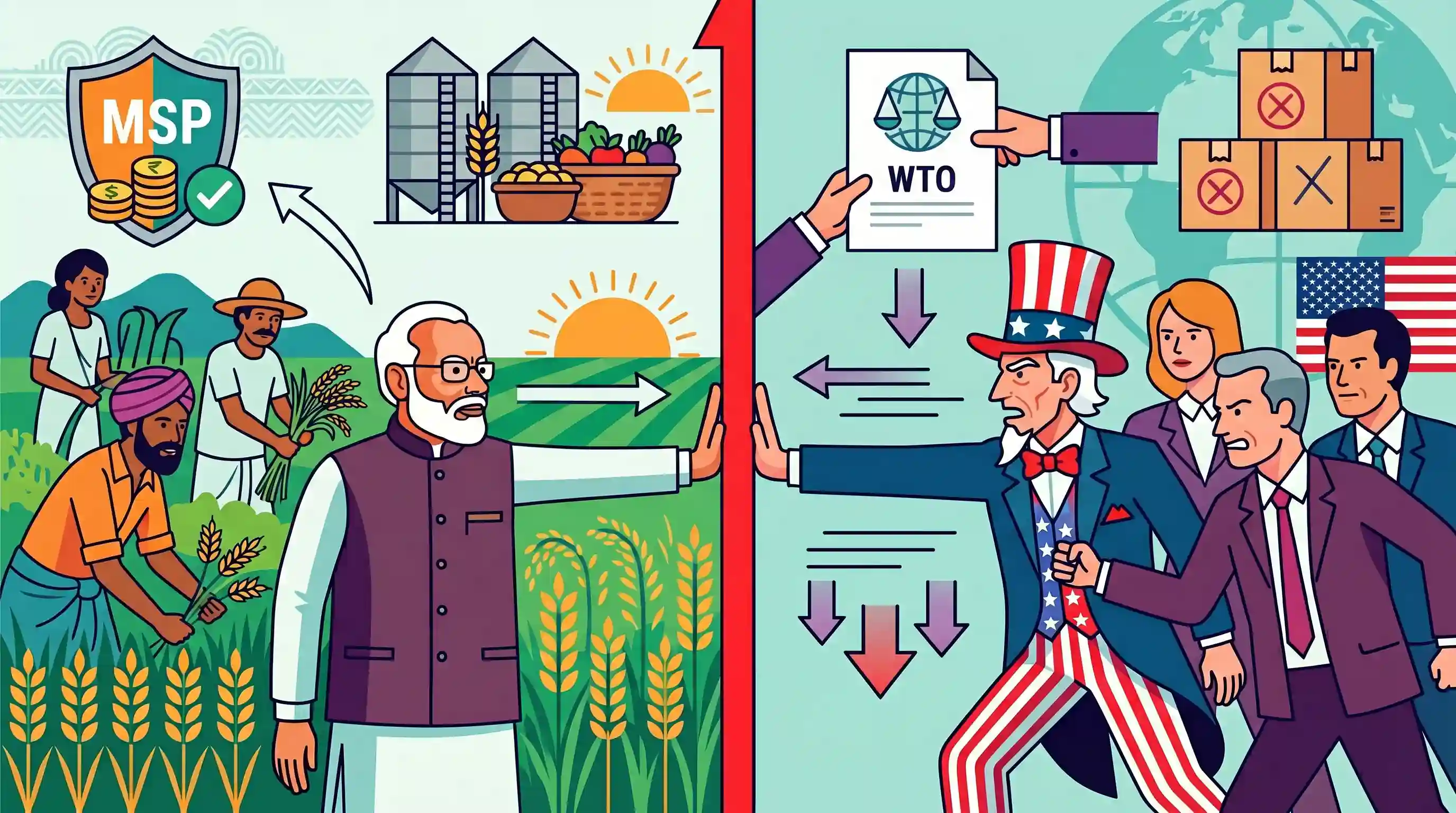
Prime Minister Narendra Modi has drawn a firm 'red line' regarding agricultural trade, asserting that India will not compromise the interests of its farmers despite rising trade pressure from the United States. Rejecting demands to dilute agricultural support, the Prime Minister emphasized that protecting the livelihoods of millions of Indian farmers and ensuring food security are non-negotiable priorities. This stance reflects the ongoing friction between India and developed nations over issues like the Minimum Support Price (MSP) and agricultural subsidies at the World Trade Organization (WTO).
Key Points
- Prime Minister Narendra Modi asserted that India will not compromise on the interests of its farmers despite mounting trade pressure from the US.
- The statement underscores India's firm stance on maintaining agricultural subsidies and protective tariffs to safeguard domestic agriculture.
- Tensions frequently arise between India and developed nations over policies like the Minimum Support Price (MSP), which Western countries view as trade-distorting.
- Modi emphasized that the livelihood and food security of millions of Indian farmers are non-negotiable, stating he is 'ready to pay the price' for this stance.
Important Terms
Minimum Support Price (MSP)

A guaranteed price at which the government procures crops from farmers to prevent distress sales. It is currently fixed at 1.5 times the weighted average cost of production.
UPSC context
GS-III (Agriculture). Essential for understanding farmer welfare, price stability, and government intervention in the agrarian economy.
Agreement on Agriculture (AoA)
A 1995 WTO treaty regulating international agricultural trade by reducing trade-distorting subsidies (Domestic Support), improving Market Access, and eliminating Export Subsidies across member nations.
UPSC context
GS-III (International Trade). Tests knowledge of global trade governance, subsidy boxes, and their impact on India's agricultural policy.
Public Stockholding (PSH)
The practice of procuring and storing foodgrains (like rice and wheat) to ensure national food security and manage the Public Distribution System (PDS).
UPSC context
GS-III (Food Security). Central to India’s 'non-negotiable' stance at WTO and the implementation of the National Food Security Act.
Peace Clause (WTO)
A temporary WTO mechanism protecting developing nations from legal challenges if their agricultural subsidies exceed the 10% ceiling (de minimis) for food security purposes.
UPSC context
GS-III (WTO/Subsidies). A recurring Prelims/Mains topic regarding India’s diplomatic maneuvers to protect its domestic farm support programs.
Amber Box Subsidies
WTO category for domestic support measures considered 'trade-distorting,' such as price supports or input subsidies. Developing countries must keep these below 10% of production value.
UPSC context
GS-III (Economics). Vital for analyzing technical trade barriers and the 'North-South' divide in global agricultural negotiations.
Prelims Trap
The WTO Peace Clause permanently exempts India's MSP from being classified as an Amber Box trade-distorting subsidy.
The Peace Clause is an interim shield against dispute settlements for breaching the 10% subsidy limit. It does not alter MSP's 'Amber Box' classification.
Static Concepts Connected
What are the three subsidy 'Boxes' under the WTO Agreement on Agriculture (AoA)?
- Green Box: Subsidies that do not distort trade or cause minimal distortion, such as research, disease control, or direct income support decoupled from production. Uncapped.
- Amber Box: Trade-distorting subsidies linked to production quantities, such as MSP or fertilizer subsidies. Capped at 10% (de minimis) of agricultural production value for developing nations.
- Blue Box: Essentially 'Amber Box with conditions'. Subsidies that would normally be trade-distorting but require farmers to limit their production to receive them. Uncapped.
Why does India contest the WTO's Aggregate Measurement of Support (AMS) calculation?
- Outdated Base Year: The External Reference Price (ERP) used as the benchmark to calculate trade-distorting subsidies is permanently frozen at 1986-1988 global price levels.
- Inflation Penalty: Because the formula ignores over 35 years of global inflation, it mathematically exaggerates the perceived value of India's current MSP payouts, easily breaching the 10% cap.
Cross-Topic Patterns
Food Security Act vs WTO Rules
India's domestic National Food Security Act (2013) legally mandates massive grain procurement via MSP, creating a structural, recurring clash with WTO's 10% Amber Box cap on public stockholding.
Climate mandates vs Agriculture Subsidies
Developed nations increasingly frame their trade pushback using environmental and climate narratives, arguing that broad agricultural subsidies (like free electricity and fertilizer) encourage unsustainable practices.

Expect a 2026 multi-statement Prelims question linking WTO's 1986-88 External Reference Price, Amber Box limits, and the Peace Clause.
Linked PYQs · 5
Linked PYQs · 5
- 2023MainsGS3
What are the direct and indirect subsidies provided to farm sector in India? Discuss the issues raised by the World Trade Organization (WTO) in relation to agricultural subsidies.
- 2018MainsGS3
What do you mean by Minimum Support Price (MSP)? How will MSP rescue the farmers from the low income trap?
- 2017MainsGS3
How do subsidies affect the cropping pattern, crop diversity and economy of farmers? What is the significance of crop insurance, minimum support price and food processing for small and marginal farmers?
- 2020PrelimsGS1
Consider the following statements: 1. In the case of all cereals, pulses and oil-seeds, the procurement at Minimum Support Price (MSP) is unlimited in any State/UT of India. 2. In the case of cereals and pulses, the MSP is fixed in any State/UT at a level to which the market price will never rise. Which of the statements given above is/are correct?
- 2012MainsGS2
Discuss the likely negative impact of the protectionist measures proposed by the US on India's software industry.
