Jaisalmer Border Demolition Drive Targets Illegal Structures
Source:The Hindu ↗
Why It Matters
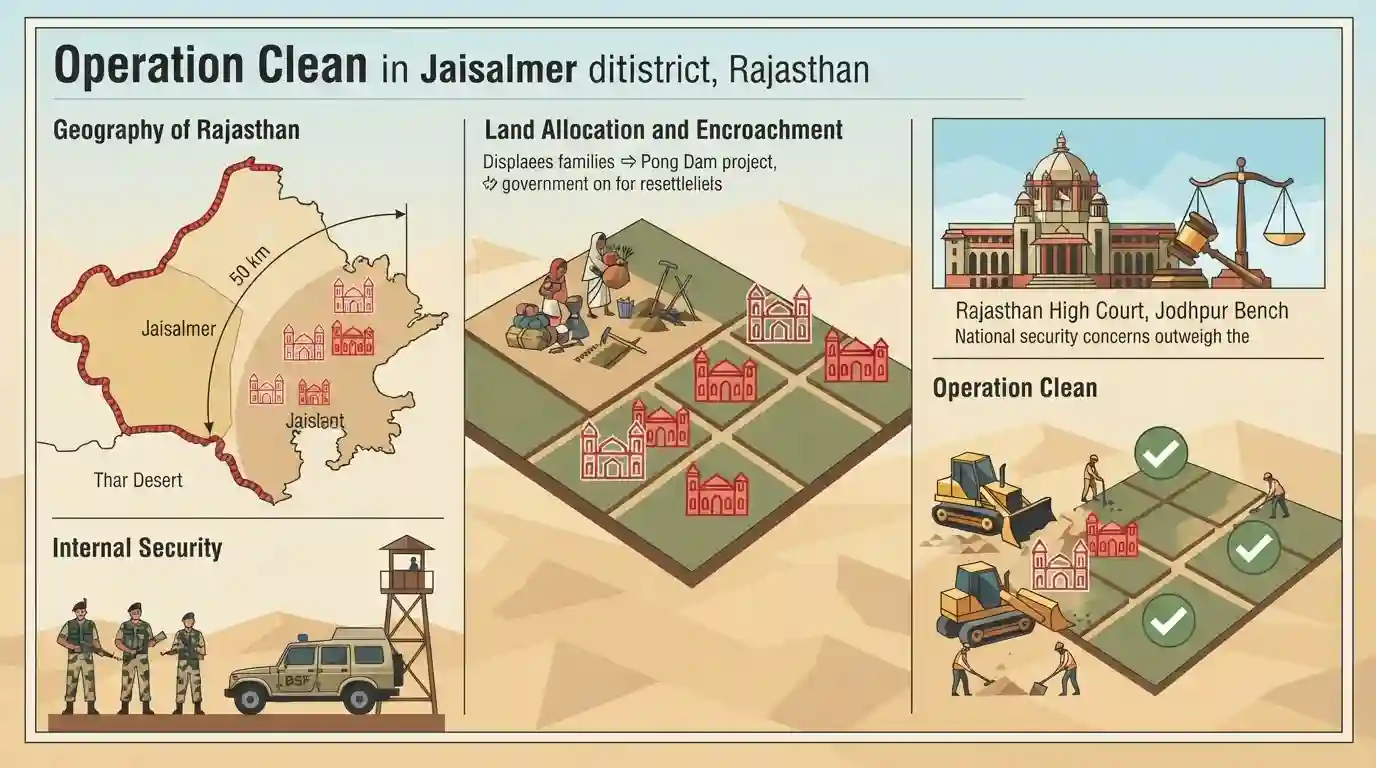
This event illustrates the intersection of national security imperatives and civil administration in sensitive border districts. For RPSC RAS aspirants, it highlights key geographical locations in western Rajasthan (Jaisalmer, Tanot, Nachna) and touches upon the historical resettlement issues of the Pong Dam project, while demonstrating judicial backing for border area security management.
Summary
The Jaisalmer district administration in Rajasthan launched "Operation Clean" to demolish allegedly illegal mosques and madrassas located within 50 km of the India-Pakistan border. The targeted structures in the Nachna, Tanot, and Shahgarh areas were built on government land, some of which had been set aside for families displaced by the Pong Dam project on the Beas River. The eviction drive proceeded after the Jodhpur Bench of the Rajasthan High Court dismissed petitions challenging the action, noting that national security concerns outweigh the preservation of unauthorized religious structures.
Key Points
- The Jaisalmer district administration demolished several allegedly illegal mosques and madrassas under 'Operation Clean'.
- The structures were situated within 50 km of the India-Pakistan international border in areas including Nachna, Tanot, and Shahgarh.
- The cleared encroachments were on government land, including plots originally reserved for the resettlement of families displaced by the Pong Dam project.
- The Jodhpur Bench of the Rajasthan High Court declined to stay the demolitions, observing that national security takes precedence over unauthorized religious structures.
Important Terms
Operation Clean

An anti-encroachment drive by the Jaisalmer district administration to demolish unauthorized structures, including illegal mosques and madrassas, on government land within 50 km of the India-Pakistan border.
UPSC context
GS Paper 3: Security Challenges in Border Areas. Tests understanding of border management, national security, and encroachment clearance policies.
Pong Dam project
A 1974 embankment dam on the Beas River in Himachal Pradesh. Thousands displaced by its construction were allotted land in Rajasthan, which recently became the target of illegal border encroachments.
UPSC context
GS Paper 1 & 2: Geography & Social Justice. Tests knowledge of river valley projects, development-induced displacement, and interstate rehabilitation issues.
Rajasthan High Court
The highest judicial body in Rajasthan. It dismissed petitions against Operation Clean, ruling that national security in sensitive border zones outweighs the preservation of unauthorized religious structures.
UPSC context
GS Paper 2: Indian Polity & Judiciary. Tests the judicial balancing of national security imperatives against claims of religious freedom and procedural justice.
Jaisalmer District Administration
The local government authority in Rajasthan that, in coordination with intelligence and security agencies, executed the demolition of illegal border structures to reclaim government land.
UPSC context
GS Paper 3: Internal Security. Highlights the crucial role of local administration and inter-agency coordination in securing sensitive international border zones.
Prelims Trap
The Pong Dam rehabilitation scheme allocated land to displaced families exclusively within the state of Himachal Pradesh.
While the Pong Dam is located on the Beas River in Himachal Pradesh, its displaced oustees were rehabilitated and allocated land in the Indira Gandhi Canal command area of Rajasthan's border districts.
Static Concepts Connected
What is the geographical and ecological significance of the Pong Dam?
- River and Location: Built across the Beas River in the Shivalik hills of Kangra district, Himachal Pradesh; also known as Maharana Pratap Sagar.
- Ecological Status: Designated as a Ramsar Wetland of International Importance, serving as a critical winter nesting ground for migratory birds.
- Inter-state Resettlement: Displaced families (oustees) were allocated agricultural lands in the command area of the Indira Gandhi Canal in Rajasthan under a bilateral state agreement.
What are the boundaries of the BSF's territorial jurisdiction?
- Statutory Mandate: Empowered under the BSF Act, 1968, to exercise powers of search, seizure, and arrest to prevent trans-border crimes.
- Territorial Limit: The Ministry of Home Affairs unified the BSF's jurisdiction to a 50 km belt from the international border in Punjab, West Bengal, Assam, and Rajasthan.
- Administrative Division: BSF does not have policing or land-use regulation powers; maintaining law and order and clearing encroachments remains the domain of state civil administration.
Cross-Topic Patterns
Water infrastructure & inter-state migration
Development-induced displacement from Himachal's Beas basin created complex socio-legal property rights in Rajasthan’s borderlands, intersecting with national security decades later.
Federalism in border zone policing
While central agencies like BSF manage border security, land administration and encroachment clearance remain State List subjects, demanding close civil-military coordination.

Prelims may test the inter-state dimension of Pong Dam resettlement alongside BSF's 50km jurisdictional powers in border states.
Linked PYQs · 2
Linked PYQs · 2
- 2024RPSC_PRELIMSGS1
Which of the following group of districts/cities of Rajasthan are arranged in ascending order as per their distance from the border with Pakistan?
- 2007RPSC_PRELIMSGS1
The adjacent districts of Rajasthan are:
