Border management challenges emerge in illegal immigration debate
Source:Indian Express ↗
Why It Matters
The issue illustrates the complexities of border management and internal security in India, specifically how illegal transborder migration is facilitated by porous borders and administrative loopholes. It underscores the critical need for inter-state coordination and federal cooperation to effectively address security threats, a core component of the GS2 and GS3 syllabus.
Summary
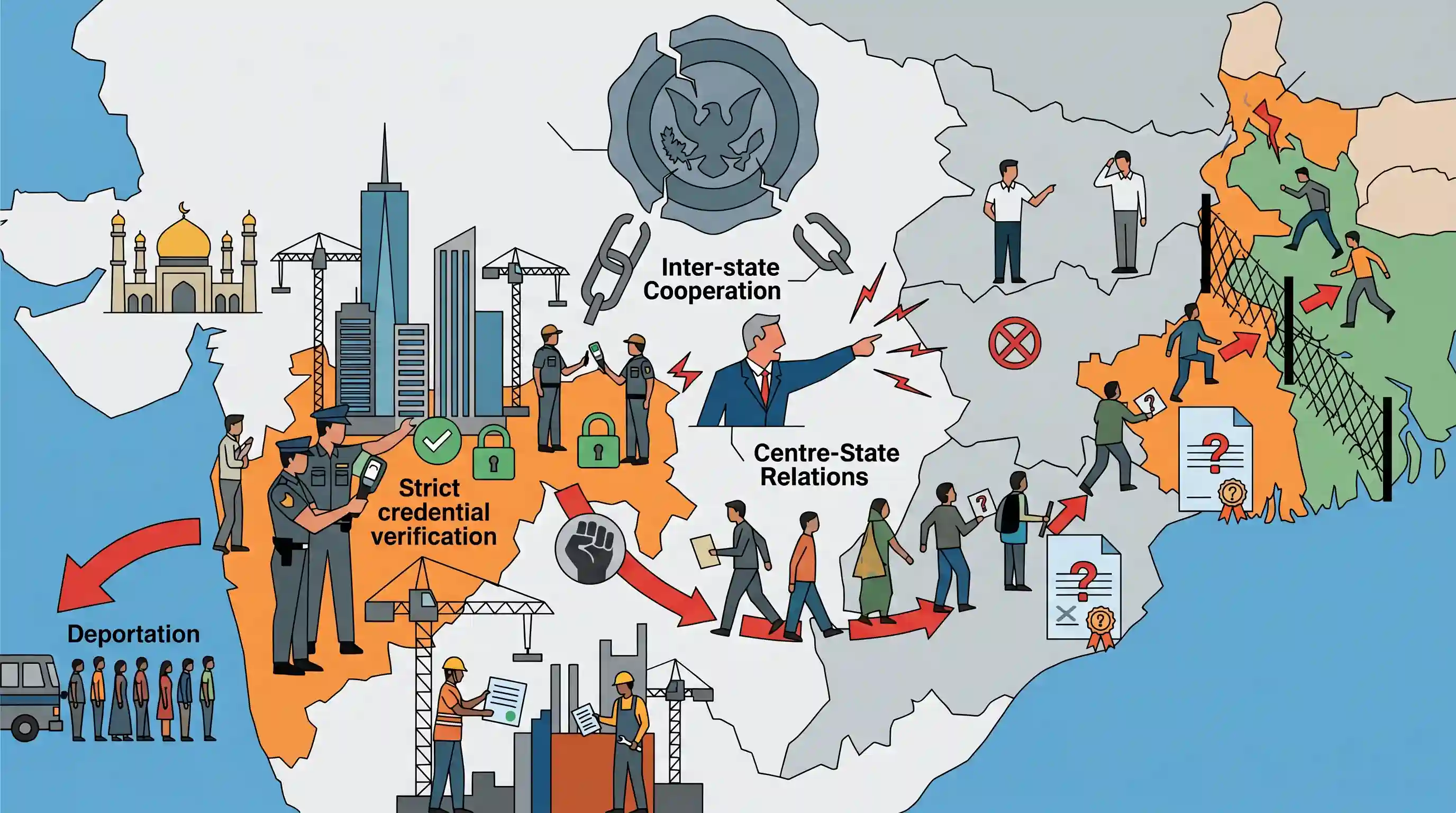
Maharashtra Chief Minister Devendra Fadnavis emphasized that the problem of illegal Bangladeshi immigration cannot be resolved without strict enforcement by the West Bengal government. He pointed out that migrants exploit porous borders to enter West Bengal, secure fraudulent documents, and then relocate to cities like Mumbai for work. While Maharashtra has adopted an 'iron hand' approach—mandating credential verification at construction sites and deporting maximum offenders—the lack of robust action at the entry points severely undermines national internal security and highlights gaps in inter-state cooperation.
Key Points
- Maharashtra CM Devendra Fadnavis stated that illegal immigration from Bangladesh cannot be effectively stopped unless West Bengal takes stringent action to secure its porous borders.
- Illegal immigrants frequently cross into West Bengal, obtain fraudulent paperwork, and subsequently migrate to cities like Mumbai for employment in construction and hospitality.
- Maharashtra claims to lead the country in identifying and deporting illegal immigrants, implementing strict credential verification at construction sites.
- The situation highlights significant challenges in internal security and underscores the need for effective inter-state coordination in border management and immigration enforcement.
Important Terms
Illegal Immigration

The act of entering or residing in a country without legal authorization or valid travel documents, or overstaying a permitted visa period.
UPSC context
GS Paper III: Internal Security. Tests understanding of demographic shifts, socio-economic strain, and security threats in border states like West Bengal.
Internal Security
The maintenance of peace, law, and order within a nation's territory, protecting sovereignty against threats like insurgency, terrorism, and organized cross-border crime.
UPSC context
GS Paper III: Security. Focuses on the state's responsibility to counter non-traditional threats and safeguard national integrity.
Porous Borders
National boundaries that are difficult to police due to geographic features like riverine stretches, dense forests, or rugged terrain, facilitating unauthorized movement.
UPSC context
GS Paper III: Border Management. Examines vulnerabilities in the Indo-Bangladesh border and the need for technological solutions like CIBMS.
Foreigners Act, 1946
A pre-independence law that empowers the Central Government to regulate the entry, stay, and departure of foreign nationals, including the power to deport.
UPSC context
GS Paper II/III: Governance and Security. Central to the legal framework for identifying and deporting illegal migrants.
Centre-State Relations
The administrative and legislative relationship between the Union and States, particularly concerning concurrent subjects and the enforcement of national security mandates.
UPSC context
GS Paper II: Federalism. Analyzes friction when state-level enforcement (or lack thereof) impacts national security and inter-state migration.
Border Management
The integrated approach of securing a nation's frontiers through physical fencing, patrolling, and technological interventions like sensors and surveillance.
UPSC context
GS Paper III: Security. Core topic regarding the 'first line of defense' against infiltration, smuggling, and illegal migration.
Prelims Trap
Border guarding and the deportation of foreign nationals are exclusively the mandate of the Union Government.
Though border management is a Central subject, inland identification, detention, and deportation rely heavily on State Police since 'Police' is a State subject.
Static Concepts Connected
What is the Comprehensive Integrated Border Management System (CIBMS)?
- Tech deployment: Uses sensors, thermal imagers, and radars to secure riverine and rugged terrains where physical fencing is impossible.
- Command architecture: Integrates technological feeds into a centralized command and control center for real-time BSF response.
- BOLD-QIT: Project under CIBMS specifically deployed along the Brahmaputra in Assam to curb illegal cross-border migration.
How is jurisdiction divided for border security and inland policing?
- Central mandate: The Union Ministry of Home Affairs and CAPFs (like BSF) guard physical international borders.
- State mandate: Once immigrants cross the border, tracking and prosecuting them falls to State Police under the Seventh Schedule.
Cross-Topic Patterns
Demographic changes & internal security
The link between illegal immigration, localized demographic shifts, and consequent political or ethnic friction is a recurring theme linking GS-1 (Society) and GS-3 (Internal Security).
Asymmetric federalism in border management
The Centre's reliance on state governments for inland deportation highlights federal friction, often tested in Mains alongside the recently extended jurisdiction of the BSF in border states.

Expect a GS-3 or Prelims multi-statement question testing the overlapping jurisdictions of BSF and State Police in border areas.
Linked PYQs · 2
Linked PYQs · 2
- 2014MainsGS3
How does illegal transborder migration pose a threat to India's security? Discuss the strategies to curb this, bringing out the factors which give impetus to such migration.
- 2024MainsGS2
What changes has the Union Government recently introduced in the domain of Centre-State relations ? Suggest measures to be adopted to build the trust between the Centre and the States and for strengthening federalism.
