IIT Mandi Flags Critical Glacial Lakes in Himachal
Source:the-new-indian-express ↗
Why It Matters
Directly relevant to Himachal Pradesh's state-specific environmental vulnerabilities, disaster management preparedness against flash floods/GLOFs, and geographical assessments important for HPAS Prelims.
Summary
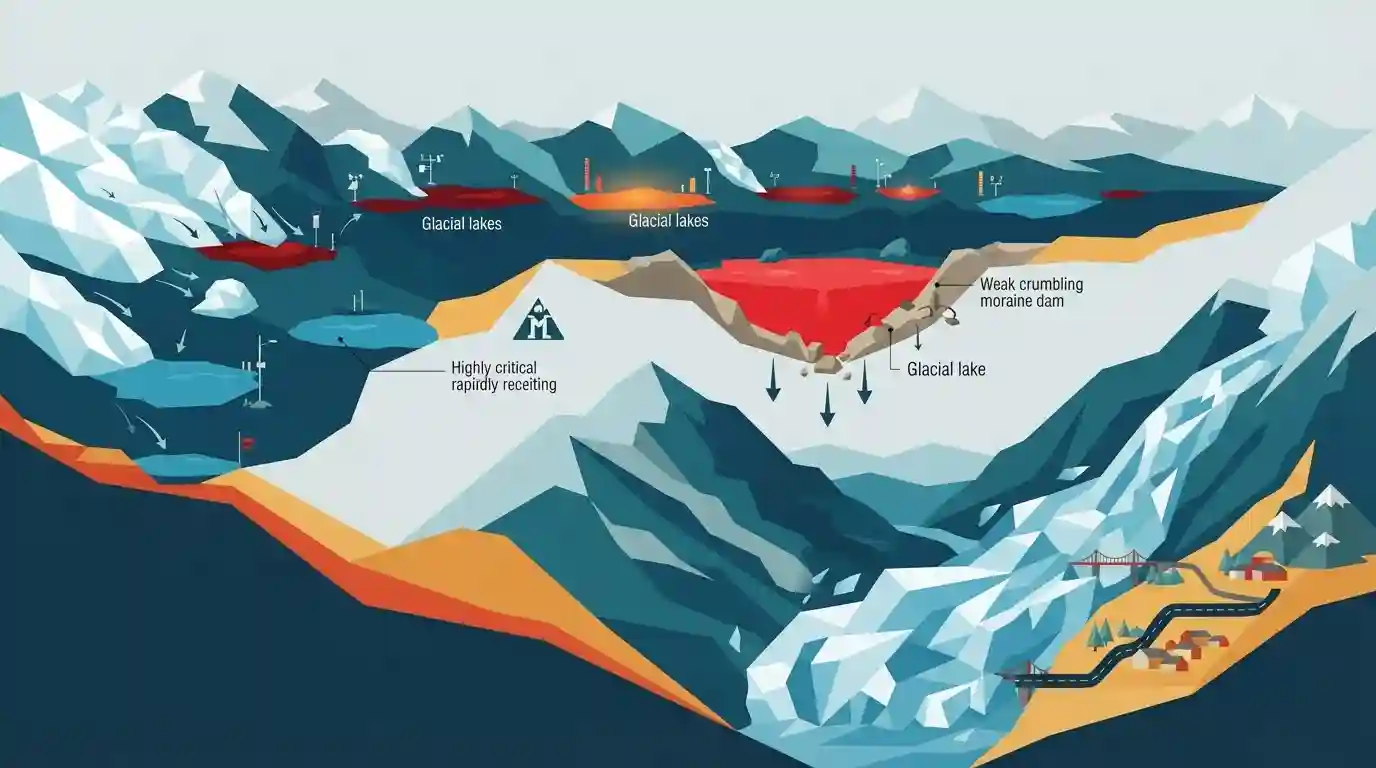
A study conducted by IIT Mandi has identified 9 to 12 glacial lakes in Himachal Pradesh as highly critical, highlighting significant risks of Glacial Lake Outburst Floods (GLOFs) driven by climate change and rapid glacial melting in the fragile Himalayan ecosystem.
Key Points
- An IIT Mandi study has flagged 9 to 12 glacial lakes in Himachal Pradesh as critical due to high risks of Glacial Lake Outburst Floods (GLOFs).
- Rising global temperatures are accelerating the melting of Himalayan glaciers, leading to the formation and expansion of unstable high-altitude glacial lakes.
- Such critical lakes pose severe flash flood threats to downstream habitations, infrastructure, and hydropower projects in Himachal Pradesh.
Important Terms
Glacial Lake Outburst Floods (GLOFs)

Floods caused by the sudden release of water from a glacial lake due to the failure of its natural dam, often triggered by ice avalanches, earthquakes, or rapid melting.
UPSC context
Crucial for GS Paper III (Disaster Management, Climate Change impacts in fragile Himalayan ecosystems).
Permafrost Melting
The degradation of permanently frozen ground layers beneath mountain terrain, which when thawed can lead to slope instability, rockfalls, and sudden terrain collapse.
UPSC context
Important for GS Paper I (Geography - Cryosphere dynamics) and GS Paper III (Environmental degradation and disaster risks).
Glacial Lakes
Bodies of water pooled in front of or on top of melting glaciers, whose continuous expansion poses severe flooding hazards to downstream Himalayan settlements and infrastructure.
UPSC context
Important for HPAS Prelims/Mains regarding Himachal geography, natural hazards, and environmental vulnerabilities.
Prelims Trap
Only the National Disaster Management Authority (NDMA) can designate glacial lakes as critical in Himachal Pradesh.
Aspirants might assume NDMA is the only body identifying critical lakes, missing state-specific research bodies like IIT Mandi.
Static Concepts Connected
What is a Glacial Lake Outburst Flood (GLOF) and how does it occur in the Himalayas?
- Definition & Trigger: Sudden release of water from a glacial lake dammed by moraine or ice, often triggered by avalanches, earthquakes, or rapid melting.
- Himalayan Vulnerability: Himalayan moraine-dammed lakes are highly unstable, prone to cascading downstream disasters affecting habitations and hydropower projects.
Cross-Topic Patterns
GLOF Vulnerability vs. NDMA Guidelines
GLOF risk assessments in the Himalayas intersect directly with disaster management protocols under the NDMA guidelines for landslide and glacial hazards.
Glacial Melting & HP Hydropower Vulnerability
Rapid expansion of high-altitude lakes threatens major run-of-the-river hydropower installations in Himachal, directly impacting state fiscal planning and energy security.

GLOF risk factors, black carbon impact on albedo, and IIT Mandi's specific lake classifications are high-yield for HPAS Prelims & Mains.
Linked PYQs · 2
Linked PYQs · 2
- 2020HPAS_PRELIMSGS1
Consider the given four statements and choose the correct answer from the given options. Select the true statements from the following: 1. Chamba, Kullu and Kinnaur are considered the most susceptible of landslide threat. 2. Una, Bilaspur, Sirmaur, Shimla and Solan are considered as low vulnerable of disaster threats. 3. Hum valley of Una district has hardly any natural drinking water source. 4. As per the study of central water board, Kala Amb valley in Sirmaur district has exploited the least underground water.
- 2024HPAS_PRELIMSGS1
Arrange the following climatic zones of Himachal Pradesh according to rainfall amount from lowest to highest : (1) Frigid aridic zone (2) Wet temperate zone (3) Humid sub-tropical zone (4) Sub-humid sub-tropical zone Choose the correct answer from the options given below :
