IIT Mandi identifies critical glacial lakes in Himachal Pradesh
Source:wionews ↗
Why It Matters
Crucial for HPAS aspirants tracking state-specific environmental vulnerabilities, disaster management, and geographical hazards like GLOFs and permafrost degradation.
Summary
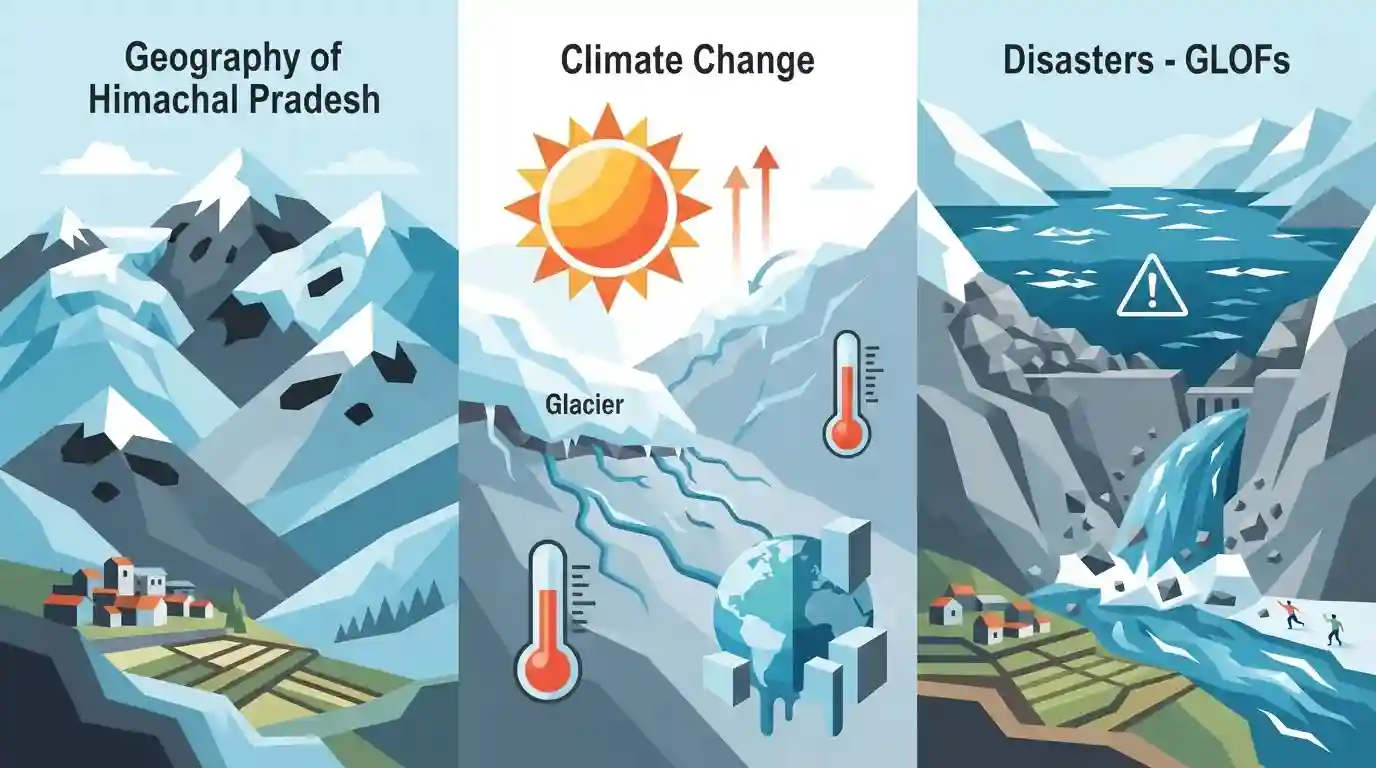
IIT Mandi researchers have flagged 9 to 12 glacial lakes in Himachal Pradesh as critical due to increasing risks of permafrost loss and climate change, highlighting potential threats of Glacial Lake Outburst Floods (GLOFs) in the region.
Key Points
- IIT Mandi has identified 9 to 12 glacial lakes as critical in Himachal Pradesh.
- The assessment highlights risks from permafrost loss and climate change impacts in the Himalayan region.
- Glacial lake outburst floods (GLOFs) pose a significant threat to downstream settlements and infrastructure in Himachal Pradesh.
Important Terms
Glacial Lake Outburst Flood (GLOF)

A sudden release of water from a glacial lake due to the failure of its moraine or ice dam, causing catastrophic downstream floods in mountainous regions.
UPSC context
HPSAS Paper III (Geography/Disaster Management) - tests understanding of Himalayan cryosphere hazards, climate change impacts, and mitigation strategies.
Permafrost Loss
Ground, soil, or rock that remains at or below 0°C for at least two consecutive years, whose thawing destabilizes slopes and glacial lakes.
UPSC context
HPAS Paper III (Environment & Climate Change) - important for questions on high-altitude cryospheric degradation, mass movements, and ecological vulnerabilities.
IIT Mandi
Premier technical institute whose researchers mapped critical glacial lakes in Himachal Pradesh, highlighting increasing risks of GLOFs and permafrost degradation.
UPSC context
HPAS General Studies - relevant for local scientific research, state-specific disaster mapping, and institutional interventions in Himachal Pradesh.
Prelims Trap
All 2,076 glacial lakes in Himachal Pradesh are categorized as immediate high-risk zones for GLOFs.
Aspirants often assume all 2,000+ mapped glacial lakes in HP are immediate flashpoints, whereas researchers have flagged only 9 to 12 as critical.
Static Concepts Connected
What is a Glacial Lake Outburst Flood (GLOF) and what are its primary causes?
- Definition: Sudden release of water from a glacial lake fed by melting glaciers or permafrost thaw, contained by weak moraine dams.
- Triggers: Earthquakes, ice avalanches, rockfalls, or excessive hydrostatic pressure causing moraine breach and downstream catastrophic flooding.
- HP Vulnerability: Steep Himalayan topography, vulnerable settlements, hydropower dams, and bridge infrastructure along river valleys.
Cross-Topic Patterns
Himalayan Climate Vulnerability + Disaster Management
HPAS frequently links Himalayan geography with disaster management frameworks. GLOF risk assessment connects climate science to state disaster response protocols (SDMA).
Glacial Retreat + Hydropower Security
Permafrost degradation and glacial retreat directly threaten hydropower projects in Chenab and Sutlej river basins, testing Himachal's energy security policies.

Expect a matching-list or statement-based question on specific high-risk Himachal glacial lakes (e.g., Gepang Gath, Chandratal) and GLOF drivers.
Linked PYQs · 2
Linked PYQs · 2
- 2022HPAS_PRELIMSGS1
Milam glacier is located in :
- 2025HPAS_PRELIMSGS1
Mountain Soil Zone in Himachal Pradesh is found between :
