Surface ozone pollution threatens agricultural yield in rural India
Source:The Hindu ↗
Why It Matters
This study provides critical insights into the intersection of air pollution and agriculture, a frequent focus in UPSC Mains. It specifically highlights how surface ozone—a secondary pollutant—impacts staple food crops, and exposes a critical gap in current environmental policies (NCAP) which are predominantly urban-centric.
Summary
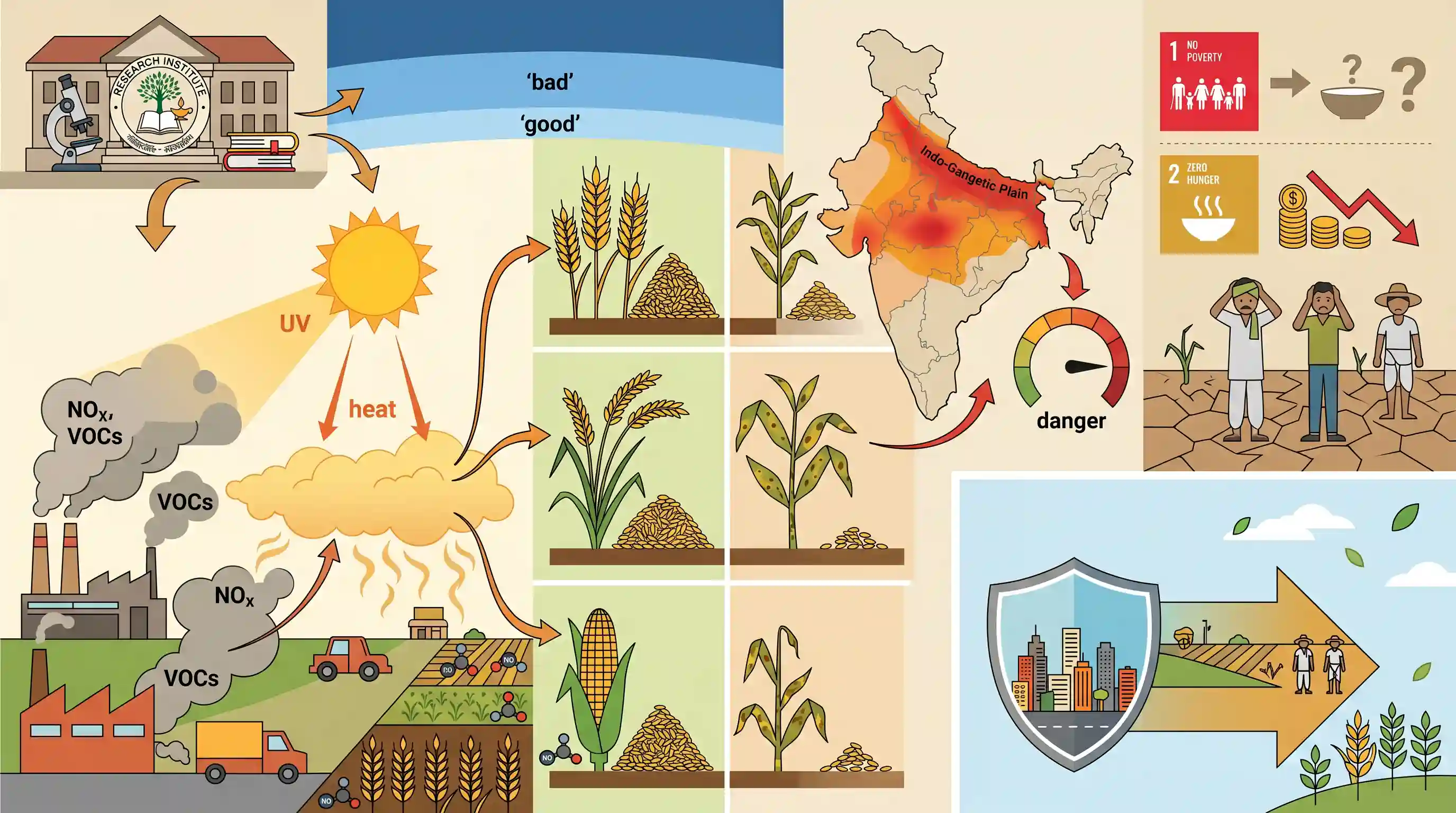
A recent study by IIT Kharagpur highlights the severe threat of surface (tropospheric) ozone pollution to rural agriculture in India. Unlike urban-centric pollutants, surface ozone significantly damages plant tissues, leading to reduced crop productivity. Under high-emission scenarios, the study predicts drastic yield declines—up to 20% for wheat and 7% for rice and maize—particularly in the vulnerable Indo-Gangetic Plain and Central India. This threatens India's food security and its ability to meet UN Sustainable Development Goals like zero hunger (SDG 2) and no poverty (SDG 1). The findings emphasize the urgent need for national policies, such as the National Clean Air Programme (NCAP), to expand their focus beyond urban centers and specifically address pollution in agricultural zones.
Key Points
- An IIT Kharagpur study warns that surface (tropospheric) ozone pollution is causing severe damage to crops in rural India, threatening food security.
- Under high-emission climate scenarios, wheat yields could see an additional 20% decline, while rice and maize yields may drop by around 7%.
- Surface ozone, a secondary pollutant formed by the reaction of sunlight with emissions from vehicles and industries, damages plant tissues and disrupts photosynthesis.
- The Indo-Gangetic Plain and Central India are identified as the most vulnerable regions to this pollution.
- The researchers highlighted a major policy gap: India's National Clean Air Programme (NCAP) focuses primarily on urban areas, neglecting the critical threat of ozone pollution in agricultural regions.
Important Terms
National Clean Air Programme (NCAP)

A 2019 government initiative targeting a 40% reduction in particulate matter (PM2.5 and PM10) concentrations by 2026 across 131 'non-attainment' cities.
UPSC context
GS Paper III (Environment). Essential for understanding India’s national strategy and specific quantitative targets for combating air pollution.
Surface Ozone (Tropospheric Ozone)
A secondary pollutant formed by photochemical reactions between NOx and VOCs; unlike stratospheric ozone, it is toxic to humans and damages plant tissues (phytotoxicity).
UPSC context
GS Paper III (Environment/Science). Tests understanding of pollutant chemistry and its direct impact on agricultural productivity and public health.
Sustainable Development Goal 2 (Zero Hunger)
A United Nations 2030 target aimed at ending hunger, achieving food security, improving nutrition, and promoting sustainable agricultural practices worldwide.
UPSC context
GS Paper II (Social Justice) and GS III (Economy). Key framework for evaluating India's progress in food security and malnutrition.
Indo-Gangetic Plain (IGP)
A fertile alluvial region in North India that produces nearly 50% of the country’s food grains but remains highly vulnerable to climate change.
UPSC context
GS Paper I (Geography) and GS III (Agriculture). Crucial for analyzing regional environmental stressors, irrigation crises, and national food security.
Coupled Model Intercomparison Project Phase 6 (CMIP6)
The latest global climate modeling framework used by the IPCC for its Sixth Assessment Report (AR6) to project future climate scenarios and impacts.
UPSC context
GS Paper III (Environment/S&T). Tests awareness of international scientific tools used to predict climate-driven disruptions like crop yield declines.
Food Security
A condition where all people have consistent physical and economic access to sufficient, safe, and nutritious food to meet their dietary needs.
UPSC context
GS Paper III (Economy/Agriculture). Central theme for topics related to PDS, buffer stocks, and agricultural resilience against environmental pollution.
Prelims Trap
"Surface ozone is a primary pollutant directly emitted by industries and vehicles in rural areas."
Surface ozone is always a secondary pollutant. It is never emitted directly but forms in the lower atmosphere when precursor gases (NOx and VOCs) react in the presence of sunlight.
Static Concepts Connected
How does surface (tropospheric) ozone form and impact the ecosystem?
- Secondary pollutant: It is not directly emitted. It forms via photochemical reactions between Nitrogen Oxides (NOx) and Volatile Organic Compounds (VOCs) under sunlight.
- Agricultural damage: It acts as a highly reactive oxidant, entering plant stomata to damage internal tissues, stunt growth, and drastically impair photosynthesis.
- Greenhouse gas: Unlike the protective stratospheric ozone layer, tropospheric ozone is a potent greenhouse gas that contributes to global warming.
What is the National Clean Air Programme (NCAP) and its core mandate?
- Core objective: A national framework aiming to reduce coarse (PM10) and fine (PM2.5) particulate matter concentrations by 40% by 2026 (base year 2017).
- Non-attainment focus: It primarily targets 131 'non-attainment cities' that consistently failed to meet National Ambient Air Quality Standards (NAAQS) for five consecutive years.
- Urban bias: NCAP funding and strategies are overwhelmingly urban-centric, lacking robust mechanisms to monitor or mitigate rural air pollution and secondary pollutants like ozone.
Cross-Topic Patterns
Air quality dragging down SDG 2
Linkages between environmental pollution and agriculture are tightening. Surface ozone acting as an oxidant restricts photosynthesis, connecting vehicular emissions directly to food inflation and Zero Hunger (SDG 2) challenges.
NCAP's urban-rural policy gap
While NCAP targets PM10/PM2.5 in urban "non-attainment" cities, it misses the rural drift of precursor gases that form crop-destroying surface ozone over India's primary agricultural belts.

Expect a 2026 multi-statement question linking NCAP's urban bias with the chemistry of secondary pollutants (ozone) and crop yield drops.
Linked PYQs · 3
Linked PYQs · 3
- 2019PrelimsGS1
Consider the following: 1. Carbon monoxide 2. Methane 3. Ozone 4. Sulphur dioxide Which of the above are released into atmosphere due to the burning of crop/biomass residue?
- 2017MainsGS3
What are the major reasons for declining rice and wheat yield in the cropping system? How crop diversification is helpful to stabilise the yield of the crops in the system?
- 2020MainsGS3
What are the key features of the National Clean Air Programme (NCAP) initiated by the Government of India?
