IIT Kanpur develops artificial intelligence tool for welfare targeting
Source:tribuneindia ↗
Why It Matters
It highlights the application of indigenous artificial intelligence in improving governance, transparency, and targeted delivery of welfare schemes.
Summary
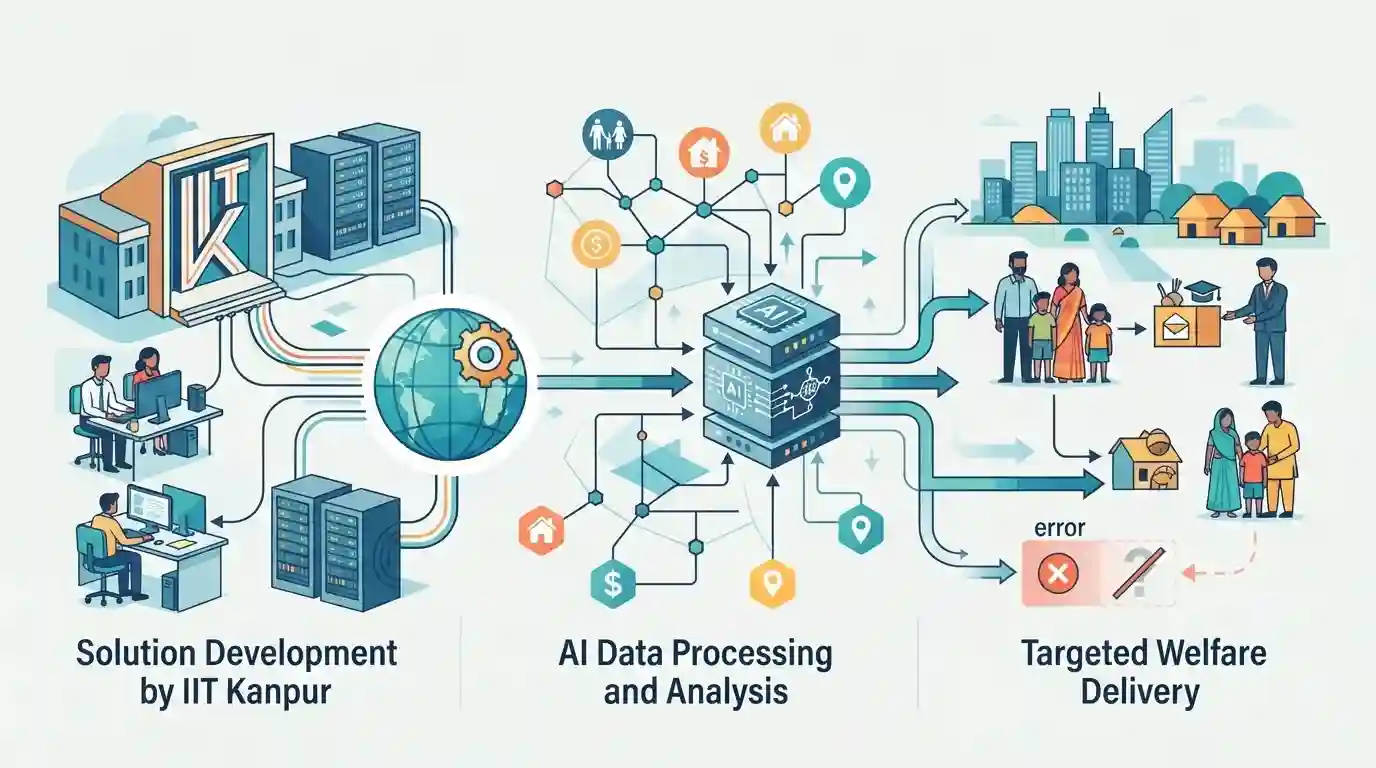
IIT Kanpur has developed an AI solution to assist governments in accurately identifying households that require welfare support, thereby improving public welfare targeting and reducing errors in beneficiary identification.
Key Points
- Researchers at IIT Kanpur have developed an Artificial Intelligence (AI) solution designed to help governments identify households that genuinely require welfare support and social benefits.
- The AI-driven tool leverages advanced data analytics to target welfare distribution accurately, minimizing inclusion and exclusion errors in government schemes.
- This technological intervention aims to enhance transparency, efficiency, and resource optimization in public service delivery.
Important Terms
Family Score

An AI-powered system developed by IIT Kanpur to assess socio-economic conditions and identify households needing welfare support by analyzing existing government datasets without new door-to-door surveys.
UPSC context
Important for GS Paper II (E-Governance Applications, Governance) and GS Paper III (Technology Missions), testing innovations in public service delivery.
IIT Kanpur
A premier public technical institute in India that recently developed advanced artificial intelligence applications to streamline administrative decision-making and improve welfare delivery.
UPSC context
Relevant for Science and Technology (GS Paper III) and institutional contributions to national governance and digital governance models.
E-Governance Applications
The application of information and communication technologies (ICT) and emerging tools like AI by government agencies to transform public services, enhance transparency, and optimize welfare targeting.
UPSC context
Core syllabus topic in GS Paper II (Governance, Transparent Administration) examining digital tools for citizen-centric governance.
Welfare Schemes
Targeted government programs and social safety nets designed to provide financial, nutritional, and social security support to marginalized and economically vulnerable populations.
UPSC context
Key theme under GS Paper II (Social Justice, Vulnerable Sections) focusing on delivery mechanisms and leakage reduction.
Static Concepts Connected
What are inclusion and exclusion errors in the targeting of public welfare schemes in India?
- Exclusion Error: Exclusion error occurs when genuine, eligible beneficiaries are wrongfully left out of welfare schemes due to faulty data or rigid criteria.
- Inclusion Error: Inclusion error occurs when undeserving, non-eligible individuals or households receive welfare benefits meant for the vulnerable.
- Minimization Tools: Proxy Means Testing (PMT) and socioeconomic registries are used to minimize these errors and optimize fiscal resources.
Cross-Topic Patterns
AI Welfare Targeting & Right to Privacy
AI-driven socio-economic profiling intersects with the Right to Privacy, data localization mandates, and the ethical use of administrative data for targeted welfare delivery under Article 21.
Academic R&D in Digital Public Infrastructure
Utilizing state data centers for governance models highlights cooperative federalism and academic-state partnerships in scaling digital public infrastructure (DPI).

Expect assertion-reasoning on AI welfare targeting, distinguishing between inclusion/exclusion errors and the role of administrative data.
Linked PYQs · 1
Linked PYQs · 1
- 2019UPPSC_PRELIMSGS1
National Social Assistance include the following scheme for 'Below Poverty Line' households
