IIT Kanpur methodology for predicting solar cycles
Source:The Hindu ↗
Why It Matters
As India expands its footprint in space and relies heavily on satellite-based infrastructure for navigation, communication, and security, understanding and predicting space weather becomes vital. This topic aligns with the UPSC syllabus on indigenous technology development and awareness in space sciences.
Summary
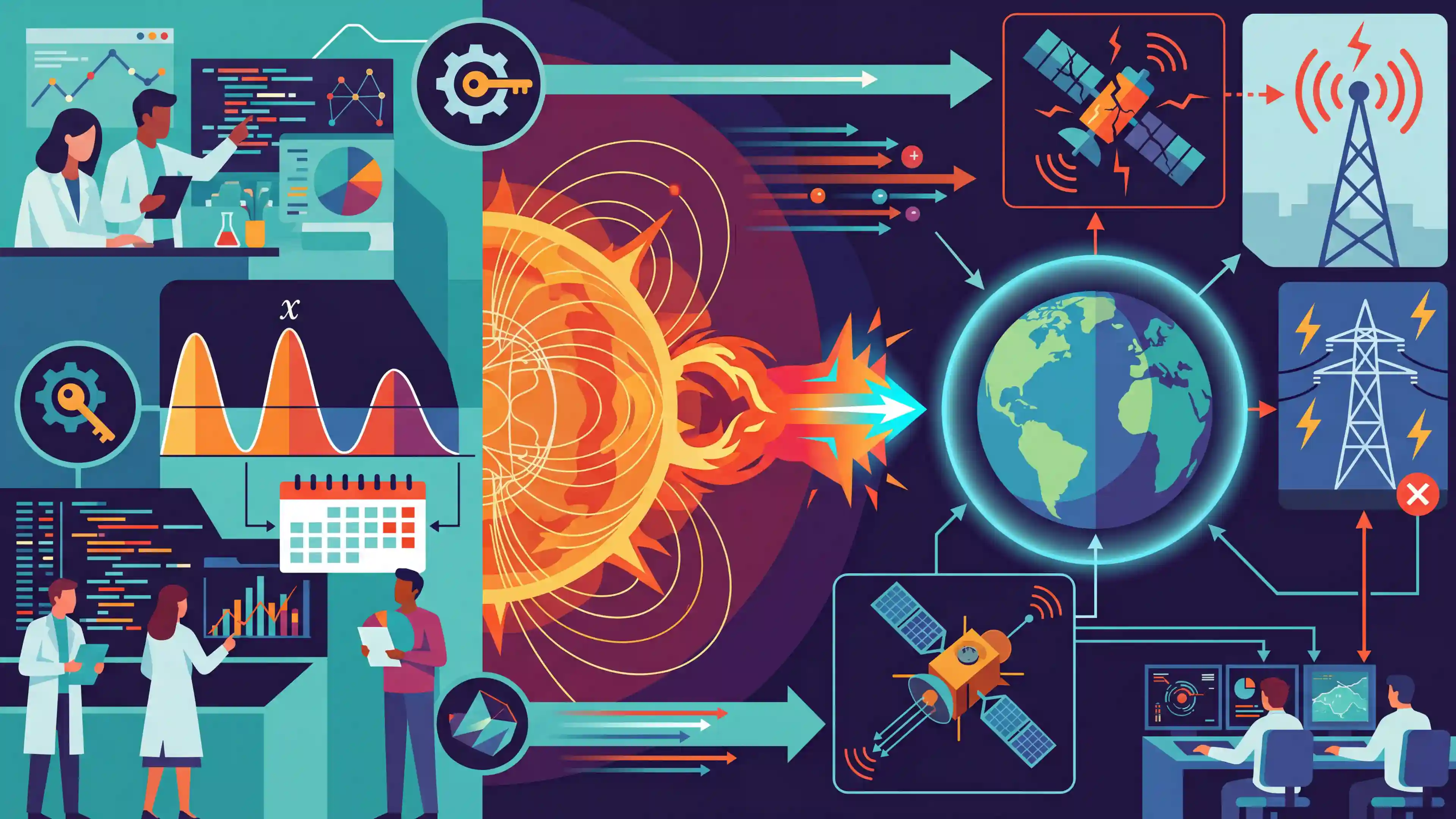
A research team from IIT-Kanpur has developed a new method to predict solar cycles, offering a significant boost to space weather forecasting. The Sun's magnetic activity fluctuates in roughly 11-year cycles, driving phenomena like solar flares and coronal mass ejections (CMEs). Because extreme space weather can severely disrupt Earth's technological infrastructure—including satellites, power grids, and communication systems—accurate predictive models are crucial. This indigenous scientific advancement complements India's broader space ambitions, such as the Aditya-L1 mission, by providing better tools to anticipate and mitigate the impacts of solar storms.
Key Points
- Researchers at IIT-Kanpur have developed a novel methodology for predicting the timing and intensity of solar cycles.
- Solar cycles typically span an 11-year period, characterized by fluctuations in the Sun's magnetic activity and sunspot numbers.
- Accurate prediction of these cycles is essential for forecasting severe space weather events, such as Solar Flares and Coronal Mass Ejections (CMEs).
- Improved space weather forecasting helps protect critical Earth-bound and orbital infrastructure, including satellites, telecommunications networks, power grids, and GPS systems.
- The development bolsters India's indigenous capabilities in solar physics and space weather forecasting, complementing ISRO's Aditya-L1 solar observatory mission.
Important Terms
Aditya-L1 mission

India's first space-based solar observatory mission, positioned in a halo orbit around Lagrange Point 1 (L1) to study the Sun's atmosphere and solar wind continuously.
UPSC context
GS Paper III (Science & Technology - Space); focuses on indigenous technological capabilities and solar physics research.
Solar Cycle
An approximately 11-year cycle of solar magnetic activity, characterized by the flipping of the Sun's poles and periodic changes in sunspot numbers and solar eruptions.
UPSC context
GS Paper I (Physical Geography) and GS Paper III (S&T); essential for understanding solar-terrestrial relations and space weather forecasting.
Coronal Mass Ejection (CME)
Large-scale expulsions of magnetized plasma and magnetic fields from the Sun's corona that can cause geomagnetic storms and disrupt power grids and satellites on Earth.
UPSC context
GS Paper III (S&T and Disaster Management); significant for assessing risks to technological infrastructure from extraterrestrial events.
Space Weather
The environmental conditions in near-Earth space, primarily driven by solar activity like CMEs and solar flares, that can affect satellite operations and communication systems.
UPSC context
GS Paper III (S&T and Disaster Management); tests understanding of non-terrestrial disasters and their impact on global infrastructure.
Solar Flares
Sudden, intense bursts of electromagnetic radiation from the Sun's surface, often originating near sunspots, capable of causing immediate ionospheric disturbances and radio blackouts.
UPSC context
GS Paper III (S&T); involves classifying solar events (A, B, C, M, X classes) and their specific impacts on radio communication.
Sunspots
Temporary, relatively cool, dark regions on the Sun's photosphere with intense magnetic activity; their frequency is used to track the progress of the solar cycle.
UPSC context
GS Paper I (Geography) and GS Paper III (S&T); serves as a fundamental indicator for solar activity and space weather prediction.
Prelims Trap
Solar flares and Coronal Mass Ejections (CMEs) both eject physical plasma that takes several days to reach Earth.
Solar flares are bursts of electromagnetic radiation that reach Earth in 8 minutes. CMEs are physical plasma expulsions that take 1-3 days to arrive.
Static Concepts Connected
What distinguishes Sunspots, Solar Flares, and CMEs?
- Sunspots: Cooler, darker regions on the Sun's photosphere characterized by concentrated and intense magnetic fields.
- Solar Flares: Sudden flashes of electromagnetic radiation (light) that travel at the speed of light, reaching Earth in about 8 minutes.
- Coronal Mass Ejections: Massive clouds of magnetized plasma and protons expelled from the corona, taking 1 to 3 days to reach Earth.
Why was Lagrange Point 1 (L1) chosen for Aditya-L1?
- Continuous Observation: It offers an uninterrupted, continuous view of the Sun without any eclipses or occultation by Earth.
- Fuel Efficiency: The gravitational equilibrium between Earth and Sun at this point minimizes the fuel required for station-keeping.
- Magnetic Distance: Located roughly 1.5 million km away (1% of Earth-Sun distance), it sits outside Earth's magnetic field interference.
Cross-Topic Patterns
Solar storms and Grid resilience
Geomagnetic storms from severe CMEs can induce currents disrupting terrestrial power grids and submarine communication cables, linking space technology directly to infrastructure disaster management.
Ionospheric disruption of NavIC/GPS
Solar flares increase ionospheric ionization, causing GPS/NavIC signal scintillation and positioning errors, a critical vulnerability for both civilian aviation and strategic defense operations.

Expect a statement-based question contrasting CMEs vs. Solar flares, tied to Aditya L1's payload functions or L1 point characteristics.
Linked PYQs · 3
Linked PYQs · 3
- 2022PrelimsGS1
If a major solar storm (solar flare) reaches the Earth, which of the following are the possible effects on the Earth? 1. GPS and navigation systems could fail. 2. Tsunamis could occur at equatorial regions. 3. Power grids could be damaged. 4. Intense auroras could occur over much of the Earth. 5. Forest fires could take place over much of the planet. 6. Orbits of the satellites could be disturbed. 7. Shortwave radio communication of the aircraft flying over polar regions could be interrupted. Select the correct answer using the code given below:
- 2025PrelimsGS1
Consider the following statements : Statement I: Scientific studies suggest that a shift is taking place in the Earth's rotation and axis. Statement II: Solar flares and associated coronal mass ejections bombarded the Earth's outermost atmosphere with tremendous amount of energy. Statement III : As the Earth's polar ice melts, the water tends to move towards the equator. Which one of the following is correct in respect of the above statements?
- 2016MainsGS3
Discuss India's achievements in the field of Space Science and Technology. How the application of this technology has helped India in its socio-economic development?
