IIT Jodhpur Researchers Decode Brain Mechanisms for Cognition
Source:free-press-journal ↗
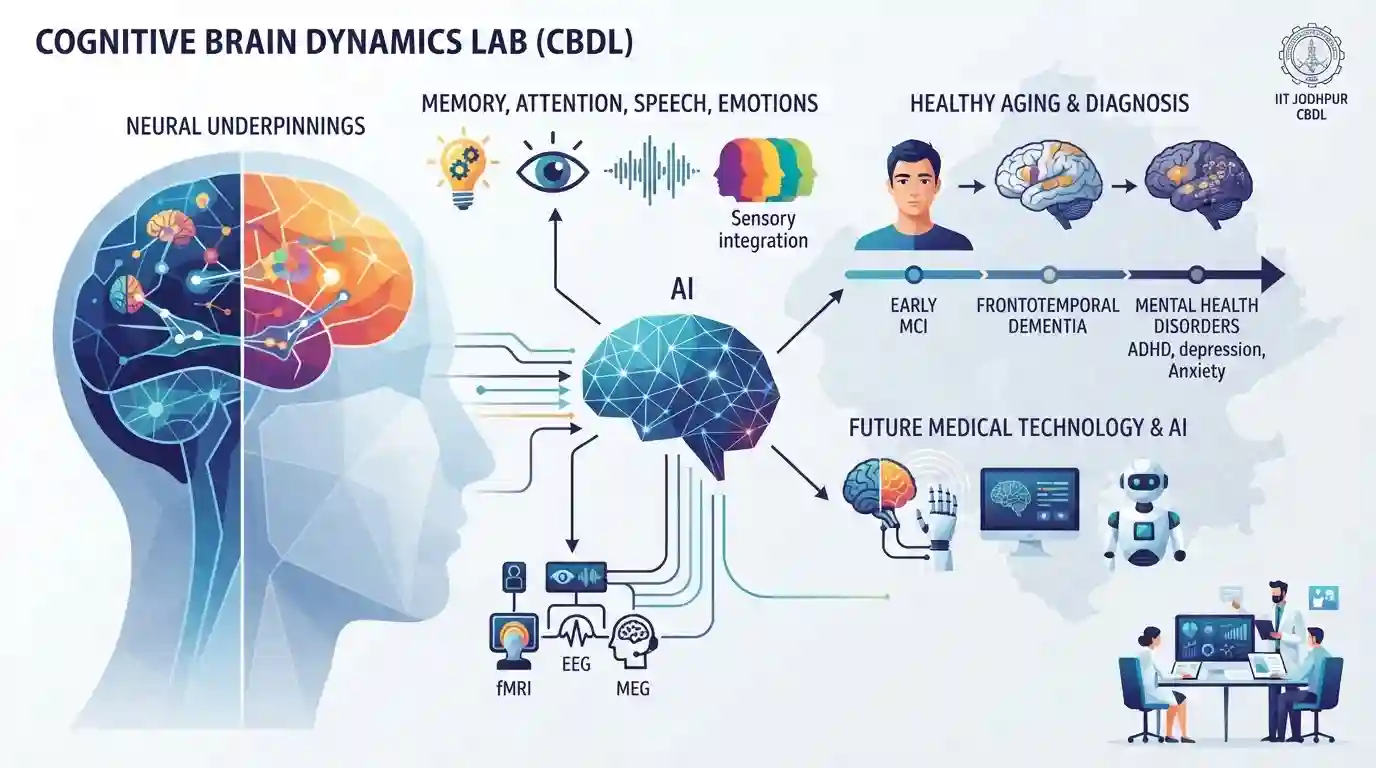
Why It Matters
This research highlights the significant contribution of premier educational institutions in Rajasthan (IIT Jodhpur) to cutting-edge cognitive science, brain-inspired AI, and diagnostic healthcare technologies. It directly aligns with questions on science, technology, human health, and Rajasthan's regional research developments.
Summary
Researchers at the Cognitive Brain Dynamics Lab (CBDL) at IIT Jodhpur, led by Dr. Dipanjan Roy, are using fMRI, EEG, MEG, and AI models to study the neural underpinnings of memory, attention, speech, and emotions. Their discoveries in sensory integration, healthy aging, and real-world emotional processing aim to aid early diagnosis of Mild Cognitive Impairment (MCI), Frontotemporal Dementia, and mental health disorders like ADHD, depression, and anxiety, while driving the future of brain-inspired AI and medical technology.
Key Points
- Researchers at the Cognitive Brain Dynamics Lab (CBDL) at IIT Jodhpur, led by Dr. Dipanjan Roy, have decoded neural mechanisms behind attention, memory, emotions, speech perception, and cognitive resilience.
- The study utilizes advanced functional Magnetic Resonance Imaging (fMRI), Electroencephalography (EEG), Magnetoencephalography (MEG), and AI-driven computational modeling.
- Their speech perception research shows how specific brain waves (neural oscillations) and subtle electrical stimulation can alter auditory and visual integration, opening up possibilities for next-generation hearing aids and auditory prosthetics.
- The team's aging and working memory research identifies neural signatures that can potentially enable the early detection of Mild Cognitive Impairment (MCI) and Frontotemporal Dementia.
- Using naturalistic fMRI settings, the lab is uncovering neurocognitive markers associated with depression, anxiety, OCD, and attention-related conditions like ADHD.
Important Terms
Cognitive Brain Dynamics Lab (CBDL)

A specialized interdisciplinary research laboratory at IIT Jodhpur that investigates neural mechanisms of cognition, emotion, and memory using advanced tools like fMRI, EEG, and artificial intelligence.
UPSC context
GS Paper 3 (Science & Tech). Highlights India's institutional capacity in cognitive science, neuromorphic engineering, and AI-driven healthcare research.
Indian Institute of Technology Jodhpur (IIT Jodhpur)
A premier technical and research university in Rajasthan, India, recognized for integrating conventional engineering with cutting-edge interdisciplinary fields like artificial intelligence, neuro-engineering, and medical technologies.
UPSC context
GS Paper 3 (Science & Technology). Relevant to the role of premier academic institutes in driving indigenous scientific research and healthcare innovation.
School of Artificial Intelligence and Data Science
An academic department at IIT Jodhpur dedicated to combining AI, machine learning, and data analytics to solve complex real-world challenges, including computational neuroscience and cognitive modeling.
UPSC context
GS Paper 3 (IT & Computers). Demonstrates the formal integration of AI and data science into Indian higher education and applied R&D.
Prelims Trap
fMRI maps brain activity by directly recording the electrical impulses and magnetic fields emitted by active neural networks.
fMRI measures indirect metabolic changes (blood oxygenation/flow), not direct electrical or magnetic signals, which are captured by EEG and MEG respectively.
Static Concepts Connected
What are the core differences between EEG, MEG, and fMRI neuroimaging technologies?
- fMRI mechanism: Measures blood-oxygen-level-dependent (BOLD) changes, offering high spatial resolution but slow temporal response.
- EEG signals: Records electrical activity directly from the scalp, offering excellent temporal resolution but poor spatial accuracy.
- MEG advantage: Tracks magnetic fields generated by neural currents, combining high temporal resolution with superior spatial tracking.
How does Frontotemporal Dementia (FTD) differ clinically from Alzheimer's Disease?
- Primary pathology: FTD selectively damages frontal and temporal lobes, whereas Alzheimer's typically targets the hippocampus and cerebral cortex.
- Symptom presentation: FTD causes early-stage personality, behavioral, and language shifts, while Alzheimer's primarily manifests as progressive short-term memory loss.
- Age of onset: FTD typically affects younger populations (aged 45 to 65), unlike Alzheimer's which is predominantly diagnosed in older adults.
Cross-Topic Patterns
Neuro-rights and Article 21
Decoding neural markers for mental illness using AI risks cognitive profiling, necessitating a robust legal framework around neuro-privacy and mental autonomy under India's Right to Privacy.
Indigenous R&D and Assistive Technology
Indigenously developed brain-computer interfaces and sensory prosthetics support the Rights of Persons with Disabilities (RPwD) Act 2016 and India's Accessible India Campaign.

Comparative questions on neuroimaging tools (fMRI vs MEG) and neurodegenerative profiles (FTD vs Alzheimer's) are highly probable for 2026.
Linked PYQs · 3
Linked PYQs · 3
- 2013RPSC_PRELIMSGS1
The Indian Institutes of Technology and the National Law University are located in Rajasthan in -
- 2021RPSC_PRELIMSGS1
Which part of the human body is infected by the virus causing Japanese encephalitis?
- 2023RPSC_PRELIMSGS1
Where will the “Artificial Intelligence of Things Innovation Hub” be established in Rajasthan?
