Free-Space Quantum Communication Link Demonstration by IIT Gandhinagar
Source:The Hindu ↗
ఇది ఎందుకు ముఖ్యం
The successful demonstration of free-space quantum communication over significant atmospheric distances highlights India's indigenous research capabilities in cutting-edge quantum technology, which is central to future secure communications, cryptography, and defense infrastructure under the National Quantum Mission.
సారాంశం
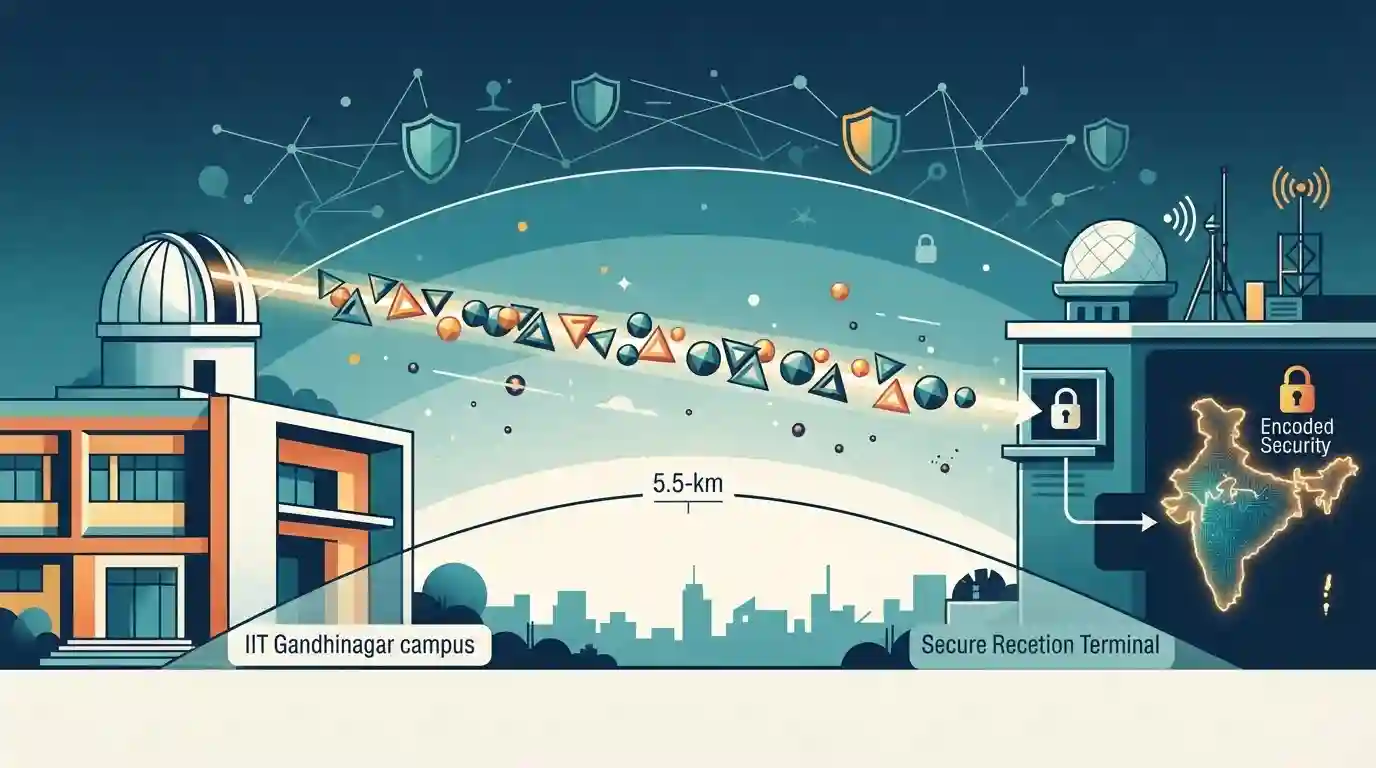
Scientists at IIT Gandhinagar have successfully demonstrated a free-space quantum link over a 5.5-km distance through open air. This achievement marks a significant step forward in quantum communication technology, enabling secure key distribution through the atmosphere rather than fiber optic cables, which is vital for secure national security and defense applications under India's National Quantum Mission.
ముఖ్య అంశాలు
- Researchers at IIT Gandhinagar successfully demonstrated a free-space quantum link over a distance of 5.5 kilometres through the air.
- Free-space quantum communication allows secure transmission of cryptographic keys using photons, bypassing the need for physical optical fibers.
- This technology is crucial for advancing secure defense and space communication, aligning with the objectives of India's National Quantum Mission.
- Key challenges in atmospheric quantum communication include atmospheric turbulence, beam divergence, and weather-related disruptions.
ముఖ్యమైన పదాలు
National Quantum Mission

An ambitious government initiative aimed at scaling scientific and industrial R&D in quantum technologies, fostering quantum computers, secure communications, and advanced sensing across India.
UPSC context
Mains GS-3 (Science and Technology - Indigenous technologies and policy initiatives). Tests understanding of India's strategic tech preparedness.
IIT Gandhinagar
A premier institute of technology in India that recently collaborated to demonstrate a record-breaking free-space quantum communication link over 5.5 kilometers.
UPSC context
Prelims/GS-3 (Science & Technology - Applications of Quantum Mechanics). Tests institutional contributions to cutting-edge research.
ప్రిలిమ్స్ ఉచ్చు
Free-space quantum communication allows secure transmission of data using photons, completely bypassing classical encryption.
Aspirants often assume quantum key distribution (QKD) encrypts the actual data payload using quantum mechanics, whereas QKD only securely distributes cryptographic keys; actual data is encrypted using conventional algorithms (like AES) driven by those quantum keys.
అనుసంధానమైన స్థిర భావనలు
What are the core pillars and objectives of India's National Quantum Mission (NQM)?
- Financial Outlay: Funding quantum computing, quantum communication, quantum materials, and sensors with a budgetary outlay over 8 years.
- Quantum Sensors: Developing magnetometers with high sensitivity in atomic systems and atomic clocks for precision timing.
- Quantum Communication: Establishing satellite-based secure quantum communications between ground stations over 2000 km within India.
అంతర-అంశ నమూనాలు
Quantum Mission + Satellite Communications
India's National Quantum Mission intersects with ISRO's satellite roadmap to enable satellite-based quantum key distribution, bridging terrestrial free-space links with orbital assets.
Quantum Cryptography + Defense Communications
Free-space QKD innovations directly strengthen encrypted tactical military links, reducing reliance on vulnerable undersea and land-based fiber networks.

Free-space QKD vs Fiber QKD + National Quantum Mission pillars will likely be tested via a statement-based prelims question.
అనుసంధాన PYQలు · 2
అనుసంధాన PYQలు · 2
- 2026PrelimsGS1
Which of the following statements with regard to the National Quantum Mission (NQM) is/are correct? 1. It aims at developing intermediate-scale quantum computers with 50-1000 physical qubits. 2. Its implementation includes setting up of four Thematic Hubs (T-Hubs) in academic and national R&D institutes across India. Select the answer using the code given below :
- 2022PrelimsGS1
Which one of the following is the context in which the term "qubit" is mentioned ?
