Anthropogenic Factors Drive Extreme Weather Events in India
Source:The Hindu ↗
Why It Matters
The changing nature of the Indian monsoon and the rising frequency of extreme weather events directly impact agriculture, water security, urban infrastructure, and human life. This intersection of human geography and climate science is highly relevant for GS1 (Geography) and GS3 (Environment & Disaster Management) exams.
Summary
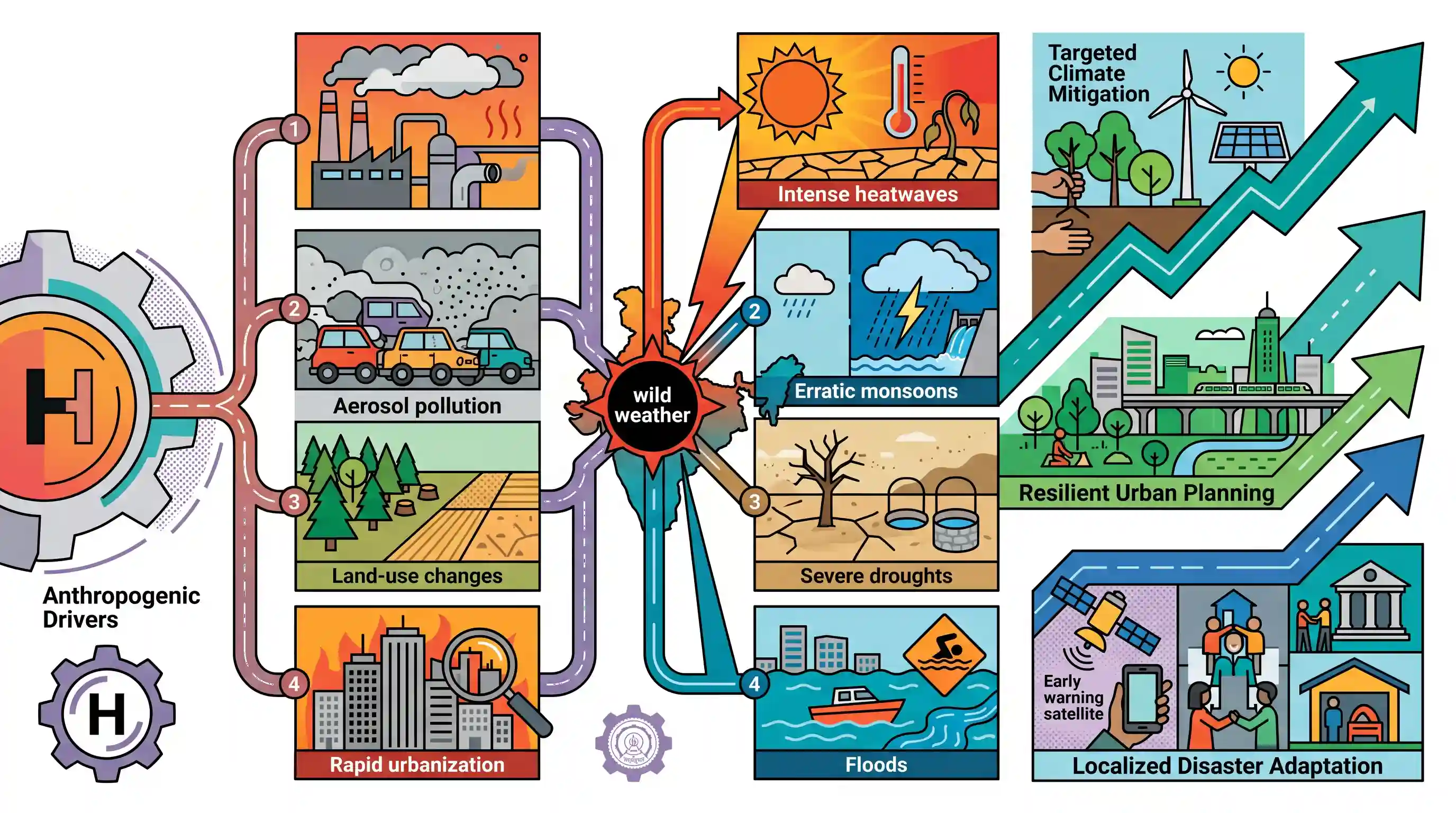
A recent study conducted by researchers at IIT Delhi reveals that anthropogenic (human-induced) factors are the primary drivers of extreme weather events in India. The study attributes the rise in "wild weather"—such as intense heatwaves, erratic monsoons, severe droughts, and floods—to greenhouse gas emissions, aerosol pollution, land-use changes, and rapid urbanization. These human activities are drastically altering India's climatic conditions, underscoring the urgent need for targeted climate mitigation, resilient urban planning, and localized disaster adaptation strategies to protect vulnerable populations and the economy.
Key Points
- A study by IIT Delhi concludes that human activities are the primary drivers behind India's increasingly extreme and erratic weather events.
- Key anthropogenic factors include greenhouse gas emissions, aerosol pollution, rapid urbanization, and significant land-use changes.
- These activities disrupt natural climatic patterns, leading to severe heatwaves, unpredictable monsoon rains, droughts, and urban flooding.
- The findings emphasize the critical need for localized climate adaptation strategies, improved urban planning, and robust early warning systems to mitigate disaster risks.
Important Terms
Anthropogenic Factors

Human-induced activities, such as burning fossil fuels and deforestation, that release greenhouse gases and alter the Earth's climate system, leading to global warming and extreme weather.
UPSC context
GS Paper III (Environment). Tests understanding of human impact vs. natural variability in driving contemporary climate change and environmental degradation.
Greenhouse Gas (GHG) Emissions
Gases like CO2, methane, and nitrous oxide that trap heat in the atmosphere, causing the 'greenhouse effect.' Human activities have significantly increased their concentration since the Industrial Revolution.
UPSC context
GS Paper III (Environment). Central to discussions on India’s Nationally Determined Contributions (NDCs) and international climate negotiations like the Paris Agreement.
Aerosols
Minute solid or liquid particles suspended in the air (e.g., soot, dust, sulfates). They can scatter or absorb sunlight, influencing cloud formation, rainfall patterns, and regional phenomena like winter fog.
UPSC context
GS Paper III (Pollution/Environment). Important for understanding non-GHG drivers of the Indian monsoon and public health challenges in the Indo-Gangetic Plain.
Urban Heat Island (UHI) Effect
A phenomenon where urban areas experience significantly higher temperatures than surrounding rural areas due to dense infrastructure, concrete surfaces, lack of vegetation, and concentrated human activity.
UPSC context
GS Paper I (Urbanization) & GS Paper III (Environment). Relevant for sustainable urban planning, disaster management, and public health policies in India.
Land Use and Land Cover (LULC) Change
The transformation of Earth's surface through human arrangements like agriculture, settlements, and industry. These changes affect carbon sinks, surface reflectivity (albedo), and local hydrological cycles.
UPSC context
GS Paper I (Geography) & GS Paper III (Environment). Key to studying land degradation, biodiversity loss, and climate resilience in various Indian states.
Climate Mitigation
Human interventions aimed at reducing the sources or enhancing the sinks of greenhouse gases to limit the magnitude of global warming and its long-term impacts.
UPSC context
GS Paper III (Environment). Tests knowledge of strategies like renewable energy expansion and carbon sequestration to meet global climate targets.
Climate Adaptation
Adjustments in human or natural systems in response to actual or expected climatic stimuli. It focuses on managing the impacts of climate change to reduce vulnerability and increase resilience.
UPSC context
GS Paper III (Disaster Management). Essential for understanding India's strategies for localized resilience against floods, droughts, and erratic monsoons.
Prelims Trap
"Aerosol pollution increases surface temperatures and strengthens the South-West Monsoon by heating the Indian landmass."
Aerosols cause "solar dimming" by blocking sunlight, which reduces land surface heating. This lowers the land-sea thermal contrast, thereby weakening—not strengthening—the South-West monsoon.
Static Concepts Connected
How do atmospheric aerosols affect the South-West Monsoon dynamics?
- Solar Dimming: Aerosols block incoming solar radiation, leading to a cooling effect at the surface known as solar dimming.
- Thermal Contrast: Reduced land heating lowers the crucial temperature gradient between the Indian landmass and the Indian Ocean, weakening monsoon winds.
- Cloud Microphysics: Aerosols increase cloud condensation nuclei, making water droplets too small to precipitate easily, which delays and disrupts rainfall.
What is the relationship between heatwaves and ground-level ozone?
- Secondary Pollutant: Ground-level (tropospheric) ozone is not directly emitted. It forms when nitrogen oxides (NOx) and volatile organic compounds (VOCs) interact in sunlight.
- Photochemical Catalyst: Intense heatwaves act as catalysts, drastically accelerating the photochemical reactions in the atmosphere that produce dangerous surges in toxic ozone.
Cross-Topic Patterns
Urban flooding + Wetland encroachment
Links erratic intense rainfall directly to municipal planning failures and wetland destruction, shifting focus from natural disasters to human-made urban flooding crises in GS1/GS3.
Albedo + Local moisture recycling
Deforestation and agricultural expansion alter surface albedo and reduce evapotranspiration, disrupting local moisture cycles. UPSC frequently tests these micro-climatic geography concepts.

Expect a multi-statement Prelims question comparing the opposing impacts of GHGs (intensifying) and aerosols (weakening) on the monsoon.
Linked PYQs · 3
Linked PYQs · 3
- 2015MainsGS1
How far do you agree that the behaviour of the Indian monsoon has been changing due to humanizing landscapes? Discuss.
- 2024MainsGS3
Flooding in urban areas is an emerging climate-induced disaster. Discuss the causes of this disaster. Mention the features of two such major floods in the last two decades in India. Describe the policies and frameworks in India that aim at tackling such floods.
- 2022MainsGS3
Discuss global warming and mention its effects on the global climate. Explain the control measures to bring down the level of greenhouse gases which cause global warming, in the light of the Kyoto Protocol, 1997.
