PM 2.5 air pollution and its critical impact on birth risks
Source:Indian Express ↗
Why It Matters
The findings emphasize the urgent need to address the multifaceted public health impacts of environmental degradation (like PM 2.5 causing birth risks) and the critical role of scientific innovation in combating challenges like AMR and food safety, which are core themes in GS Paper 3.
Summary
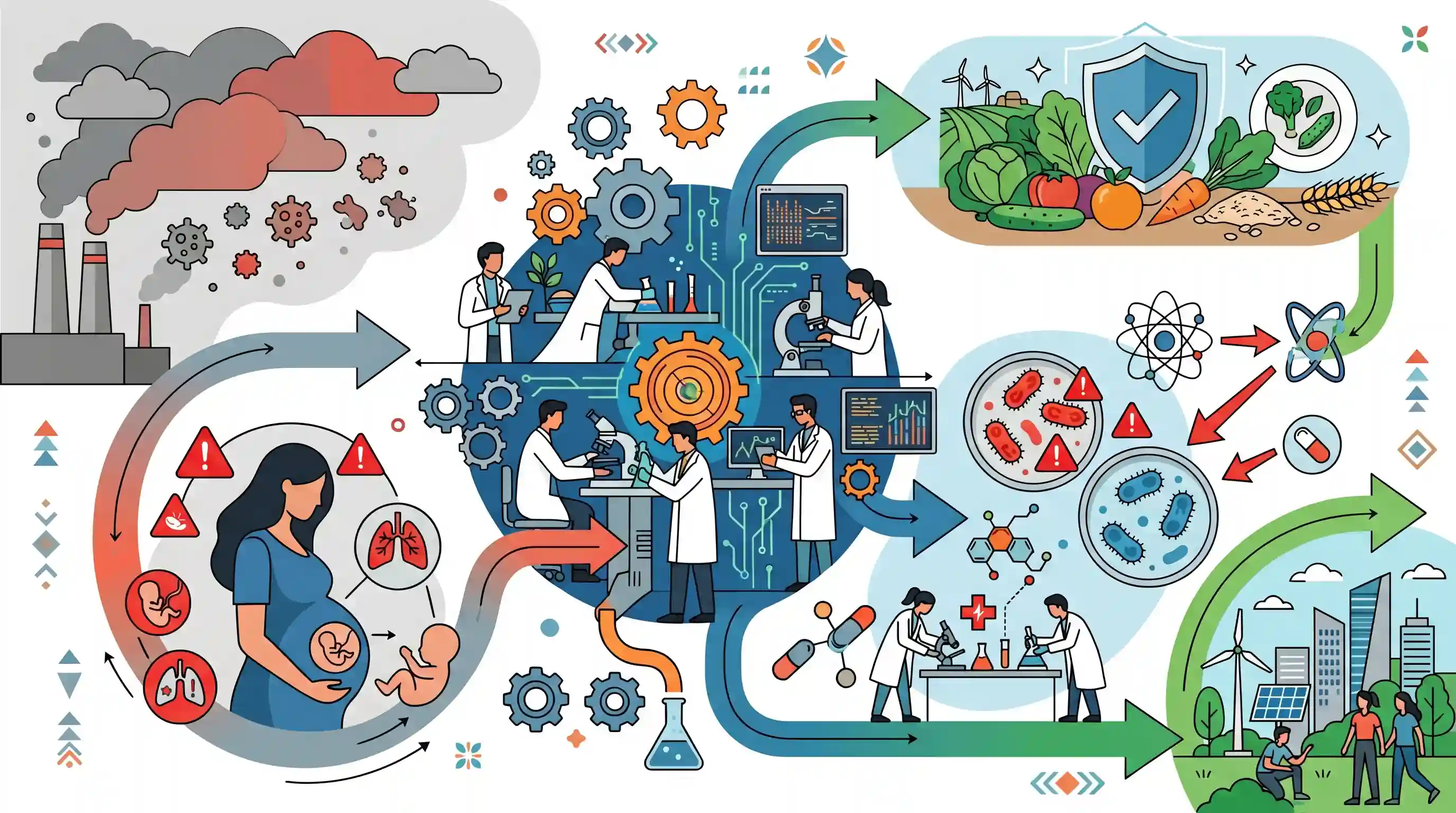
At the IIT Delhi Open House 2025, researchers showcased significant studies emphasizing the adverse impacts of PM 2.5 air pollution on maternal and neonatal health, directly linking it to various birth risks. The event also featured technological advancements and research related to food safety and the mitigation of the growing threat of antibiotic resistance. Aimed at inspiring future engineering aspirants, these exhibitions underscored the critical intersection of environmental pollution, public health, and technological innovation in solving India's pressing socio-environmental challenges.
Key Points
- IIT Delhi researchers at the Open House 2025 highlighted the severe impact of PM 2.5 air pollution on maternal and fetal health, linking it to increased birth risks and neonatal vulnerabilities.
- The event showcased scientific interventions and research dedicated to tackling antimicrobial resistance (AMR), a rapidly growing public health crisis.
- Innovations addressing food safety monitoring and technology were displayed, emphasizing the role of advanced engineering in securing public health.
- The exhibition aimed to inspire prospective engineering students (JEE aspirants) by demonstrating the tangible societal and health impacts of cutting-edge scientific research.
Important Terms
PM 2.5 (Particulate Matter)

Fine inhalable particles with diameters generally 2.5 micrometers or smaller. They can penetrate deep into the respiratory system and enter the bloodstream, posing severe risks to fetal development and neonatal health.
UPSC context
GS Paper 3: Environmental Pollution. Key for understanding air quality impacts on public health and national pollution standards.
Antimicrobial Resistance (AMR)
Occurs when bacteria, viruses, fungi, and parasites evolve to withstand the effects of medicines, making infections harder to treat and increasing risks during surgeries and childbirth.
UPSC context
GS Paper 3: Science and Technology/Health. Tested as a global health threat and a 'One Health' challenge.
National Clean Air Programme (NCAP)
A central government scheme launched in 2019 to reduce particulate matter (PM 10 and PM 2.5) concentrations by 40% by 2026 across 131 non-attainment cities.
UPSC context
GS Paper 3: Environment. Flagship policy for air quality management and urban environmental governance.
Institution of Eminence (IoE)
A recognition scheme by the University Grants Commission (UGC) providing selected higher education institutions with greater administrative and financial autonomy to achieve global excellence.
UPSC context
GS Paper 2: Governance/Education. Relevant for reforms in higher education and enhancing India's global research standing.
WHO Air Quality Guidelines
Stringent global air quality standards revised in 2021, recommending an annual PM 2.5 limit of 5 µg/m³ to protect health from even low levels of exposure.
UPSC context
GS Paper 3: Environment. International benchmark for evaluating India's National Ambient Air Quality Standards (NAAQS).
One Health Approach
An integrated, unifying approach that aims to sustainably balance and optimize the health of people, animals, and ecosystems by addressing interconnected threats like AMR.
UPSC context
GS Paper 3: Health. Essential strategy for managing zoonotic diseases and antimicrobial resistance.
Preterm Birth (PTB)
The live birth of a baby before 37 completed weeks of pregnancy; identified in the study as a significant risk linked to high PM 2.5 exposure.
UPSC context
GS Paper 2: Social Justice/Health. Tests understanding of maternal and child health indicators in the context of environment.
Low Birth Weight (LBW)
A birth weight of less than 2,500 grams (5.5 pounds), which increases susceptibility to infections and long-term health complications like diabetes.
UPSC context
GS Paper 2: Social Justice/Health. A key neonatal health outcome impacted by socio-environmental determinants.
Prelims Trap
"PM 2.5 affects only respiratory organs and is too large to cross the blood-placental or blood-brain barriers."
PM 2.5 particles are ultrafine and can cross both the blood-placental and blood-brain barriers, acting as systemic toxins causing premature births and neuro-inflammation.
Static Concepts Connected
How does PM 2.5 impact the human body beyond the respiratory system?
- Ultrafine penetration: It bypasses respiratory defenses, entering the bloodstream to successfully cross both the blood-brain and blood-placental barriers.
- Fetal risks: Induces systemic oxidative stress and inflammation as an intrauterine toxin, leading to preterm births and low birth weight.
- Cognitive impairment: Triggers neuroinflammation which impairs cognitive development and increases neurodegenerative disease risks in early childhood.
What are the environmental drivers of Antimicrobial Resistance (AMR) under the One Health approach?
- Livestock rearing: Misuse of antibiotics as growth promoters in poultry and livestock creates resistant bacterial strains.
- Industrial effluents: Untreated pharmaceutical waste and sewage discharged into water bodies act as major reservoirs for AMR evolution.
- One Health strategy: Integrating human, animal, and ecosystem health to trace and mitigate these interlinked resistance pathways (NAP-AMR 2.0).
Cross-Topic Patterns
Nanotech in Food Safety & Agriculture
Real-time nanosensors (like quantum dots) detecting pathogens and heavy metals bridge GS-3 tech advancements directly with food processing, safety regulations, and nutritional security frameworks.
Pollution's hit on Demographic Dividend
PM 2.5-induced cognitive impairment and neonatal vulnerabilities connect GS-3 environmental degradation directly to GS-2 challenges regarding human capital and India's demographic dividend.

Expect a 2026 multi-statement Prelims question testing PM 2.5's ability to cross placental/blood-brain barriers alongside AMR One Health.
Linked PYQs · 3
Linked PYQs · 3
- 2021MainsGS3
Describe the key points of the revised Global Air Quality Guidelines (AQGs) recently released by the World Health Organisation (WHO). How are these different from its last update in 2005? What changes in India's National Clean Air Programme are required to achieve these revised standards?
- 2022PrelimsGS1
In the context of WHO Air Quality Guidelines, consider the following statements: 1. The 24-hour mean of PM2.5 should not exceed 15 µg/m³ and annual mean of PM2.5 should not exceed 5 µg/m³. 2. In a year, the highest levels of ozone pollution occur during the periods of inclement weather. 3. PM10 can penetrate the lung barrier and enter the bloodstream. 4. Excessive ozone in the air can trigger asthma. Which of the statements given above are correct?
- 2014MainsGS3
Can overuse and free availability of antibiotics without Doctor's prescription, be contributors to the emergence of drug-resistant diseases in India? What are the available mechanisms for monitoring and control? Critically discuss the various issues involved.
