Microbial Research and Ecological Rule Decoding by IIT Bombay
Source:The Hindu ↗
Why It Matters
Microorganisms play a crucial role in maintaining ecological balance and offer biotechnological solutions to issues like energy shortages, disease outbreaks, and environmental pollution. UPSC frequently tests the real-world applications of microbial technology in both Prelims and Mains.
Summary
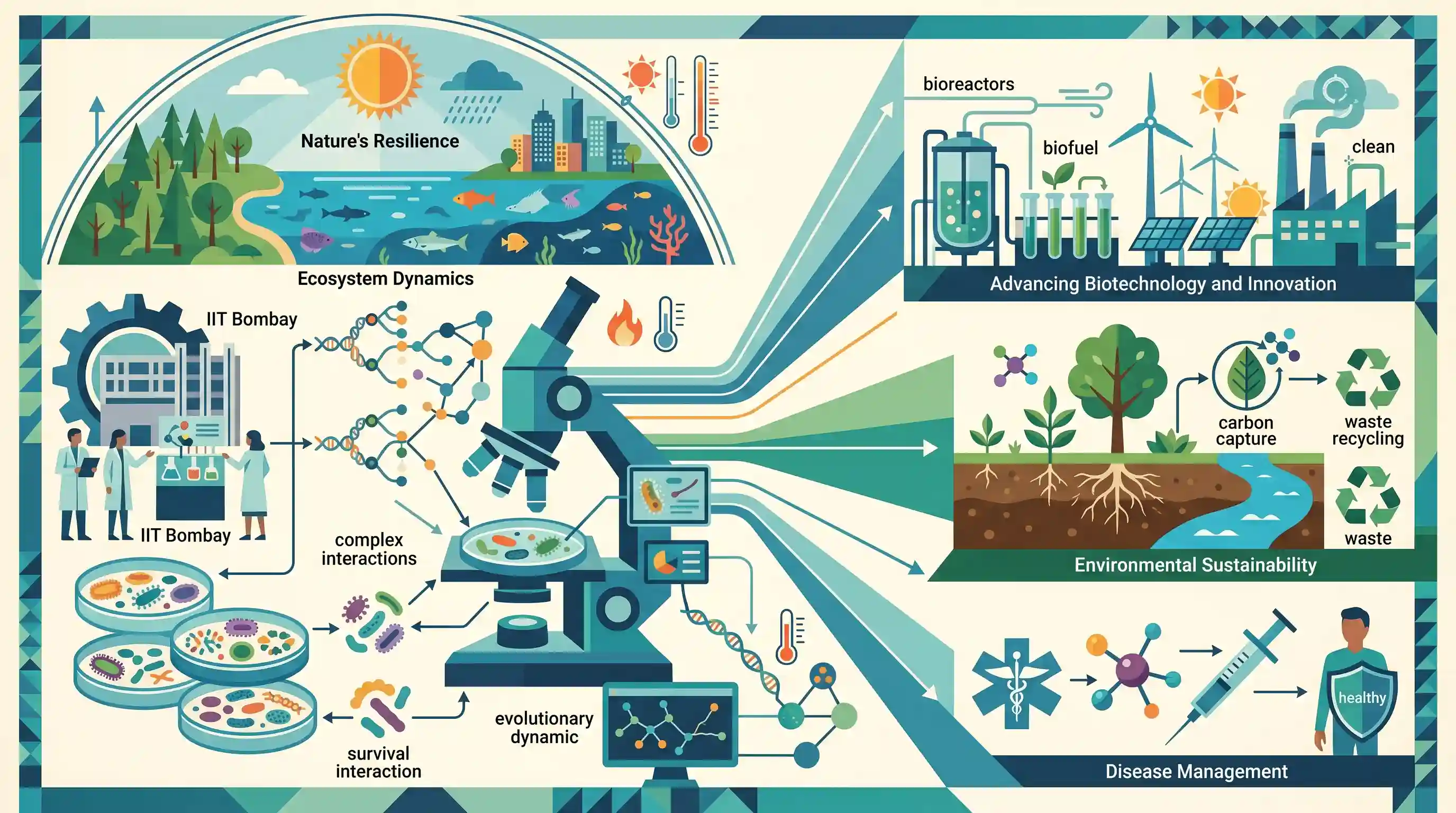
Researchers at IIT Bombay are leveraging microbes to uncover fundamental biological and ecological rules that govern natural ecosystems. By examining the complex interactions, survival strategies, and evolutionary dynamics within microbial communities, scientists can gain valuable insights into the functioning of larger ecosystems. This research is pivotal for advancing biotechnology and offers innovative pathways for addressing critical challenges in environmental sustainability, disease management, and understanding nature's resilience to changing environmental conditions.
Key Points
- Researchers at IIT Bombay have utilized microbes as model organisms to decode fundamental biological rules and complex ecological dynamics.
- The study of microbial communities provides deep insights into broader ecological principles, evolutionary dynamics, and environmental adaptation.
- Understanding these 'hidden rules' of nature has significant applications in biotechnology, including environmental conservation, agriculture, and disease control.
- Microbial research is increasingly critical for developing sustainable solutions to global challenges, such as ecosystem restoration and bio-energy production.
Important Terms
Microbial Ecology

The study of the relationship between microorganisms and their environment, including interactions with each other and larger organisms to maintain ecosystem stability.
UPSC context
GS III: Environment & Science. Tests understanding of niche roles and biological functions in biodiversity conservation.
Bioremediation
The use of living organisms, primarily microbes like bacteria or fungi, to degrade or remove environmental pollutants from soil and water.
UPSC context
GS III: Environmental Pollution. A key "nature-based solution" for sustainable waste management and land restoration.
Antibiotic Resistance
The process by which microbes evolve to survive exposure to drugs (antibiotics) that once killed them or inhibited their growth.
UPSC context
GS III: Science & Tech (Health). Critical for questions on One Health and the global threat of Superbugs.
Metabolic Pathways
The series of chemical reactions within a cell that allow organisms to convert food into energy and building blocks for growth.
UPSC context
GS III: Biotechnology. Essential for understanding how scientists "re-engineer" life for biofuels or medicine.
Synthetic Biology
An interdisciplinary branch of biology that combines engineering principles with biotechnology to design and construct new biological parts or systems.
UPSC context
GS III: Science & Tech. High-priority topic involving ethics and innovation in "designer" organisms.
Biogeochemical Cycling
The natural process by which elements like carbon, nitrogen, and phosphorus are circulated through the biotic and abiotic components of the Earth.
UPSC context
GS III: Environment. Fundamental to understanding climate change, soil health, and global nutrient balance.
Prelims Trap
"The Wolbachia method involves genetically modifying mosquitoes to control Dengue and Zika."
Wolbachia is a naturally occurring bacterium. The method involves infecting mosquitoes with it to block viruses, not altering the mosquito's genome.
Static Concepts Connected
What are the key in-situ bioremediation techniques?
- Bioventing: Supplying air and nutrients directly to contaminated soil to stimulate the growth of indigenous degrading microbes.
- Biosparging: Injecting air under pressure below the groundwater table to increase oxygen concentration for microbial degradation.
- Bioaugmentation: Introducing specific cultured microorganisms into a contaminated site to accelerate the degradation of complex pollutants.
How are extremophile microorganisms classified by their habitat?
- Thermophiles: Organisms that thrive at unusually high temperatures, often utilizing heat-resistant enzymes used in biotechnology (e.g., Taq polymerase).
- Psychrophiles: Cold-adapted microbes that survive and reproduce at exceptionally low temperatures, including below freezing points.
- Halophiles: Organisms that require extremely saline environments, such as salt lakes or the Dead Sea, to survive.
Cross-Topic Patterns
Bioremediation + Renewable Energy
Microbial ecosystems like methanogens bridge environmental conservation and renewable energy by simultaneously treating wastewater and generating biogas, a frequent GS-3 overlap area.
Climate Change + Vector Diseases
As global warming expands mosquito habitats, microbial biological controls like the Wolbachia method become crucial climate-adaptation strategies for public health and disease management.

Expect a 2026 Prelims match-the-following question pairing microbial applications (Wolbachia, bioaugmentation) with their exact mechanisms.
Linked PYQs · 3
Linked PYQs · 3
- 2024PrelimsGS1
"Membrane Bioreactors" are often discussed in the context of:
- 2023PrelimsGS1
'Wolbachia method' is sometimes talked about with reference to which one of the following?
- 2023MainsGS3
Discuss several ways in which microorganisms can help in meeting the current fuel shortage.
