Carbon Capture Utilisation and Storage Geological Well Testing
Source:Indian Express ↗
Why It Matters
This project marks India's transition from theoretical CCUS studies to practical, field-level geological carbon storage testing. It is a pivotal development for India's strategy to decarbonize hard-to-abate industrial sectors and meet its net-zero emission commitments.
Summary
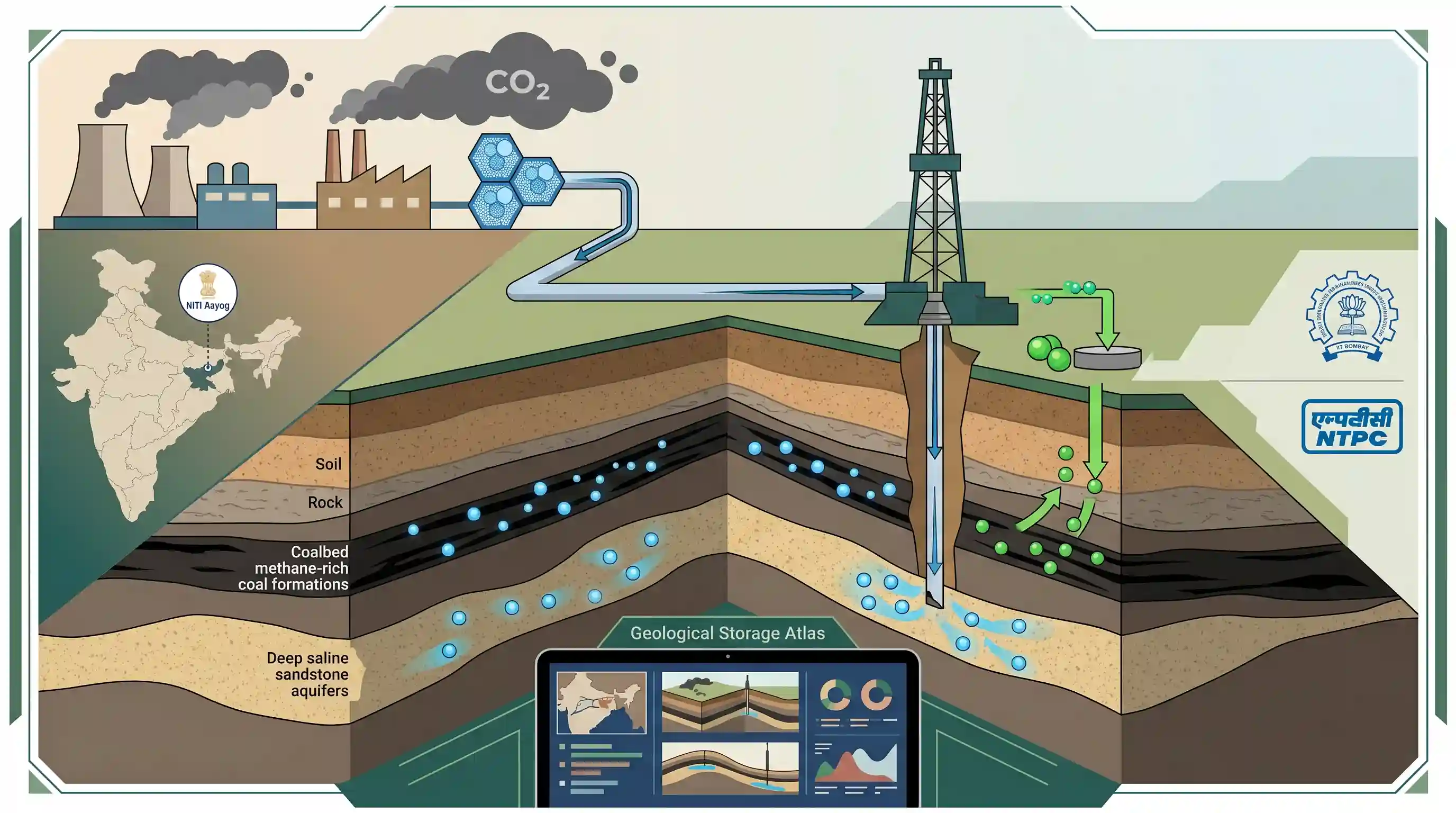
IIT Bombay and NTPC have successfully completed drilling India's first Carbon Dioxide (CO2) storage test well in Pakri Barwadih, Jharkhand. Conducted under the aegis of NITI Aayog, the project evaluates the feasibility of geological CO2 storage in coal and sandstone sedimentary formations. With drilling reaching a depth of 1,200 meters, the initiative paves the way for commercial-scale Carbon Capture, Utilisation, and Storage (CCUS) in India. The effort includes generating a geological storage atlas for coalbed methane-rich coalfields, which will play a critical role in mitigating industrial emissions and supporting India's long-term climate targets.
Key Points
- IIT Bombay and NTPC, with support from NITI Aayog, have successfully drilled India's first CO2 storage test well at Pakri Barwadih in Jharkhand.
- The project aims to test the viability of geological CO2 storage in sedimentary formations, specifically coal and sandstone.
- Researchers are developing India’s first geological storage atlas for coalbed methane-rich coalfields as part of this initiative.
- The well was drilled to a depth of 1,200 meters, and a second well is currently being drilled to implement CO2 injection and plume monitoring.
- This milestone provides crucial feasibility and risk assessments for full-scale Carbon Capture and Storage (CCS) in the North Karanpura coalfield, advancing India's Carbon Capture, Utilisation, and Storage (CCUS) capabilities.
- The collaboration builds on a 2017 project where IIT Bombay and NTPC launched India’s first CO2 capture and utilisation facility (Vindhyachal CCU plant).
Important Terms
Carbon Capture, Utilisation, and Storage (CCUS)

Technologies capturing CO2 from industrial sources for reuse in products or permanent storage in deep geological formations to prevent atmospheric release.
UPSC context
GS III (Environment/S&T); crucial for decarbonizing industrial sectors and achieving India's 2070 net-zero targets.
NITI Aayog
India's premier policy think tank providing strategic and technical advice to the government, replacing the Planning Commission in 2015.
UPSC context
GS II (Governance); its role in framing the CCUS policy roadmap is a key institutional topic.
Coalbed Methane (CBM)
An unconventional natural gas, primarily methane, trapped within coal seams and extracted by reducing water pressure to release the gas.
UPSC context
GS III (Energy); relevant for energy security and its link to geological storage sites in coalfields.
Carbon Sequestration
The long-term storage of carbon dioxide in plants, soils, geologic formations, or oceans to mitigate or defer global warming.
UPSC context
GS III (Environment); tests knowledge of climate mitigation techniques and biological versus geological storage.
Hard-to-Abate Sectors
Heavy industries like steel, cement, and chemicals where reducing emissions is difficult due to high-heat and chemical process requirements.
UPSC context
GS III (Economy/Environment); focuses on industrial decarbonization challenges and applications of CCUS.
Net Zero 2070
India's national commitment to balance greenhouse gas emissions and removals from the atmosphere by the year 2070.
UPSC context
GS III (Climate Change); a core target of India's Panchamrit pledge at COP26.
Geological Storage
The injection of captured CO2 into deep subsurface rock formations, such as depleted oil reservoirs or unmineable coal seams, for permanent disposal.
UPSC context
GS III (Science & Tech); tests technical understanding of permanent carbon burial in India's rock structures.
Prelims Trap
India's first CO2 storage well safely traps carbon in the basaltic rock formations of the Deccan Traps.
The Pakri Barwadih test well targets sedimentary formations (sandstone and unmineable coal seams) for geological storage, not the igneous basaltic rocks of the Deccan plateau.
Static Concepts Connected
What are the primary geological formations used for underground Carbon Sequestration?
- Depleted oil/gas fields: Provide proven geological traps and cap rocks that successfully held hydrocarbons for millions of years.
- Unmineable coal seams: Offer high surface area where CO2 adsorbs tightly onto coal, often displacing and releasing valuable Coalbed Methane (CBM).
- Deep saline aquifers: Large, deep underground rock formations saturated with salty water that can dissolve and securely trap injected CO2 over time.
How does Coalbed Methane (CBM) differ from conventional natural gas and shale gas?
- Source rock: CBM is extracted directly from unmineable coal seams where methane is adsorbed, unlike conventional gas found in porous reservoirs or shale gas in fine-grained rocks.
- Extraction method: CBM extraction primarily requires dewatering the coal seam to reduce pressure, whereas shale gas typically relies on extensive hydraulic fracturing (fracking).
- ECBMR Linkage: Injecting CO2 into these seams displaces the methane, leading to Enhanced Coalbed Methane Recovery (ECBMR) while simultaneously sequestering the carbon dioxide.
Cross-Topic Patterns
CCUS + Green Methanol Production
NTPC's Vindhyachal plant combines captured carbon with hydrogen to produce green methanol. This merges CCUS technology with the National Green Hydrogen Mission's push for alternative marine and aviation fuels.
Coalfields as Climate Transition Assets
Mapping coal seams in the North Karanpura coalfield for CO2 storage shifts traditional fossil-fuel geography into active climate mitigation assets, aligning with India's Net Zero 2070 targets.

Expect a 2026 prelims question combining CCUS methods (like Enhanced Coalbed Methane Recovery) with the geography of India's coalfields.
Linked PYQs · 3
Linked PYQs · 3
- 2025MainsGS3
What is Carbon Capture, Utilization and Storage (CCUS)? What is the potential role of CCUS in tackling climate change?
- 2023PrelimsGS1
Consider the following activities: 1. Spreading finely ground basalt rock on farmlands extensively 2. Increasing the alkalinity of oceans by adding lime 3. Capturing carbon dioxide released by various industries and pumping it into abandoned subterranean mines in the form of carbonated waters How many of the above activities are often considered and discussed for carbon capture and sequestration?
- 2014PrelimsGS1
With reference to two non-conventional energy sources called 'coalbed methane' and 'shale gas', consider the following statements: 1. Coalbed methane is the pure methane gas extracted from coal seams, while shale gas is a mixture of propane and butane only that can be extracted from fine-grained sedimentary rocks. 2. In India, abundant coalbed methane sources exist, but so far no shale gas sources have been found. Which of the statements given above is/are correct?
