Indigenously Developed Screening Device for Anaemia and Sickle Cell
Source:The Hindu ↗
কেন এটি গুরুত্বপূর্ণ
Affordable medical devices developed indigenously are vital for bridging healthcare gaps in remote and tribal areas, directly supporting India's missions to eradicate sickle cell anaemia and manage public health burdens cost-effectively.
সারসংক্ষেপ
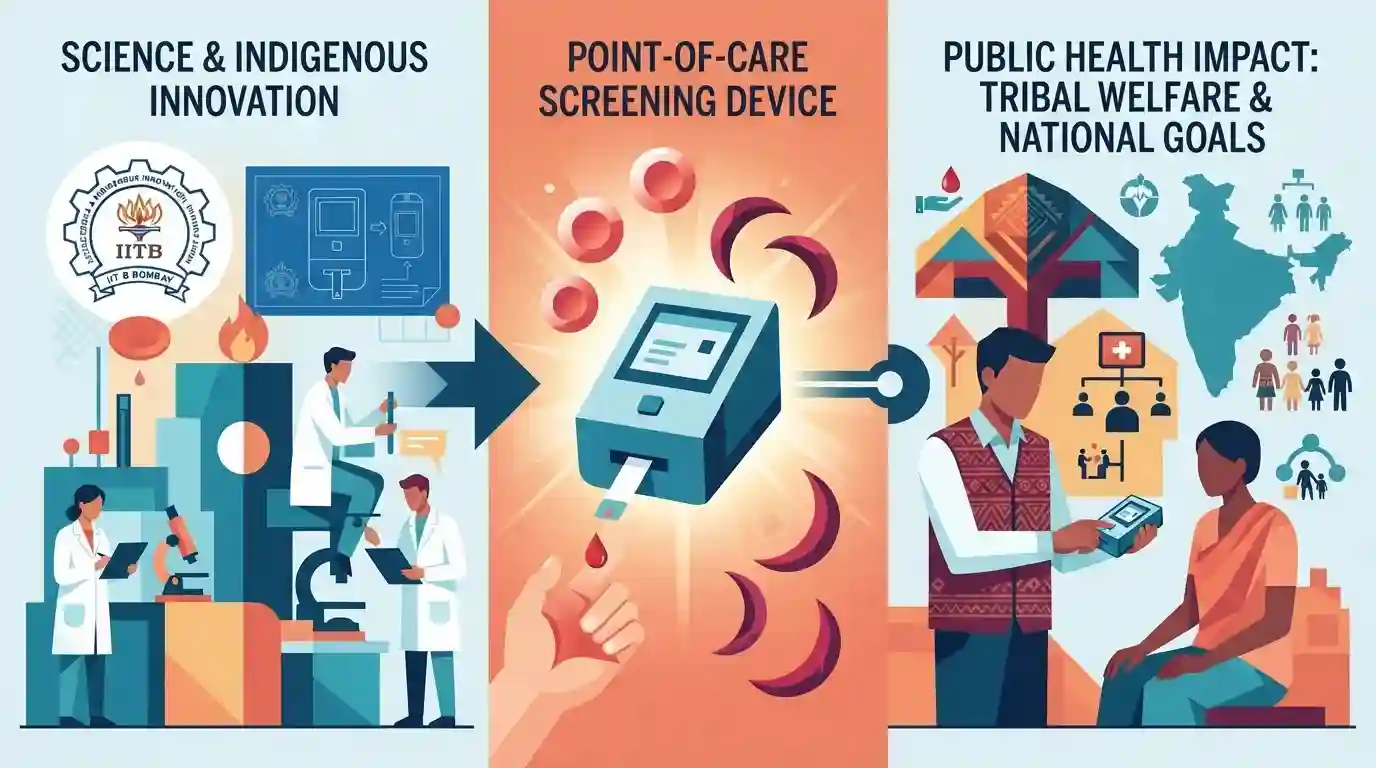
Researchers at IIT Bombay have engineered an affordable, low-cost screening device designed to detect both anaemia and sickle cell disease concurrently. This indigenous innovation acts as a vital point-of-care tool to tackle high burdens of sickle cell disease in tribal regions and widespread anaemia across India, supporting national healthcare goals such as the National Sickle Cell Anaemia Elimination Mission.
মূল বিষয়
- Researchers at IIT Bombay have developed a low-cost, portable screening device capable of detecting both anaemia and sickle cell disease simultaneously.
- Sickle cell disease disproportionately affects tribal populations in India, making affordable point-of-care testing crucial for remote and underserved areas.
- The innovation addresses public health challenges by reducing reliance on expensive laboratory infrastructure and enabling rapid field screening.
- Aligns with India's national health missions targeting genetic disorders and nutritional deficiencies like the National Sickle Cell Anaemia Elimination Mission.
গুরুত্বপূর্ণ শব্দ
National Sickle Cell Anaemia Elimination Mission

A flagship Indian public health initiative aimed at eliminating sickle cell disease as a public health problem by 2047, focusing heavily on universal screening and genetic counseling in tribal regions.
UPSC context
UPSC Mains GS Paper II: Issues relating to development and management of Social Sector/Services relating to Health and Vulnerable Tribal Groups.
Anaemia Mukt Bharat
An intensified nationwide strategy launched in 2018 under POSHAN Abhiyan to reduce anaemia across six vulnerable demographic groups using a comprehensive 6x6x6 approach.
UPSC context
UPSC Mains GS Paper II: Public health policies, nutrition interventions, and targets for vulnerable sections.
প্রিলিমস ফাঁদ
Since both anaemia and sickle cell disease are screened together, both share identical nutritional causes and modes of inheritance.
Sickle cell anaemia is a genetic blood disorder caused by a mutation, not a nutritional deficiency like iron-deficiency anaemia, though both can be screened by this device.
সংযুক্ত স্থির ধারণা
What are the key genetic characteristics and epidemiological patterns of Sickle Cell Disease in India?
- Genetic Mutation: Genetic mutation involving the substitution of glutamic acid by valine at the sixth position of the beta-globin chain.
- Tribal Vulnerability: Disproportionately prevalent among specific socio-cultural groups, particularly Scheduled Tribes (ST) in central and peninsular India.
- High Carrier Rate: Carrier frequency (trait) ranges from 1% to over 35% in certain tribal communities, necessitating targeted screening.
আন্তঃবিষয় প্যাটার্ন
Indigenous Medical Tech + Tribal Welfare Linkages
Technological self-reliance in diagnostics directly aids the National Sickle Cell Anaemia Elimination Mission, intersecting health security with tribal welfare and constitutional safeguards under Fifth/Sixth Schedules.
Low-cost Innovations + Primary Healthcare Delivery
Point-of-care innovations shift the paradigm from tertiary hospital infrastructure to grassroots PHC/CHC delivery, directly advancing SDG 3 (Good Health and Well-being).

Sickle cell disease target year (2047) combined with point-of-care tech features makes a classic multi-statement UPSC Prelims question.
সংযুক্ত PYQ · 2
সংযুক্ত PYQ · 2
- 2023PrelimsGS1
Consider the following statements in the context of interventions being undertaken under Anaemia Mukt Bharat Strategy: 1. It provides prophylactic calcium supplementation for pre-school children, adolescents and pregnant women. 2. It runs a campaign for delayed cord clamping at the time of child-birth. 3. It provides for periodic deworming to children and adolescents. 4. It addresses non-nutritional causes of anaemia in endemic pockets with special focus on malaria, hemoglobinopathies and fluorosis. How many of the statements given above are correct?
- 2020MainsGS3
What do you understand by nanotechnology and how is it helping in health sector?
