IIT Bombay and Columbia University Establish AI Manufacturing Centre
Source:Indian Express ↗
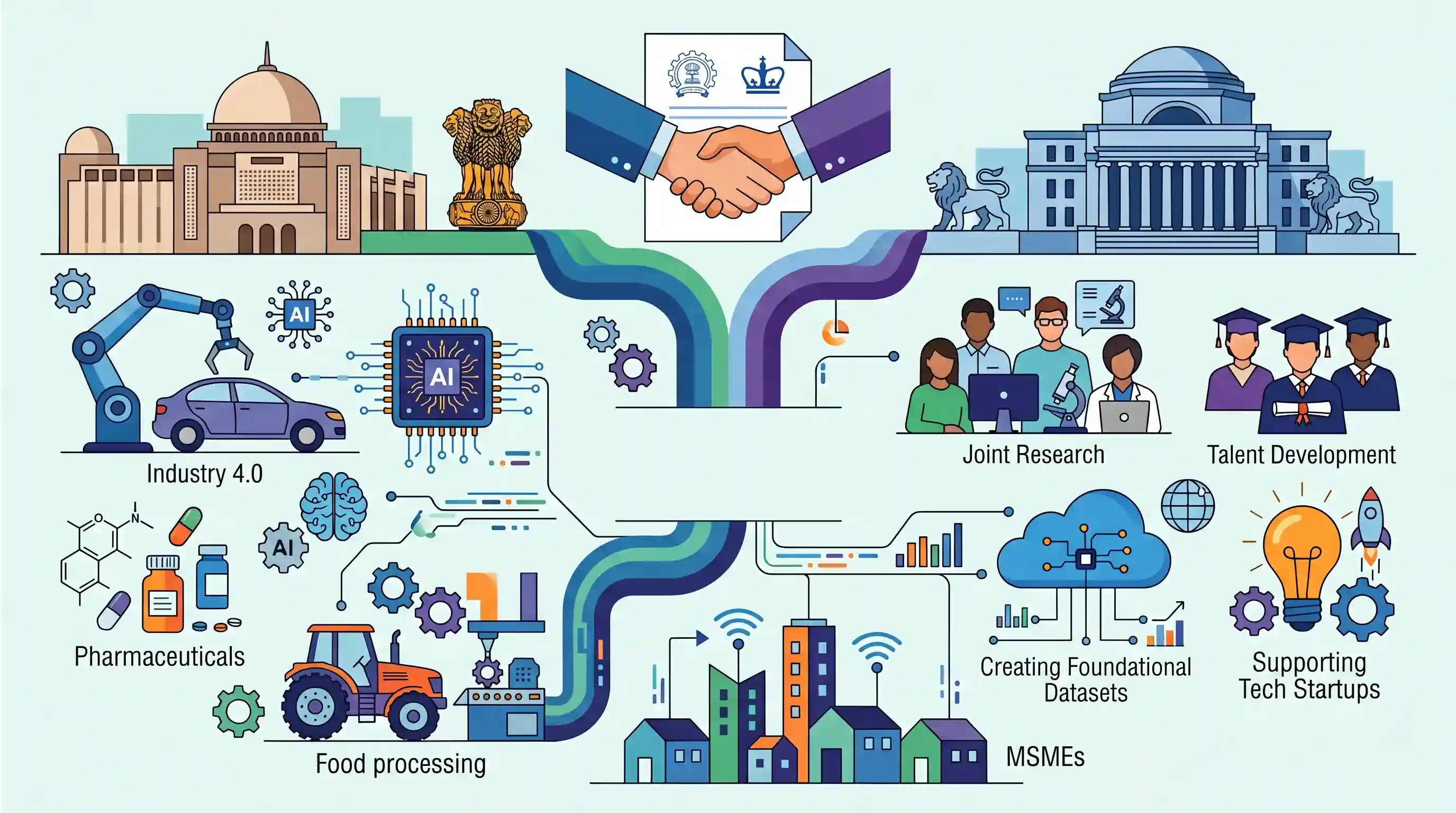
Why It Matters
It highlights India's strategic push to leverage Artificial Intelligence (Industry 4.0) to boost its manufacturing capabilities, supporting the MSME sector, and facilitating cross-border academic research for technological advancement.
Summary
IIT Bombay and Columbia University signed an MoU to establish the Columbia–IIT Bombay Centre of AI for Manufacturing, backed by the Indian government. The centre aims to accelerate the deployment of Artificial Intelligence in manufacturing sectors such as semiconductors, pharmaceuticals, robotics, and food processing. The collaboration focuses on joint research, talent development, supporting tech startups, and creating foundational datasets to aid MSMEs in technology adoption.
Key Points
- IIT Bombay and Columbia University have established a joint Centre of AI for Manufacturing to integrate Artificial Intelligence into industrial production.
- The initiative aligns with the Indian government's push to set up AI centres of excellence for critical sectors.
- The centre's focus areas include AI applications in semiconductors, robotics, pharmaceuticals, and food processing.
- A major objective is to develop foundational AI datasets and models as public goods, thereby assisting MSMEs in adopting advanced manufacturing technologies.
- The partnership will also foster joint academic research, talent development, and tech startup incubation.
Important Terms
Columbia–IIT Bombay Centre of AI for Manufacturing

A joint research and translation hub established to apply AI in manufacturing sectors like semiconductors and robotics, focusing on industrial modernization, talent development, and MSME empowerment.
UPSC context
GS Paper 2 (International Relations) & GS Paper 3 (Science & Technology; Industrial Growth).
Industry 4.0
The 4th Industrial Revolution involving the integration of digital technologies like AI, IoT, and robotics into manufacturing to create interconnected, autonomous 'smart factories'.
UPSC context
GS Paper 3 (Indian Economy; Changes in industrial policy).
MSME Sector
Enterprises contributing ~30% to India's GDP; the MoU aims to assist them in adopting AI technologies through foundational datasets and interoperable industrial infrastructure.
UPSC context
GS Paper 3 (Economy; Inclusive Growth; Employment).
India Semiconductor Mission (ISM)
A specialized division within Digital India Corporation aiming to build a vibrant semiconductor ecosystem, identified as a key application area for the new AI centre.
UPSC context
GS Paper 3 (Science & Technology; Indigenous manufacturing).
Artificial Intelligence (AI) in Manufacturing
Simulation of human intelligence by machines to optimize industrial shop-floors through predictive maintenance, real-time decision-making, and quality control.
UPSC context
GS Paper 3 (S&T; Developments in AI and their effects).
Prelims Trap
The 'Make AI in India' initiative mandates that AI Centres of Excellence be established exclusively with indigenous technology partners.
Aspirants often assume 'Make in India' umbrellas strictly prohibit foreign tie-ups, missing that global academic collaborations are actively funded and encouraged.
Static Concepts Connected
What characterizes Industry 4.0 in the manufacturing sector?
- Cyber-physical systems: Integrating computation, networking, and physical manufacturing processes directly on the shop floor.
- Internet of Things (IoT): Collecting and analyzing real-time data from legacy machinery using widespread sensor networks.
- Cognitive computing: Using Artificial Intelligence to filter noisy production data, optimize supply chains, and automate decision-making.
How are MSMEs currently defined and what is their economic significance?
- Composite definition: Classification is now based on a composite criteria of both Investment in Plant & Machinery and Annual Turnover.
- Manufacturing GVA: The sector contributes approximately 30-35% to India's manufacturing Gross Value Added (GVA).
- Employment generator: It remains the second-largest employment generator in the Indian economy after agriculture.
Cross-Topic Patterns
DPI expanding from Fintech to AI
India is applying its successful Digital Public Infrastructure (UPI, Aadhaar) playbook to AI by developing foundational datasets and models as open-source public goods to lower adoption costs for MSMEs.
iCET shaping bilateral academic tech collaborations
Academic tie-ups like the IIT Bombay-Columbia AI Centre are direct functional spill-overs of the broader Indo-US Initiative on Critical and Emerging Technology (iCET) focusing on semiconductors, AI, and robotics.

Expect a multi-statement Prelims question linking 'Make AI in India' to open-source digital public goods and MSME tech adoption.
Linked PYQs · 3
Linked PYQs · 3
- 2020PrelimsGS1
With the present state of development, Artificial Intelligence can effectively do which of the following? 1. Bring down electricity consumption in industrial units 2. Create meaningful short stories and songs 3. Disease diagnosis 4. Text-to-Speech Conversion 5. Wireless transmission of electrical energy Select the correct answer using the code given below:
- 2023MainsGS3
Faster economic growth requires increased share of the manufacturing sector in GDP, particularly of MSMEs. Comment on the present policies of the Government in this regard.
- 2023MainsGS3
Introduce the concept of Artificial Intelligence (AI). How does Al help clinical diagnosis? Do you perceive any threat to privacy of the individual in the use of Al in healthcare?
