माइक्रोग्रैविटी अनुसंधान और अंतरिक्ष बीज विश्लेषण पहल
स्रोत:द हिंदू ↗
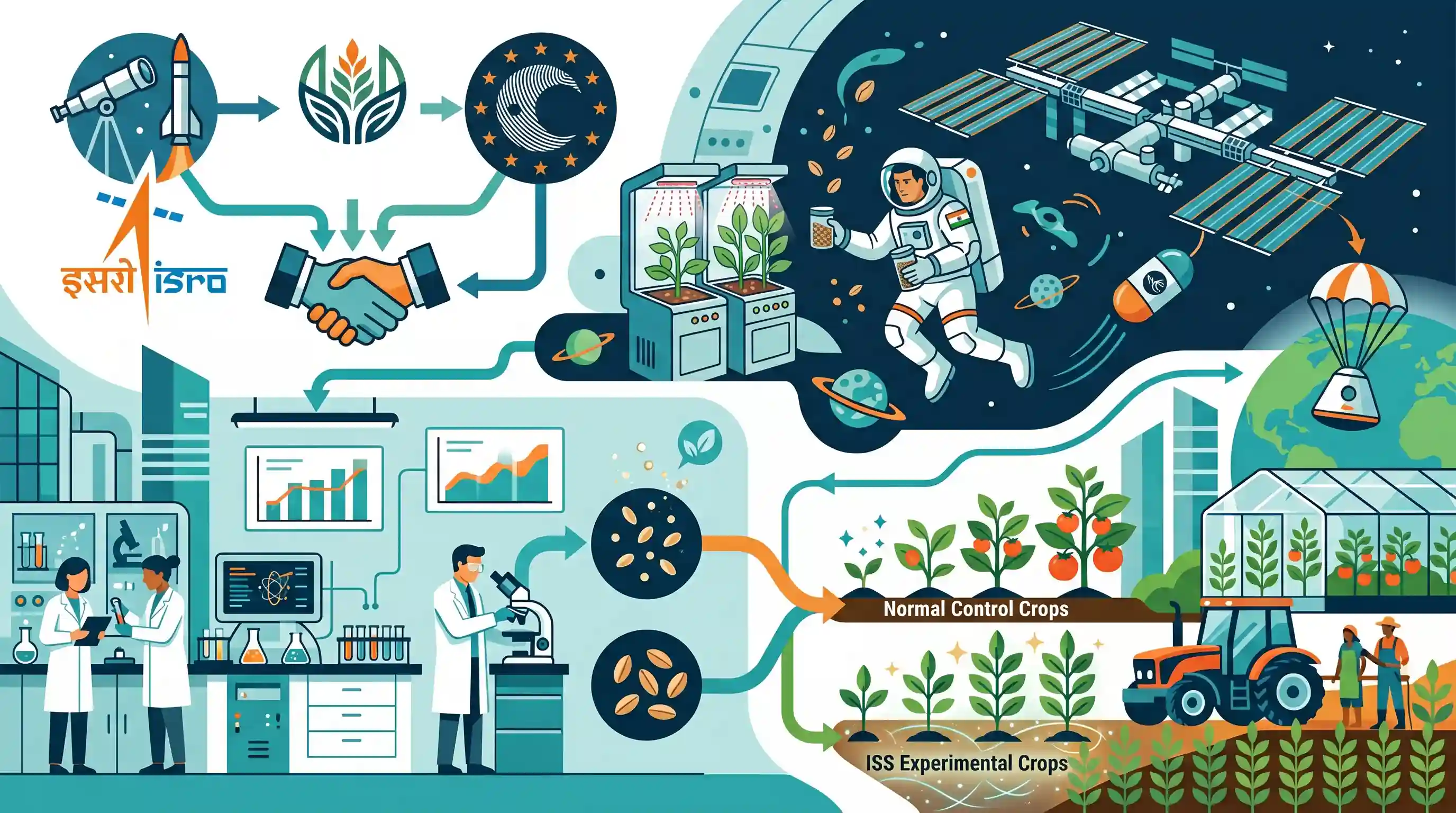
क्यों मायने रखता है
Demonstrates India's strategic push towards microgravity research and space biology as part of human spaceflight missions. It emphasizes the practical applications of space technology in agriculture, which is critical for future food security and space colonization efforts.
सारांश
Researchers from the Indian Institute of Space Science and Technology (IIST) and Kerala Agricultural University (KAU) are preparing to study agricultural seeds that were exposed to microgravity on the International Space Station (ISS) during the Axiom-4 mission. The 'Crop Seeds on ISS' project, utilizing multi-agency collaboration including ISRO and the European Space Agency, aims to assess how microgravity affects crop growth and yield. Group Captain Shubhanshu Shukla, who conducted multiple experiments on the ISS, is bringing the seeds back to Earth for comparative analysis against normal samples.
मुख्य बिंदु
- The Indian Institute of Space Science and Technology (IIST) and Kerala Agricultural University (KAU) are preparing to study seeds returned from the International Space Station (ISS).
- Seeds of rice, horse gram, tomato, sesame, and brinjal were exposed to microgravity under the 'Crop Seeds on ISS' project as part of the Axiom-4 mission.
- Group Captain Shubhanshu Shukla completed microgravity experiments on the ISS and is returning the seeds to Earth for post-flight studies.
- The project will assess the unique effects of microgravity on plant growth and yield, using multi-level collaborations between ISRO, ESA, IIST, and KAU.
महत्वपूर्ण शब्द
Axiom-4 mission

A private-led mission to the International Space Station involving an ISRO astronaut as a pilot to conduct microgravity experiments and gain operational experience for India’s Gaganyaan mission.
UPSC context
GS Paper 3 (S&T); crucial for understanding India’s international space collaborations and the roadmap toward indigenous human spaceflight (Gaganyaan).
Crop Seeds on ISS project
A collaborative initiative by IIST, KAU, ISRO, and ESA that sent indigenous Indian crop seeds to the ISS to study microgravity's impact on germination and growth.
UPSC context
GS Paper 3 (S&T, Agriculture); tests knowledge of space biology, sustainable food systems, and climate-resilient crop development.
भारतीय अंतरिक्ष विज्ञान और प्रौद्योगिकी संस्थान (IIST)
Asia’s first space university, an autonomous "Deemed to be University" under the Department of Space, Thiruvananthapuram, focused on aerospace engineering and space science research.
UPSC context
GS Paper 3 (S&T Institutions); important for questions on India’s institutional framework for space research and human resource development.
Human Spaceflight Centre (HSFC)
A specialized ISRO wing in Bengaluru responsible for implementing the Gaganyaan project and coordinating human spaceflight activities, including international astronaut training.
UPSC context
GS Paper 3 (S&T); specific knowledge on ISRO’s organizational structure and its role in milestone human space missions.
Kerala Agricultural University (KAU)
A state agricultural university in Kerala that provided high-yielding crop varieties for space-based experiments, demonstrating regional-national collaboration in advanced research.
UPSC context
GS Paper 3 (S&T); illustrates inter-disciplinary research between regional agricultural centers and national space agencies for technological self-reliance.
International Space Station (ISS)
A modular space station in low Earth orbit serving as a unique microgravity and space environment research laboratory for international scientific collaboration.
UPSC context
GS Paper 3 (S&T); the foundational platform for international space cooperation and advanced microgravity research.
प्रारंभिक ट्रैप
Axiom-4 was an indigenous ISRO mission to study the effects of space mutagenesis on Indian agricultural seeds.
Axiom-4, Axiom Space (US) द्वारा संचालित ISS के लिए एक वाणिज्यिक अंतरिक्ष उड़ान है। भारतीय अंतरिक्ष यात्री ने NASA-ISRO सहयोग समझौते के माध्यम से इसमें भाग लिया, न कि किसी स्वदेशी लॉन्च के माध्यम से।
संबंधित अवधारणाएँ
एस्ट्रोवॉटनी (Astrobotany) में स्पेस म्युटाजेनेसिस (Space Mutagenesis) क्या है?
- ब्रह्मांडीय विकिरण: Seeds are exposed to high-energy cosmic rays in space, which accelerates the rate of genetic mutations compared to traditional breeding on Earth.
- Microgravity stress: Altered gravity induces stress responses in seeds, potentially triggering epigenetic changes that result in favorable traits like drought resistance or faster growth upon Earth cultivation.
Is there "zero gravity" on the International Space Station (ISS)?
- Persistent gravity: Earth's gravity at the altitude of the ISS (approx. 400 km) is still about 90% as strong as it is on the surface.
- Microgravity condition: The ISS experiences microgravity, not zero gravity. It is in continuous free-fall around the Earth, making objects and astronauts inside appear weightless.
अंतर-विषय पैटर्न
Space tech meets climate agriculture
Utilizing cosmic radiation for induced mutation provides a faster alternative to traditional breeding, aiding the development of climate-resilient and pest-resistant crop varieties.
Axiom-4 as Gaganyaan precursor
India's participation in commercial ISS missions (Axiom) directly supports the Gaganyaan program by providing critical microgravity operational experience and human spaceflight training.

2026 में 'Space Mutagenesis' पर एक बहु-कथनीय S&T प्रश्न की अपेक्षा करें, जो माइक्रोग्रैविटी एक्सपोजर को जलवायु-अनुकूल फसल विकास (climate-resilient crop development) से जोड़ता हो।
संबद्ध PYQ · 3
संबद्ध PYQ · 3
- 2025PrelimsGS1
Consider the following space missions : I. Axiom-4 II. SpaDeX III. Gaganyaan How many of the space missions given above encourage and support micro-gravity research?
- 2017MainsGS3
India has achieved remarkable successes in unmanned space missions including the Chandrayaan and Mars Orbitter Mission, but has not ventured into manned space missions. What are the main obstacles to launching a manned space mission, both in terms of technology and logistics? Examine critically.
- 2020MainsGS3
How is science interwoven deeply with our lives? What are the striking changes in agriculture triggered off by the science-based technologies?
