IISc Study on Magnetic Fields and Chandrasekhar Limit
Source:The Hindu ↗
ఇది ఎందుకు ముఖ్యం
It updates fundamental astrophysical concepts related to stellar evolution, the Chandrasekhar limit, and standard candles used in measuring cosmic distances, which frequently feature in Prelims science and technology questions.
సారాంశం
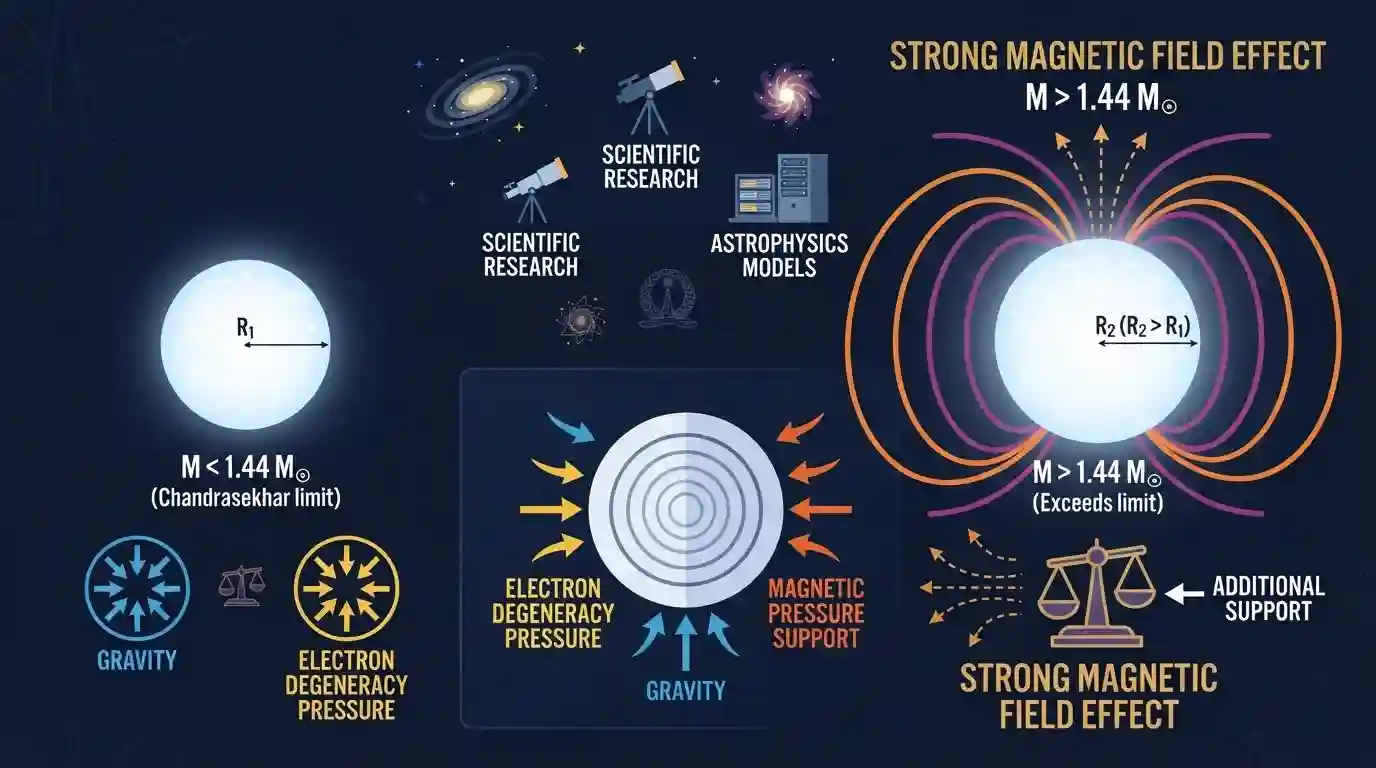
Researchers at the Indian Institute of Science (IISc) have published a study indicating that strong magnetic fields can enable white dwarf stars to exceed the classical Chandrasekhar limit (1.44 solar masses). By altering the pressure balance inside the star, powerful magnetic fields provide additional support against gravitational collapse, which impacts astrophysics models regarding white dwarfs and Type Ia supernovae.
ముఖ్య అంశాలు
- A recent study by researchers at the Indian Institute of Science (IISc) suggests that extremely strong magnetic fields could allow white dwarf stars to grow beyond the traditional Chandrasekhar limit.
- The Chandrasekhar limit is the maximum mass a stable white dwarf star can possess, approximately 1.44 times the mass of the Sun, beyond which it would typically collapse or explode into a Type Ia supernova.
- Magnetic fields introduce additional pressure and support, modifying the balance of gravitational and electron degeneracy pressures that govern white dwarf stability.
- This finding has implications for understanding stellar evolution, supernovae, and using Type Ia supernovae as standard candles for measuring cosmic distances.
ముఖ్యమైన పదాలు
Indian Institute of Science (IISc)

A premier public deemed research university located in Bengaluru, India, established in 1909 through a partnership between the industrialist Jamsetji Tata, the Maharaja of Mysore, and the Government of India.
UPSC context
GS Paper III (Science and Technology - Awareness in IT, Space, Computers, Robotics, Nano-technology, bio-technology). Tests institutional contributions to advanced scientific research.
ప్రిలిమ్స్ ఉచ్చు
no white dwarf star can under any physical conditions exceed the classical Chandrasekhar limit of 1.44 solar masses
The Chandrasekhar limit is not an absolute immutable law of nature under all physical conditions; extreme magnetic fields can alter the pressure balance and modify this limit.
అనుసంధానమైన స్థిర భావనలు
What is the Chandrasekhar limit and how do white dwarfs maintain their stability?
- Mass threshold: Approximately 1.44 times the mass of the Sun, calculated by Nobel laureate Subrahmanyan Chandrasekhar.
- Pressure balance: Maintained by a balance between inward gravitational force and outward electron degeneracy pressure arising from quantum mechanics (Pauli exclusion principle).
- Supernova trigger: Exceeding this limit traditionally leads to gravitational collapse, triggering a Type Ia supernova explosion used as a cosmic standard candle.
అంతర-అంశ నమూనాలు
Indigenous scientific research in astrophysics
Indian research institutions like IISc frequently feature in GS-3 science and tech questions testing indigenous contributions to advanced astrophysics and fundamental physics.

Expect statement-based questions on the Chandrasekhar limit, electron degeneracy pressure, and factors modifying stellar stability.
అనుసంధాన PYQలు · 2
అనుసంధాన PYQలు · 2
- 2009PrelimsGS1
Who of the following scientists proved that the stars with mass less than 1.44 times the mass of the Sun end up as White Dwarfs when they die?
- 2023PrelimsGS1
Consider the following pairs: Objects in space Description 1. Cepheids: Giant clouds of dust and gas in space 2. Nebulae: Stars which brighten and dim periodically 3. Pulsars: Neutron stars that are formed when massive stars run out of fuel and collapse How many of the above pairs are correctly matched?
