Scientific Research Must Serve as Public Good for Society
Source:Indian Express ↗
Why It Matters
This article provides critical conceptual quotes and empirical evidence for UPSC Main answers (GS3 S&T, Infrastructure, and Essay). Dr. Swaminathan's vision of 'science as a public good' and 'interdisciplinary research' is highly relevant for questions on science policy and societal development. Dr. Narayanan's rural electrification statistics serve as excellent data points for essays and GS3 answers discussing post-Independence developmental achievements and infrastructure progress.
Summary
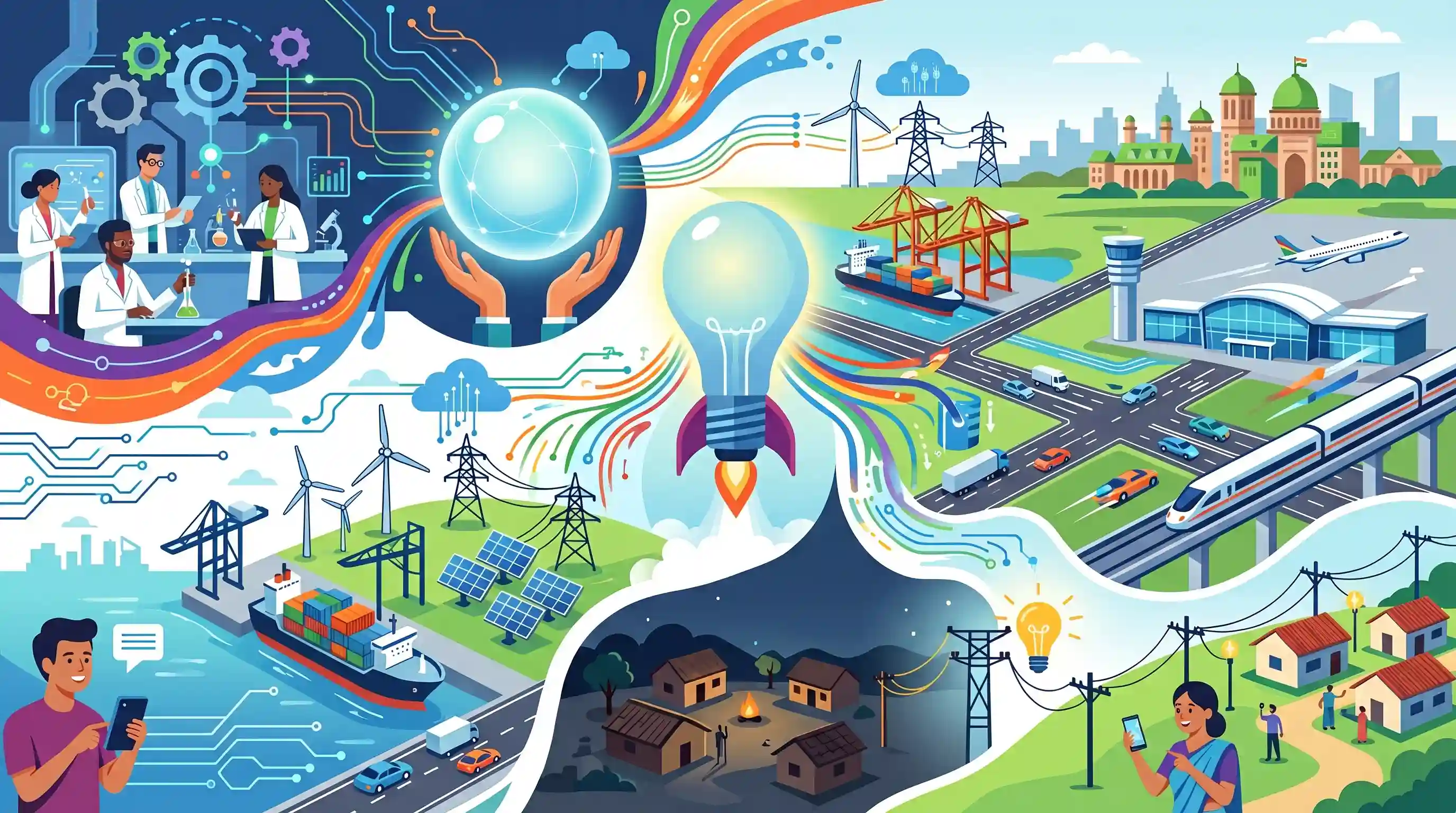
During the 2026 convocation of the Indian Institute of Science (IISc), Bengaluru, prominent leaders from India's scientific community delivered inspiring addresses on the role of science and infrastructure in nation-building. Chief Guest Dr. Soumya Swaminathan (former WHO Chief Scientist and Chairperson of MSSRF) argued that science must be pursued as a 'public good' and emphasized the vital importance of interdisciplinary collaboration for future breakthroughs. Guest of Honour and ISRO Chairman Dr. V. Narayanan reflected on India's post-Independence infrastructure triumph—noting the near-universal rural electrification of the nation from just over 3,000 villages at Independence—while highlighting the necessity of gratitude and lifelong learning.
Key Points
- Science as a Public Good: Dr. Soumya Swaminathan emphasized that science must transcend abstract pursuit and serve as a tangible public good to address critical human and social challenges.
- Interdisciplinary Research: Major breakthrough discoveries in the future will happen at the intersections of different scientific disciplines rather than within traditional academic silos. Collaboration is the cornerstone of modern research.
- Post-Independence Infrastructure: ISRO Chairman Dr. V. Narayanan highlighted India's rapid development by contrasting rural electrification at Independence (only 3,061 villages electrified) with the present day, where every village in India is electrified.
- Culture of Gratitude and Lifelong Learning: Dr. Narayanan advised graduating students that learning must be a continuous process to avoid intellectual obsolescence, and underscored the importance of acknowledging the collective contribution of all support staff (including teachers, parents, and campus workers) in academic success.
Important Terms
Indian Institute of Science (IISc), Bengaluru

A premier public research university in India, established in 1909 with the support of Jamsetji Tata, globally recognized for its pioneering research, innovation, and postgraduate education in science and engineering.
UPSC context
GS Paper III (S&T / Education). Evaluates academic infrastructure, research capabilities, and national developmental innovation.
Indian Space Research Organisation (ISRO)
The national space agency of India, established in 1969, responsible for space exploration, satellite launch systems, and utilizing space technology for socioeconomic development.
UPSC context
GS Paper III (S&T). Tests indigenous technological development, space policy, and socio-economic applications of space missions.
M S Swaminathan Research Foundation (MSSRF)
A non-profit NGO established in 1988 by Dr. M. S. Swaminathan, focused on leveraging modern science and technology for sustainable agriculture and rural development.
UPSC context
GS Paper III (Agriculture/Food Security). Analyzes ecotechnological models for rural livelihood, biodiversity conservation, and hunger alleviation.
World Health Organization (WHO)
A specialized agency of the United Nations established in 1948, tasked with directing and coordinating international public health, setting global standards, and leading emergency health responses.
UPSC context
GS Paper II (IR / Health policy). Assesses global health governance, institutional structures, and multinational pandemic management.
Prelims Trap
Achieving 100% village electrification in India meant that every rural household was successfully connected to the power grid.
Village electrification under Ministry of Power guidelines requires only 10% of households to be connected, not 100%. Universal household connection was the separate mandate of the Saubhagya Scheme.
Static Concepts Connected
What criteria define an "electrified village" under Ministry of Power guidelines?
- Basic Infrastructure: Basic distribution transformer and electricity lines must be available in the inhabited locality, including Dalit hamlets if any.
- Public Places: Electricity must be provided to public places including schools, panchayat offices, health centers, community centers, and dispensaries.
- Household Threshold: At least 10% of the total number of households in the village must have documented electricity connections.
What is India's Scientific Social Responsibility (SSR) framework?
- Institutional Mandate: Released in 2022 by the Department of Science and Technology to build a mechanism for sharing scientific infrastructure and knowledge with society.
- Time Commitment: Every scientific "knowledge worker" (scientists, researchers) is expected to voluntarily contribute at least 10 person-days per year to societal outreach.
- Constitutional Link: Draws ethical legitimacy from Article 51A(h) of the Constitution, which establishes the development of scientific temper as a Fundamental Duty.
Cross-Topic Patterns
SSR guidelines and constitutional duties
Linking the Department of Science and Technology's SSR Guidelines with Article 51A(h) demonstrates how non-justiciable Fundamental Duties are operationalized through executive policy frameworks.
Electrification metrics vs energy security
Comparing the 10% household threshold for village electrification with Saubhagya's universal household target highlights the critical difference between basic infrastructure connectivity and actual domestic energy security.

UPSC may couple the criteria for village electrification with the operational mandates of the 2022 Scientific Social Responsibility guidelines.
Linked PYQs · 2
Linked PYQs · 2
- 2020MainsGS3
How is science interwoven deeply with our lives? What are the striking changes in agriculture triggered off by the science-based technologies?
- 2021MainsGS3
What are the research and developmental achievements in applied biotechnology? How will these achievements help to uplift the poorer sections of the society?
