Industrial Growth Moderates as Rural Consumption Shows Sluggishness
Source:The Hindu ↗
Why It Matters
The article is highly relevant for understanding the structural divergences in India's macroeconomic recovery. It provides factual data on IIP components (essential for Prelims) and structural insights into rural distress, the K-shaped consumption split, and the mismatch between robust capital expenditure and sluggish private final consumption expenditure (crucial for Mains GS3).
Summary
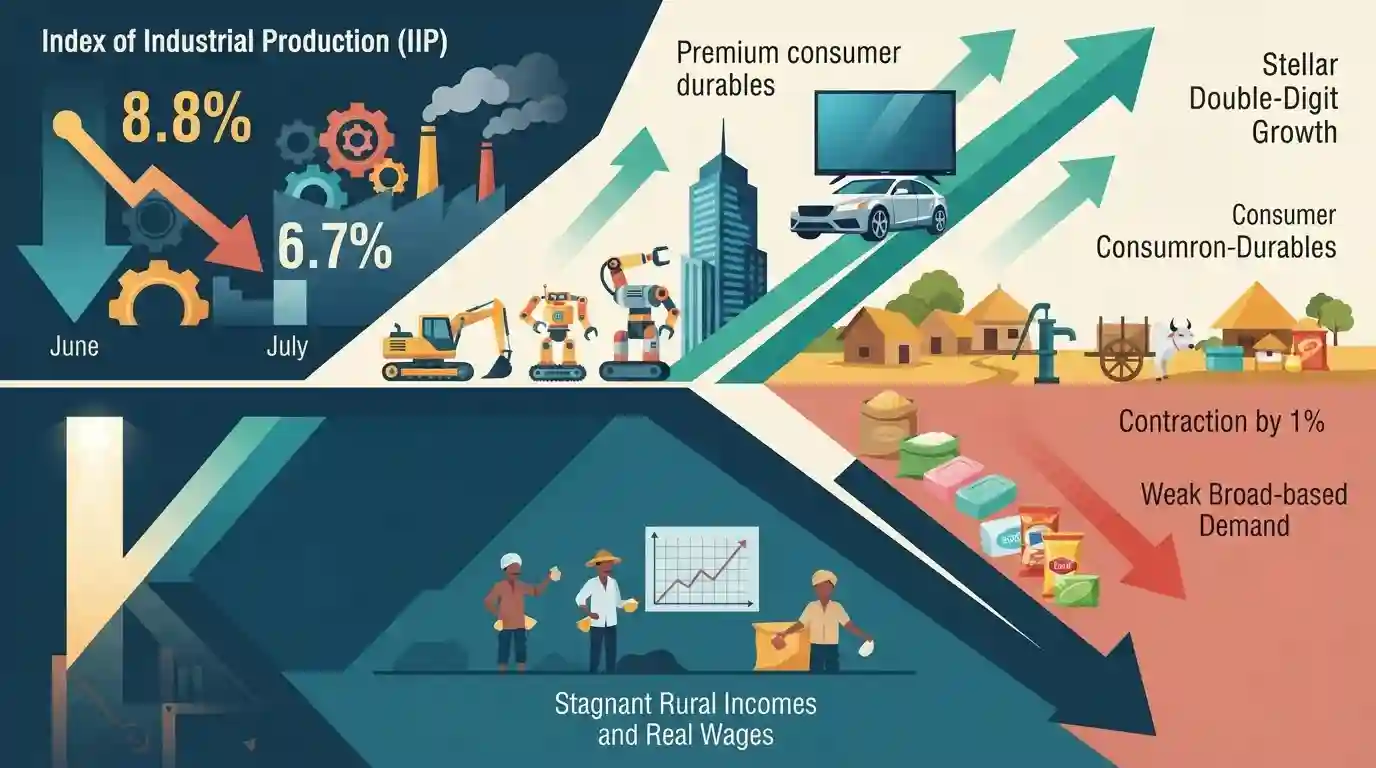
India's industrial growth (IIP) moderated to 6.7% in July 2026 from 8.8% in June. While capital goods and high-end consumer durables showed stellar double-digit growth, consumer non-durables (everyday household goods) contracted by 1%. Economists warn that this stark consumption divergence reflects stagnant rural incomes and real wages, indicating an uneven (K-shaped) economic recovery where high-end discretionary demand thrives while broad-based rural consumption remains weak.
Key Points
- India's Index of Industrial Production (IIP) growth slowed to 6.7% in July 2026 from a revised 8.8% in June. This is still the second-highest growth registered since December last year.
- The data highlights a stark 'consumption split' or divergence: high-end discretionary spending (consumer durables like vehicles and appliances) grew by 10.5%, whereas everyday essentials (consumer non-durables like food and toiletries) fell by 1%.
- This consumption divergence is linked directly to stagnant real wages and sluggish rural incomes, indicating that the headline IIP growth of 6.7% may overstate the actual breadth of the economic recovery.
- The capital goods sector, which reflects investment and asset creation, grew by 16.1% in July 2026. This marks its fourth consecutive month of double-digit growth and ninth in the last 12 months, indicating robust capital formation.
- Other sectors showed mixed performance: manufacturing grew by 7.3% (led by electrical equipment up 28.3% and motor vehicles up 22.2%), infrastructure/construction grew 6.9%, while mining contracted by 0.9% and clothing/apparel fell 0.6%.
Important Terms
Index of Industrial Production (IIP)

A monthly macroeconomic indicator measuring short-term changes in the volume of industrial production in India compared to a baseline year, tracking sectors like manufacturing, mining, electricity, and utilities.
UPSC context
GS Paper 3 (Indian Economy); tests indicators of industrial growth, GDP estimation inputs, and business cycle analysis.
K-Shaped Recovery
An economic post-recession scenario where different sectors, industries, or social groups recover at diverging rates and magnitudes, with some thriving while others continue to decline.
UPSC context
GS Paper 3 (Indian Economy); crucial for analyzing post-crisis growth patterns, income inequality, and targeted policy interventions.
National Statistical Office (NSO)
India's nodal statistical agency under MoSPI, formed in 2019 by merging CSO and NSSO, responsible for compiling national income accounts, GDP, and macroeconomic indices.
UPSC context
GS Paper 3 (Economy); tested under planning, economic data systems, and key institutions involved in national income estimation.
Ministry of Statistics and Programme Implementation (MoSPI)
The nodal ministry of the Government of India responsible for statistical development, publishing national macroeconomic accounts, and monitoring central sector infrastructure projects.
UPSC context
GS Paper 3 (Economy); essential for understanding government institutions involved in data collection, planning, and public expenditure monitoring.
Prelims Trap
The Index of Eight Core Industries and the broad IIP are both compiled and released monthly by the National Statistical Office (NSO).
While the IIP is compiled and released by the NSO (MoSPI), the Index of Eight Core Industries (which makes up over 40% of the IIP) is released by the Office of the Economic Adviser, DPIIT (Ministry of Commerce & Industry).
Static Concepts Connected
What is the classification structure and weight distribution of the Index of Industrial Production (IIP)?
- Sectoral Weights: Manufacturing is dominant at 77.63%, followed by Mining at 14.37%, and Electricity at 7.99%.
- Use-Based Weights: Divided into six categories: Primary Goods has the highest weight (~34.05%), while Capital Goods has the lowest (~8.22%).
- Base Year: Currently 2011-12, with an ongoing transition to 2022-23 using the Geometric Mean method to avoid extreme outlier distortions.
What are the Eight Core Industries in India and how do their weights stack up?
- IIP Share: They represent the capital and infrastructure backbone of the economy, collectively accounting for 40.27% of the total IIP weight.
- Descending Weights: Petroleum Refinery Products (highest, 28.04%), Electricity (19.85%), Steel (17.92%), Coal (10.33%), Crude Oil (8.98%), Natural Gas (6.88%), Cement (5.37%), and Fertilizers (lowest, 2.63%).
- Publishing Authority: Compiled and released monthly by the Office of the Economic Adviser, DPIIT, Ministry of Commerce and Industry.
Cross-Topic Patterns
K-Shaped Recovery vs Inclusive Growth
Divergence between luxury durables and FMCG essentials reflects widening inequality, challenging GS3 goals of balanced, multi-dimensional inclusive development.
Rural Real Wages and FMCG Demand
Stagnant agricultural wages and high rural food inflation suppress non-durable consumption, exposing structural limitations in agrarian safety nets like MGNREGS.

Expect questions parsing the structural weights of IIP use-based categories or the institutional divergence in releasing core sector data.
Linked PYQs · 4
Linked PYQs · 4
- 2015PrelimsGS1
In the 'Index of Eight Core Industries', which one of the following is given the highest weight?
- 2012PrelimsGS1
In India, in the overall Index of Industrial Production, the Indices of Eight Core Industries have a combined weight of 37.90%. Which of the following are among those Eight Core Industries? 1. Cement 2. Fertilizers 3. Natural gas 4. Refinery products 5. Textiles Select the correct answer using the codes given below:
- 2020MainsGS3
Explain the meaning of investment in an economy in terms of capital formation. Discuss the factors to be considered while designing a concession agreement between a public entity and a private entity.
- 2022MainsGS3
Economic growth in the recent past has been led by increase in labour productivity." Explain this statement. Suggest the growth pattern that will lead to creation of more jobs without compromising labour productivity.
