India industrial output growth reaches five-month high in May
Source:The Hindu ↗
Why It Matters
Understanding the components, base years, and calculation methodologies of macroeconomic indicators like IIP, WPI, and PPI is crucial for Prelims. The shift from WPI to PPI as an IIP deflator is a significant statistical reform that candidates must be aware of.
Summary
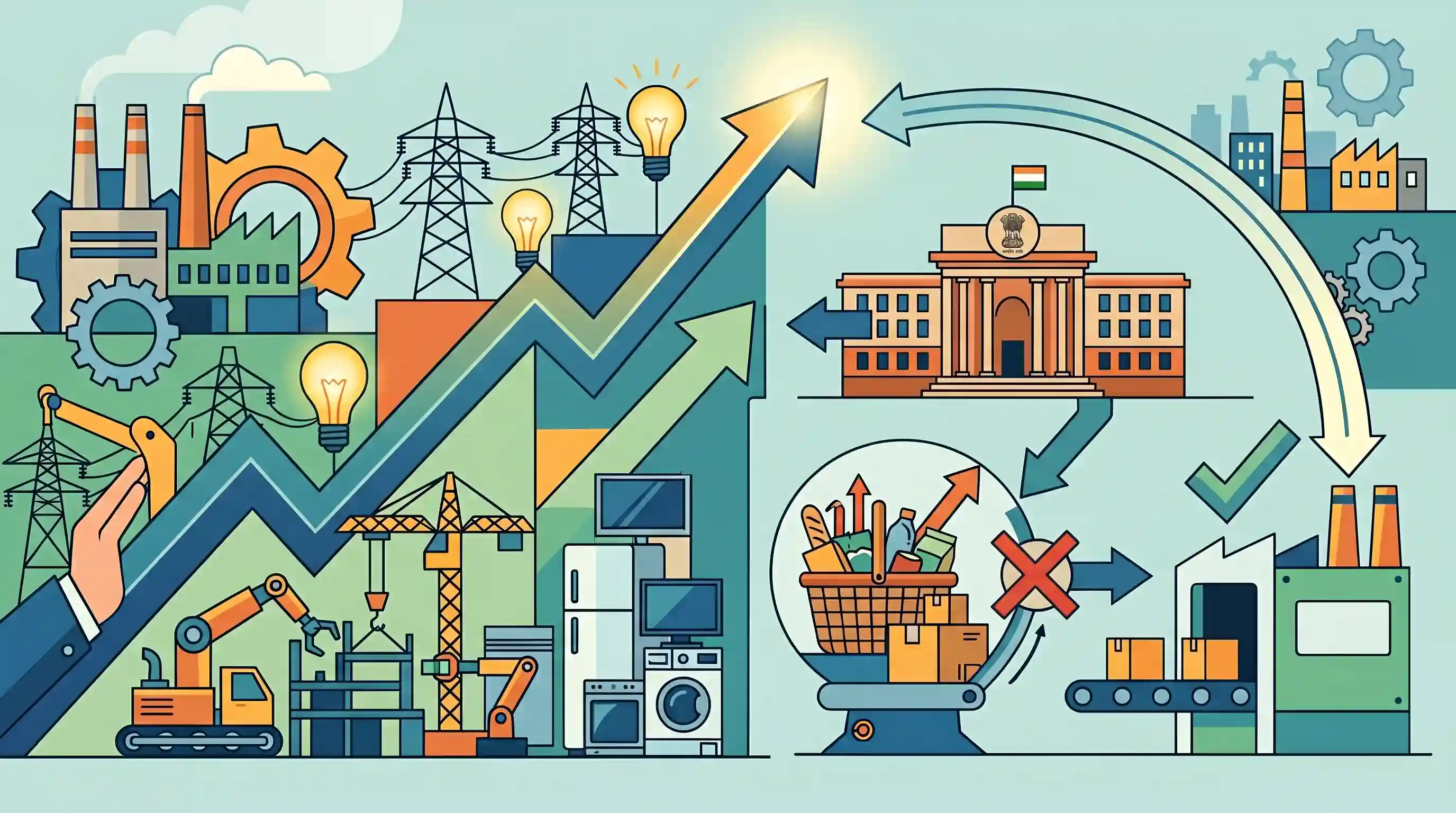
India's industrial output, measured by the Index of Industrial Production (IIP), grew by a five-month high of 5.1% in May 2026, supported by robust performances in manufacturing, electricity, capital goods, and consumer durables. Concurrently, the Ministry of Statistics and Programme Implementation (MoSPI) implemented a revised IIP series with a 2022-23 base year. A pivotal methodological change in this update involves replacing the Wholesale Price Index (WPI) with the Producer Price Index (PPI) as the deflator for value-based calculations, a move designed to yield a more accurate reflection of industrial growth by tracking factory-gate prices.
Key Points
- India's Index of Industrial Production (IIP) growth accelerated to a five-month high of 5.1% in May 2026, driven by a rebound in manufacturing and electricity sectors.
- The Ministry of Statistics and Programme Implementation (MoSPI) introduced a tweaked IIP series utilizing a new base year of 2022-23.
- The updated methodology shifts from using the Wholesale Price Index (WPI) to the Producer Price Index (PPI) as a deflator for measuring certain value-based industrial outputs.
- Growth was broad-based, with notable improvements in capital goods, consumer durables, and infrastructure sectors compared to earlier months.
Important Terms
Index of Industrial Production (IIP)

A monthly economic indicator tracking the volume changes in industrial production across sectors like manufacturing, mining, and electricity, used to gauge short-term industrial performance.
UPSC context
GS Paper 3: Economic Development. Tests understanding of macroeconomic indicators and industrial growth trends.
Ministry of Statistics and Programme Implementation (MoSPI)
The nodal central ministry responsible for the coverage and publication of industrial statistics (IIP) and national accounts (GDP) through the National Statistical Office (NSO).
UPSC context
GS Paper 2: Governance/Statutory Bodies. Tests knowledge of the institutional framework for Indian economic data.
Producer Price Index (PPI)
A price index measuring average changes in prices received by domestic producers for their output, excluding taxes and trade margins, reflecting 'factory-gate' price movements.
UPSC context
GS Paper 3: Indian Economy. Key for understanding inflation measurement shifts from WPI to global standards.
Wholesale Price Index (WPI)
An index measuring the change in the price of goods traded in bulk by wholesale intermediaries, traditionally used as the primary measure of producer inflation in India.
UPSC context
GS Paper 3: Inflation. Important for comparing different price indices and their impact on monetary policy.
Deflator
A price index used to convert nominal value figures (at current prices) into real terms (constant prices) by stripping out the effects of price inflation.
UPSC context
GS Paper 3: National Income Accounting. Essential for understanding how 'real' versus 'nominal' growth is calculated.
Base Year
A specific year used as a benchmark for measuring economic changes; in the revised IIP series, 2022-23 serves as the reference point for all comparisons.
UPSC context
GS Paper 3: Economic Statistics. Tests knowledge of data recalibration and maintaining contemporary relevance in indicators.
Prelims Trap
"PPI measures price changes in physical goods only, and includes indirect taxes to reflect the true cost of production."
PPI encompasses both goods AND tradeable services, but strictly excludes indirect taxes and transport margins to measure pure factory-gate price realizations.
Static Concepts Connected
What are the key methodological differences between PPI and WPI?
- Sectoral coverage: PPI encompasses both physical goods and tradeable services, whereas WPI measures price changes strictly in physical goods.
- Tax treatment: PPI tracks basic factory-gate prices excluding indirect taxes and transport margins. WPI reflects bulk transaction prices.
- Deflator utility: PPI relies on pure producer realizations (supply side), making it a more accurate deflator for value-based industrial output than WPI.
What is the Index of Eight Core Industries and its relation to IIP?
- Weightage in IIP: It constitutes approximately 40.27% of the total weight of items included in the overall Index of Industrial Production (IIP).
- Highest/Lowest weights: Refinery products hold the highest weight, while fertilizers hold the lowest among the eight core sectors.
- Releasing Authority: Core Industries index is compiled by the Office of Economic Adviser (DPIIT), Ministry of Commerce, unlike IIP which is released by MoSPI.
Cross-Topic Patterns
Monetary Policy + Supply-side metrics
Shifting to a PPI-deflated IIP gives the RBI's Monetary Policy Committee a cleaner supply-side metric, stripping out indirect tax distortions when assessing core inflation trends.
National Accounts + Base Year revisions
The IIP base year shift to 2022-23 foreshadows parallel revisions for CPI, WPI, and National Accounts (GDP) to capture post-pandemic structural changes and emerging tech sectors.

Expect a multi-statement Prelims question contrasting PPI vs WPI methodologies, specifically testing the inclusion of services and taxes.
Linked PYQs · 4
Linked PYQs · 4
- 2015PrelimsGS1
In the 'Index of Eight Core Industries', which one of the following is given the highest weight?
- 2012PrelimsGS1
In India, in the overall Index of Industrial Production, the Indices of Eight Core Industries have a combined weight of 37.90%. Which of the following are among those Eight Core Industries? 1. Cement 2. Fertilizers 3. Natural gas 4. Refinery products 5. Textiles Select the correct answer using the codes given below:
- 2020PrelimsGS1
Consider the following statements: 1. The weightage of food in Consumer Price Index (CPI) is higher than that in Wholesale Price Index (WPI). 2. The WPI does not capture changes in the prices of services, which CPI does. 3. Reserve Bank of India has now adopted WPI as its key measure of inflation and to decide on changing the key policy rates. Which of the statements given above is/are correct?
- 2010PrelimsGS1
With reference to India, consider the following statements : 1. The Wholesale Price Index (WPI) in India is available on a monthly basis only. 2. As compared to Consumer Price Index for Industrial Workers (CPI(IW)), the WPI gives less weight to food articles. Which of the statements given above is/are correct ?
