IIM Kozhikode Launches Uyare Project for Women Entrepreneurs
Source:Indian Express ↗
Why It Matters
The initiative illustrates the practical application of capacity building for Self-Help Groups (SHGs) and grassroots women entrepreneurs, which is highly relevant for GS2 (Governance/Social Justice) and GS3 (Economy - Micro Enterprises). Understanding such models provides concrete case studies for answers on poverty alleviation, financial inclusion, and the role of institutions in community empowerment.
Summary
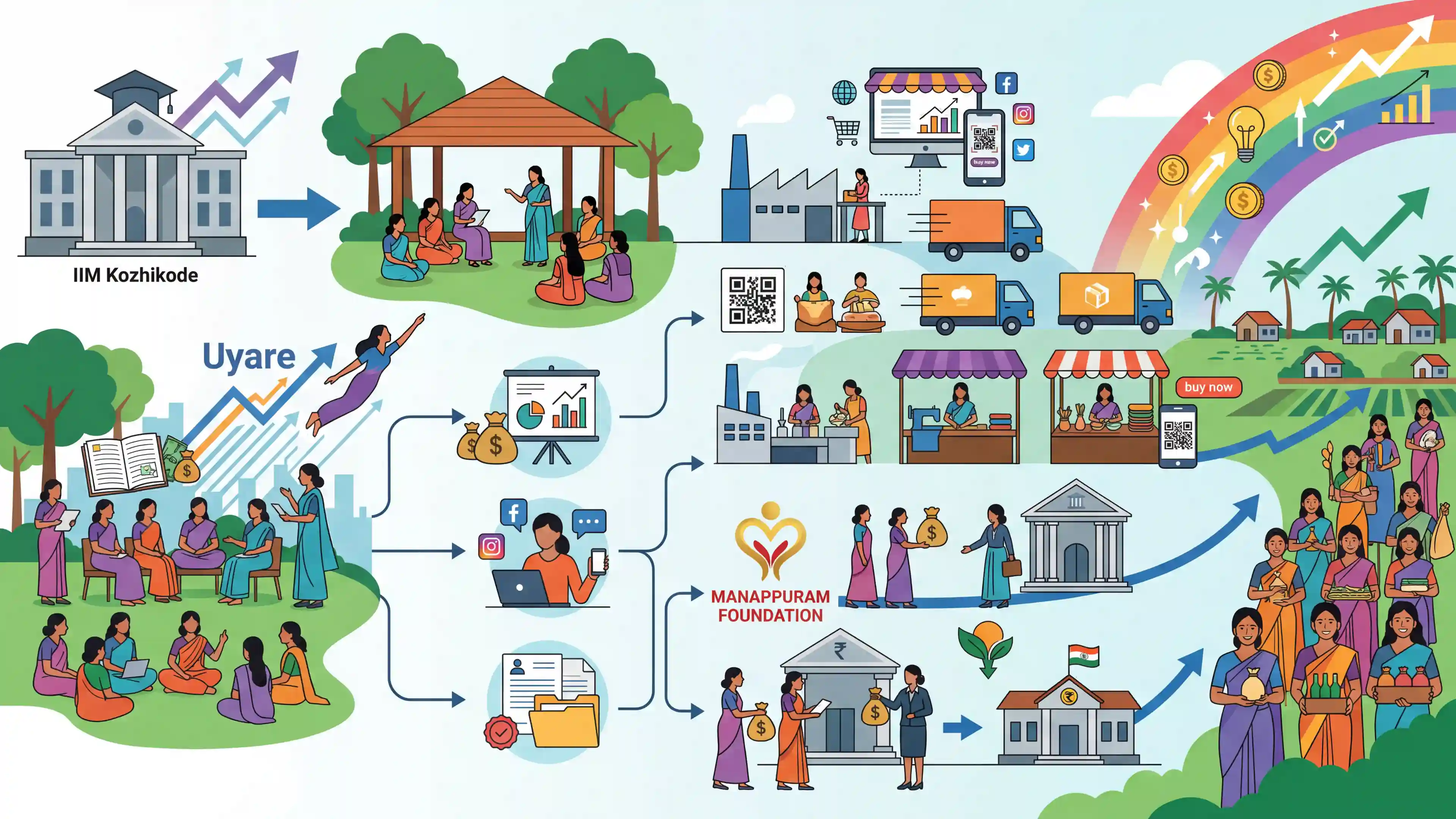
IIM Kozhikode has launched the 'Uyare' project, a research-led initiative designed to train and empower women entrepreneurs from the Kudumbashree network in Kerala. The program will equip around 700 women across 40 Gram Panchayats with essential business and managerial skills, including working capital management, digital marketing, and regulatory compliance. Supported by the Manappuram Foundation and local government bodies, the project focuses on improving operational efficiency, enhancing access to formal credit, and integrating rural micro-enterprises into digital marketplaces, thereby fostering grassroots economic development.
Key Points
- IIM Kozhikode has launched the 'Uyare' project to strengthen grassroots entrepreneurship among women associated with Kerala's Kudumbashree network.
- The initiative aims to train around 700 women entrepreneurs across 40 Gram Panchayats in Kozhikode and Malappuram districts in practical business skills.
- Training modules will cover business aspirations, working capital management, market and credit access, digital marketing, and legal compliance.
- The project seeks to generate research insights on targeted training and long-term support mechanisms for rural and semi-urban small-scale enterprises.
- Kudumbashree, a three-tiered network launched in 1997, covers over 48 lakh women and aims to eradicate poverty through empowerment.
Important Terms
Uyare project

A research-led initiative by IIM Kozhikode to train ~700 women entrepreneurs from Kerala's Kudumbashree network in business skills, digital marketing, and credit access.
UPSC context
GS Paper II & III: Evaluates 'Role of Higher Educational Institutions' and 'Social Innovation' in grassroots economic development.
Kudumbashree network
Kerala's three-tier women-led community network (Neighborhood Groups, Area Development Societies, and Community Development Societies) focused on poverty eradication and socio-economic empowerment.
UPSC context
GS Paper II: Significant for 'Self Help Groups (SHGs)' and 'Poverty Alleviation' topics. Often cited as a successful model.
District Industries Centre (DIC)
A district-level nodal agency under the Directorate of Industries and Commerce that provides support, registration, and credit guidance to Micro, Small, and Medium Enterprises (MSMEs).
UPSC context
GS Paper II & III: Relevant to 'Industrial Policy' and 'Institutional Framework' for micro-enterprises and local employment.
Kudumbashree District Mission
The administrative arm of the Kudumbashree Mission at the district level, responsible for implementing livelihood programs and facilitating credit for local women's collectives.
UPSC context
GS Paper II: Tests 'Decentralized Governance' and the role of district missions in welfare state functions.
Manappuram Foundation
The Corporate Social Responsibility (CSR) wing of Manappuram Finance, which sponsors social initiatives in education, health, and women’s economic development.
UPSC context
GS Paper IV: Illustrates 'Corporate Ethics' and the role of CSR in public-private partnerships for social justice.
Entrepreneurship Development Society (EDS)
The specialized implementing partner for the Uyare project, responsible for conducting grassroots-level capacity-building and business training sessions for rural entrepreneurs.
UPSC context
GS Paper III: Relevant to 'Skill Development' and 'Human Resource Development' strategies for the informal sector.
Prelims Trap
Kudumbashree is a Central Sector Scheme launched by the Ministry of Rural Development.
Kudumbashree is a Kerala State Poverty Eradication Mission launched in 1997. While it acts as the state nodal agency for DAY-NRLM, it is fundamentally a state-originated model.
Static Concepts Connected
What is the three-tier organizational structure of Kerala's Kudumbashree network?
- Neighborhood Groups (NHGs): The lowest tier functioning at the grassroots level, typically comprising 10-20 women from at-risk families.
- Area Development Societies: The middle tier formed at the ward level by federating the grassroots Neighborhood Groups.
- Community Dev Societies: The top tier at the Panchayat or Municipal level, overseeing and coordinating the lower tiers to integrate with local governance.
How does Unnat Bharat Abhiyan (UBA) link higher education to rural development?
- Academic Integration: Connects premier Higher Educational Institutions (HEIs like IITs and IIMs) with local communities to identify and address grassroots developmental challenges.
- Knowledge Transfer: Applies academic expertise to build capacity, improve local technologies, and help formalize rural micro-enterprises into viable businesses.
Cross-Topic Patterns
Digital formalization of SHGs
Training rural women in digital marketing and regulatory compliance highlights the transition of SHGs from traditional microfinance collectives to formalized entities ready for digital marketplaces like ONDC.
Multi-stakeholder convergence models
The 'Uyare' initiative demonstrates an emerging governance pattern where academia, local government, state SHG networks, and CSR funds converge to solve specific regional development bottlenecks.

Expect a GS2 Mains question on the evolution of SHGs from mere micro-credit groups to micro-entrepreneurs, citing HEI & tech integration.
Linked PYQs · 5
Linked PYQs · 5
- 2021MainsGS2
Can the vicious cycle of gender inequality, poverty and malnutrition be broken through microfinancing of women SHGs? Explain with examples.
- 2020MainsGS2
Micro-Finance as an anti-poverty vaccine, is aimed at asset creation and income security of the rural poor in India". Evaluate the role of the Self Help Groups in achieving the twin objectives along with empowering women in rural India.
- 2017MainsGS2
The emergence of the Self-Help Groups (SHGs) in contemporary times points to the slow but steady withdrawal of the State from developmental activities." Examine the role of the SHGs in developmental activities and the measures taken by the Government of India to promote the SHGs.
- 2023MainsGS3
Faster economic growth requires increased share of the manufacturing sector in GDP, particularly of MSMEs. Comment on the present policies of the Government in this regard.
- 2025MainsGS2
Women's social capital complements in advancing empowerment and gender equity. Explain.
