IIM Kozhikode Launches Four Year Management BMS Programme Under NEP
Source:Indian Express ↗
Why It Matters
This serves as an excellent case study of NEP 2020 implementation by a premier Indian institution (HEI). Aspirants can cite this structural shift towards 4-year degrees, multiple entry-exit points, and interdisciplinary learning (e.g., combining management with AI/ML and liberal studies) in Mains answers evaluating higher education reforms and skill development.
Summary
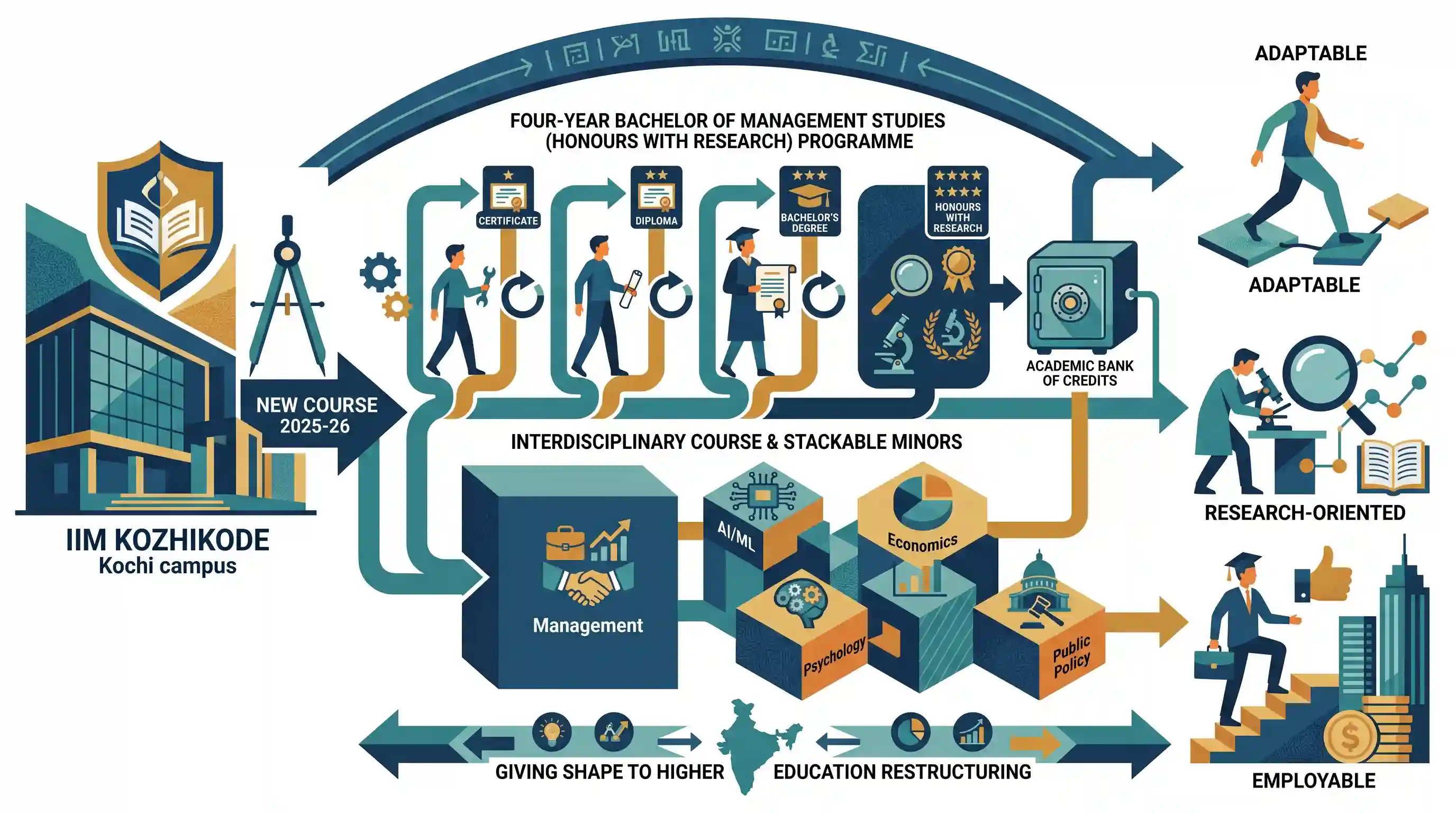
IIM Kozhikode has introduced a new four-year Bachelor of Management Studies (Honours with Research) programme, integrating the flexible multiple entry and exit provisions of the National Education Policy (NEP) 2020. Based in the Kochi campus starting academic year 2025-26, the interdisciplinary course will offer a major in Management alongside stackable minors in areas like AI/ML, psychology, economics, and public policy. The initiative serves as a tangible model of restructuring higher education in India to make graduates more adaptable, research-oriented, and employable.
Key Points
- IIM Kozhikode has launched a 4-year Bachelor of Management Studies (BMS) with Honours and Research, starting in the 2025-26 academic year at its Kochi campus.
- The programme implements the National Education Policy (NEP) 2020 mandate by offering flexible multiple entry and exit options.
- Students will major in Management while taking stackable minors in diverse fields such as Economics, Public Policy, Artificial Intelligence/Machine Learning, Psychology, and Liberal Studies.
- The interdisciplinary curriculum emphasizes internships, student exchange semesters, and research projects to bridge the gap between academic capability and employability.
Important Terms
National Education Policy (NEP) 2020

A comprehensive framework launched to transform India's education system, emphasizing holistic development, flexibility, multidisciplinary learning, and increasing the Gross Enrolment Ratio (GER) to 50% by 2035.
UPSC context
GS Paper 2: Social Justice (Education) and Government Policies. Crucial for understanding structural reforms in human capital development.
Academic Bank of Credits (ABC)
A digital repository that stores academic credits earned by students from various Higher Education Institutions (HEIs), facilitating credit transfer, accumulation, and seamless student mobility across different programs and universities.
UPSC context
GS Paper 2 and 3: Governance and Technology in Education. Tests knowledge of digital infrastructure for administrative efficiency.
Multiple Entry and Exit System (MEES)
A flexible provision under NEP 2020 allowing students to drop out and rejoin academic programs at various stages with appropriate certifications (Certificate, Diploma, or Degree) based on credits earned.
UPSC context
GS Paper 2: Issues relating to development and management of Social Sector/Services relating to Education and Human Resources.
Four-Year Undergraduate Programme (FYUP)
A preferred undergraduate structure under NEP 2020 that provides a degree with 'Honours with Research' after four years, integrating major subjects with diverse minors and research projects.
UPSC context
GS Paper 2: Education. Relevant for discussions on making Indian graduates globally competitive and research-oriented.
IIM Kozhikode
A premier Indian business school that pioneered a full-time undergraduate program (BMS) aligned with NEP 2020, serving as a model for restructuring management education at the foundational level.
UPSC context
Current Affairs: Significant as an example of premier Institutions of National Importance (INIs) leading policy implementation.
Interdisciplinary Education
An educational approach that integrates different disciplines (e.g., Management with AI or Psychology) to provide holistic knowledge and prepare students for complex, multifaceted career paths.
UPSC context
GS Paper 2: Education policy objectives. Essential for analyzing the shift from siloed to integrated learning systems.
Prelims Trap
IIMs award degrees because they are recognised as 'Deemed to be Universities' by the UGC.
IIMs award degrees because the IIM Act 2017 declared them 'Institutes of National Importance', granting them statutory autonomy to issue degrees directly, bypassing the UGC's deemed university route.
Static Concepts Connected
What is the Academic Bank of Credits (ABC) under NEP 2020?
- Digital repository: A digital repository that stores, accumulates, and transfers academic credits earned by students.
- Student mobility: Facilitates the Multiple Entry and Exit System (MEES) by allowing seamless credit transfer across different higher education institutions.
- Lifelong learning: Supports non-traditional learning paths and bridges formal and informal education, aligning with SDG-4.
What does the status of 'Institute of National Importance' (INI) entail?
- Statutory origin: It is a status conferred by an Act of Parliament on premier public institutions like IITs, IIMs, and AIIMS.
- Academic autonomy: Grants significant administrative autonomy, including the power to independently award degrees instead of diplomas.
Cross-Topic Patterns
NEP 2020 + Industry 4.0 skills
Stackable minors in AI/ML alongside management degrees link human resource development to India's National Strategy for Artificial Intelligence and the changing nature of work.
Statutory Autonomy + Higher Education
The INI status granted via the IIM Act 2017 reflects the broader governance shift from centralized UGC control to institutional autonomy, boosting global competitiveness.

NEP 2020's Multiple Entry/Exit System and Academic Bank of Credits are ripe for a 2026 Prelims statement-based question on eligibility.
Linked PYQs · 2
Linked PYQs · 2
- 2020MainsGS2
National Education Policy 2020 is in conformity with the Sustainable Development Goal-4 (2030). It intends to restructure and reorient education system in India. Critically examine the statement.
- 2015MainsGS2
The quality of higher education in India requires major improvements to make it internationally competitive. Do you think that the entry of foreign educational institutions would help improve the quality of higher and technical education in the country? Discuss.
