Film Festival Awards and Central Censorship Row
Source:Indian Express ↗
Why It Matters
It highlights the constitutional tensions between the Union government's regulatory authority over broadcasting and censorship, and the state governments' cultural autonomy, raising critical debates around Article 19(1)(a) and democratic freedoms.
Summary
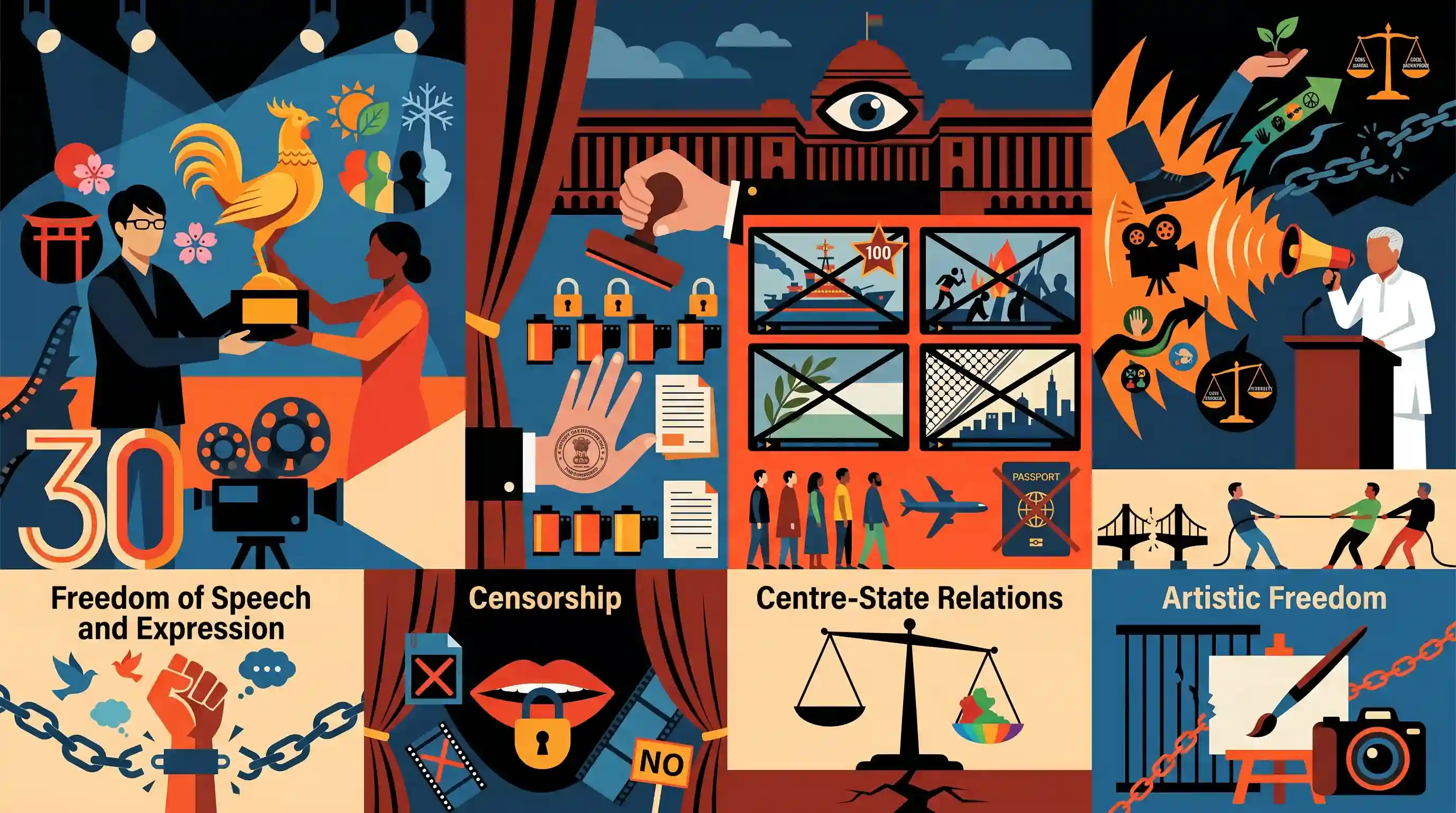
The 30th International Film Festival of Kerala (IFFK) concluded with the Japanese film 'Two Seasons, Two Strangers' winning the Best Film award. However, the event was heavily overshadowed by a political dispute after the Union Ministry of Information and Broadcasting denied censor exemptions for several films, leading to the cancellation of six screenings, including classics like 'Battleship Potemkin' and certain Palestinian movies. Visas for several international guests were also withheld. Kerala Chief Minister Pinarayi Vijayan strongly criticized the Union government, framing the censorship as an anti-democratic, fascist attempt to stifle the festival's progressive politics and a direct attack on freedom of expression.
Key Points
- The Japanese film 'Two Seasons, Two Strangers' won the Suvarna Chakoram for Best Film at the 30th IFFK.
- The Union Ministry of Information and Broadcasting denied censor exemptions to several films, cancelling screenings of six movies, including 'Battleship Potemkin' and 'Beef', as well as Palestinian films.
- Visas for certain international guests from specific countries were also denied by the Union government.
- Kerala Chief Minister Pinarayi Vijayan and Cultural Affairs Minister Saji Cheriyan condemned the Centre's actions as anti-democratic, fascist, and an encroachment on freedom of expression meant to stifle the festival.
- Mauritanian filmmaker Abderrahmane Sissako was honored with the Lifetime Achievement award.
Important Terms
Union Ministry of Information and Broadcasting

The apex Government of India body responsible for formulating media rules, regulating broadcasting, and overseeing film certification through the CBFC. It grants censor exemptions for film festivals.
UPSC context
GS Paper II: Statutory/regulatory bodies. Tests understanding of executive control over media and its impact on fundamental rights.
Kerala State Chalachitra Academy (KSCA)
An autonomous institution under Kerala's Department of Cultural Affairs established in 1998 to promote cinema. It serves as the primary organizer for state-level international film festivals.
UPSC context
GS Paper I & II: Indian Culture/State Institutions. Relevant for understanding state-led cultural promotion and federal friction in film regulation.
International Film Festival of Kerala (IFFK)
One of India's leading annual film festivals held in Thiruvananthapuram. It focuses on Asian, African, and Latin American cinema and is known for its democratic, audience-centric approach.
UPSC context
GS Paper I: Indian Culture. Significant for its role in promoting "parallel cinema" and fostering global cultural exchange.
Central Board of Film Certification (CBFC)
A statutory body under the Ministry of Information and Broadcasting that regulates the public exhibition of films in India under the Cinematograph Act, 1952.
UPSC context
GS Paper II: Fundamental Rights (Article 19). Tests knowledge of "reasonable restrictions" on freedom of speech and expression.
Cinematograph Act, 1952
The primary legislation governing film certification and exhibition in India. It empowers the Central Government to censor or restrict films on grounds of national security and public order.
UPSC context
GS Paper II: Government Policies. Crucial for understanding the legal framework of censorship and its evolution through judicial review.
Suvarna Chakoram
The highest award at the IFFK, given to the Best Film in the International Competition. It includes a cash prize and a trophy of the "Golden Crow Pheasant."
UPSC context
UPSC Prelims: Awards and Honors. Relevant for cultural current affairs and recognition of international cinematic excellence.
Prelims Trap
State governments can grant censorship exemptions for films screened at state-sponsored film festivals.
The power to exempt uncertified films from censorship requirements under the Cinematograph Act rests exclusively with the Union Ministry of Information and Broadcasting, not the State.
Static Concepts Connected
How is jurisdiction over cinema distributed between the Union and States?
- Union List (Entry 60): Parliament has exclusive power over the "Sanctioning of cinematograph films for exhibition" (certification and censorship).
- State List (Entry 33): States regulate physical exhibition, licensing of theatres, and cinemas, but this is explicitly subject to the provisions of Entry 60 of the Union List.
What is the constitutional and legal basis for film censorship in India?
- Article 19(2): Freedom of speech and expression can be restricted on grounds of sovereignty, public order, decency, or morality.
- K.A. Abbas Case (1970): The Supreme Court upheld pre-censorship of films, noting cinema's deep emotional impact and mass appeal compared to other forms of expression.
- Cinematograph Act, 1952: Provides the statutory framework for the CBFC. Section 9 allows the Union government to exempt uncertified films for non-commercial film festivals.
Cross-Topic Patterns
Culture as a federal flashpoint
Disputes over film censorship align with controversies over Republic Day tableaux selections and language policies, showing how soft power and cultural expression frequently test Centre-State relations.
IT Rules vs Cinematograph Act
The Union's discretionary power to deny festival exemptions under the Cinematograph Act mirrors digital blocking powers under IT Rules, highlighting executive discretion over Article 19(1)(a).

Expect a 2026 Prelims question mapping 7th Schedule entries, differentiating film certification (Union List) vs theatre regulation (State).
Linked PYQs · 2
Linked PYQs · 2
- 2014MainsGS2
What do you understand by the concept "freedom of speech and expression"? Does it cover hate speech also ? Why do the films in India stand on a slightly different plane from other forms of expression ? Discuss.
- 2024MainsGS2
What changes has the Union Government recently introduced in the domain of Centre-State relations ? Suggest measures to be adopted to build the trust between the Centre and the States and for strengthening federalism.
