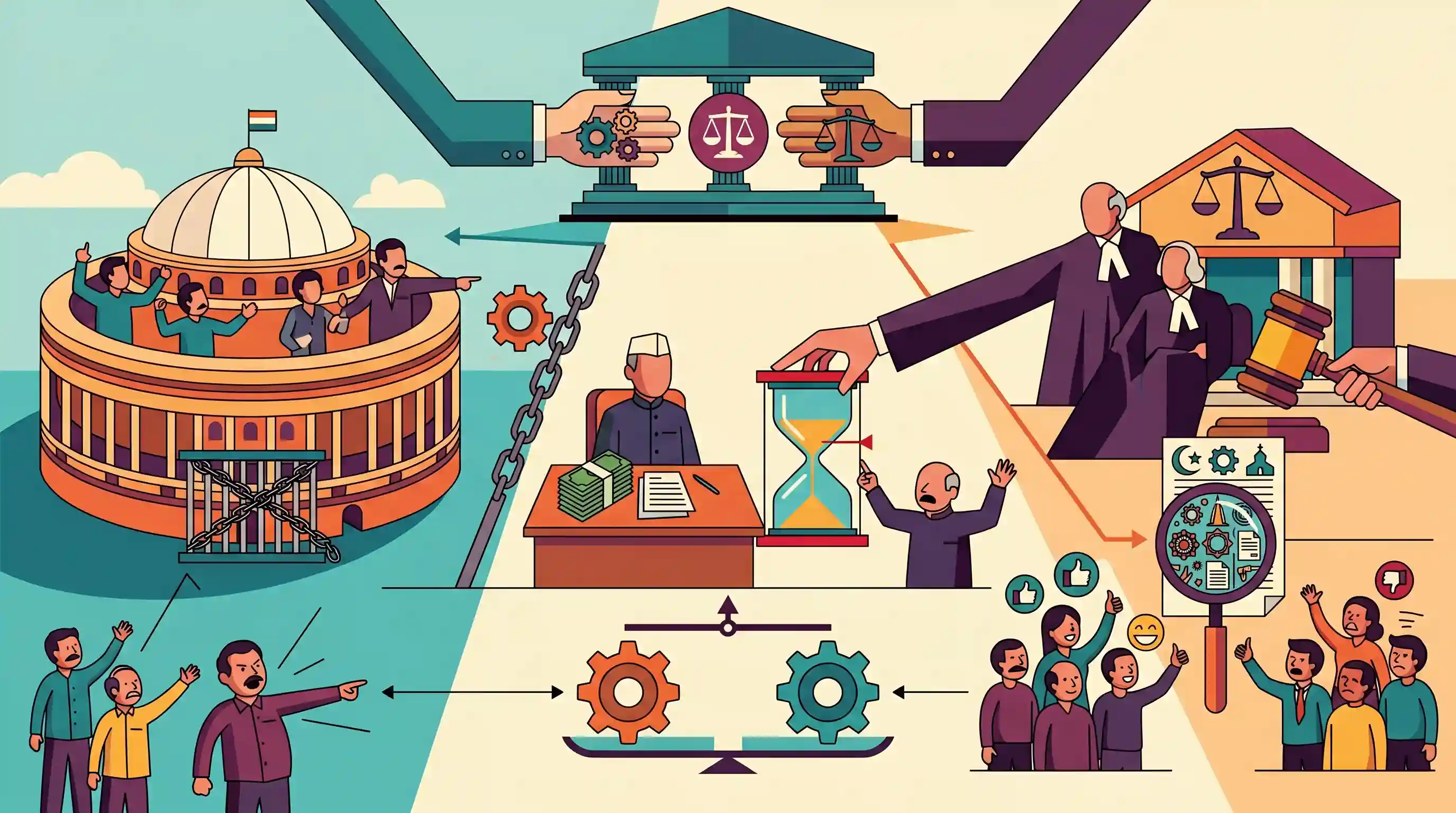
Separation of powers and judicial overreach debates in parliament
Source:The Hindu ↗
Why It Matters
This article underscores the recurring constitutional friction between the Judiciary and the Executive/Legislature in India. It is highly relevant for GS Paper 2 topics on the separation of powers, judicial overreach, and the constitutional powers of the President regarding legislative assent.
Summary
BJP MP Nishikant Dubey's recent remarks criticizing the Supreme Court for allegedly usurping the lawmaking powers of Parliament have sparked a debate on the separation of powers. Dubey stated that if the judiciary begins making laws, the Parliament building should be shut down. This criticism comes amidst two major judicial interventions: the Supreme Court's ongoing scrutiny of the constitutional validity of the recently passed Waqf (Amendment) Act, and a recent ruling where the Court set a timeline for the President of India to decide on Bills. The latter was also heavily criticized by Vice-President Jagdeep Dhankhar. Opposition parties, however, have welcomed the Supreme Court's proactive stance on both issues.
Key Points
- BJP MP Nishikant Dubey criticised the Supreme Court, stating that if the Court makes laws, Parliament should be shut down, highlighting tensions over the separation of powers.
- The comments arise against the backdrop of the Supreme Court hearing constitutional challenges to the Waqf (Amendment) Act, during which the Centre agreed to pause implementation of certain contentious provisions.
- The debate also follows a recent Supreme Court decision setting a timeline for the President to decide on Bills, a ruling that drew strong disapproval from Vice-President Jagdeep Dhankhar.
- Opposition parties have lauded the Supreme Court's intervention regarding both the Waqf (Amendment) Act and the timeline for the President\'s assent.
Important Terms
Separation of Powers

Constitutional doctrine dividing government functions into three branches—Legislature, Executive, and Judiciary—to prevent power concentration and ensure mutual checks and balances.
UPSC context
GS II: Indian Constitution. Core principle for understanding inter-organ relations and the 'Basic Structure' doctrine.
Judicial Overreach
When the judiciary exceeds its constitutional mandate by performing functions reserved for the legislature or executive, such as framing policies or 'making' law.
UPSC context
GS II: Judiciary. Tests the ability to analyze the thin line between activism and unconstitutional encroachment.
Waqf (Amendment) Act, 2025
Legislation passed in 2025 (renaming the 1995 Act) to reform waqf management, mandate online registration, and include non-Muslims and women on Waqf Boards.
UPSC context
GS II: Governance/Social Justice. Significant for minority rights, administrative transparency, and legislative reform.
Article 111
Constitutional provision outlining the procedure for the President's assent to Bills, including the power to grant assent, withhold it, or return non-money Bills.
UPSC context
GS II: Parliament. Crucial for understanding the legislative process and the veto powers of the President.
Judicial Activism
The proactive role of the judiciary in protecting citizens' rights and enforcing social justice, often filling legal vacuums left by the other organs.
UPSC context
GS II: Judiciary. Key concept for evaluating the evolving role of courts in Indian democracy.
Article 201
Article detailing the process where a Governor reserves a State Bill for the President’s consideration, central to debates on legislative timelines.
UPSC context
GS II: Federalism/State Legislatures. Tests understanding of Centre-State relations and Gubernatorial powers.
Prelims Trap
The Supreme Court can issue a writ mandating the President to grant assent to a Bill within a specified timeframe.
Article 361 grants explicit immunity; the President is not answerable to any court for official duties. Furthermore, Article 111 prescribes no time limit for assent.
Static Concepts Connected
What are the President's veto powers under Article 111?
- Absolute Veto: Withholding assent to a bill altogether, preventing it from becoming an Act. It is usually exercised for Private Member Bills.
- Suspensive Veto: Returning the bill for reconsideration. It can be overridden by the legislature passing the bill again with a simple majority.
- Pocket Veto: Taking no action indefinitely. The Indian Constitution does not prescribe any time limit for the President to decide on a bill.
What constitutional immunities are provided under Article 361?
- Non-answerability: The President or Governor is not answerable to any court for the exercise and performance of their official duties.
- Criminal Proceeding Bar: No criminal proceedings whatsoever can be instituted or continued against the President or Governor during their term of office.
- Civil Proceeding Conditions: Civil proceedings regarding personal acts require a two-month prior written notice before they can be initiated in any court.
Cross-Topic Patterns
Separation of Powers & Basic Structure
Judicial directives setting executive timelines are increasingly debated in Mains as potential violations of the Separation of Powers, an established Basic Structure doctrine element.
Waqf Amendments & Article 26
The Waqf dispute links to fundamental rights debates over a religious denomination's right to manage its own affairs versus the state's power to regulate secular property administration.

Expect a 2026 Prelims question pairing Article 111 (Pocket Veto) with Article 361 (Presidential Immunity) and SC judicial review limits.
Linked PYQs · 2
Linked PYQs · 2
- 2020MainsGS2
Judicial Legislation is antithetical to the doctrine of separation of powers as envisaged in the Indian Constitution. In this context justify the filing of large number of public interest petitions praying for issuing guidelines to executive authorities.
- 2014MainsGS2
Instances of President's delay in commuting death sentences has come under public debate as denial of justice. Should there be a time limit specified for the President to accept/reject such petitions ? Analyse.
