NC MP Raises Political Debate Over Article 370 and Statehood
Source:Indian Express ↗
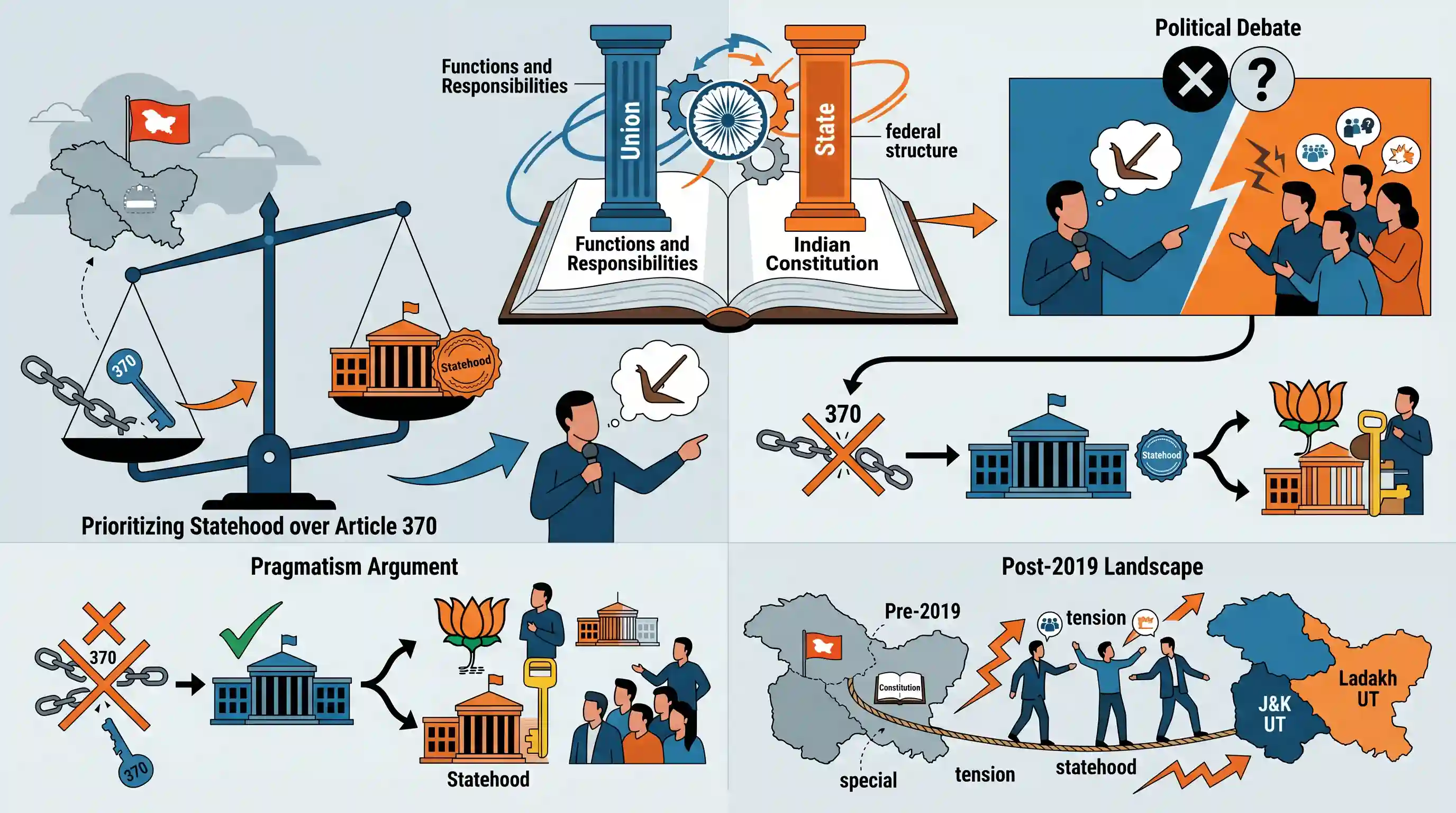
Why It Matters
It highlights the ongoing political fallout, regional aspirations, and the friction between ideological goals and administrative pragmatism in Jammu & Kashmir following the abrogation of Article 370. This touches upon themes of federalism, asymmetric federalism, and constitutional provisions.
Summary
A Srinagar National Conference (NC) MP has sparked political debate by criticizing the "pragmatic" approach of prioritizing the restoration of statehood for Jammu and Kashmir over the demand for restoring Article 370. He argued that if abandoning the core ideological demand for Article 370 is acceptable for the sake of political pragmatism, the opposition might as well have allowed the BJP to win, as securing statehood would have been easier under their rule. The statement reflects the underlying tensions within Kashmiri regional parties as they navigate the post-2019 political landscape, balancing ideological commitments with the immediate administrative and democratic need for full statehood.
Key Points
- A Srinagar National Conference (NC) MP criticized the 'pragmatic' political approach of dropping the demand for Article 370 to secure statehood for Jammu & Kashmir.
- The MP argued that if conceding the ideological battle for Article 370 is deemed acceptable, the opposition should have let the BJP win, as obtaining statehood from them would have been more straightforward.
- The remarks highlight a persistent ideological debate within Kashmiri regional parties regarding their core demands and compromises in the post-2019 political landscape.
- The issue underscores the tension between seeking immediate administrative relief (statehood) and fighting for long-term constitutional rights (special status).
Important Terms
Article 370

A temporary constitutional provision (Part XXI) that granted special autonomous status to Jammu and Kashmir, allowing it a separate constitution, until its abrogation in August 2019.
UPSC context
GS Paper 2; tests understanding of historical underpinnings, evolution of significant constitutional provisions, and the nature of Indian federalism.
Jammu and Kashmir Reorganisation Act, 2019
Parliamentary legislation that bifurcated the former State of Jammu and Kashmir into two separate Union Territories—Jammu & Kashmir (with a legislature) and Ladakh (without one).
UPSC context
GS Paper 2; examines Article 3 powers, the reorganization of states, and the legal process of administrative restructuring.
Statehood
The constitutional status of a territory as a full State, granting it legislative and executive autonomy over State List subjects within India’s federal framework.
UPSC context
GS Paper 2; relevant for center-state relations, federal integrity, and the balance between Union authority and regional autonomy.
Asymmetrical Federalism
A federal design where different constituent units possess varying powers or autonomy, often used in India to protect ethnic, linguistic, or cultural diversity (e.g., Articles 371A-J).
UPSC context
GS Paper 2; tests conceptual clarity on India's 'quasi-federal' structure and challenges to the federal balance.
National Conference (NC)
A prominent regional political party in Jammu and Kashmir, historically led by the Abdullah family, which advocates for the restoration of the region's special status and statehood.
UPSC context
GS Paper 2; highlights the role of regional parties in navigating constitutional change and center-state political dynamics.
Union Territory (UT)
Administrative units governed directly by the Union government through an appointee (Lieutenant Governor/Administrator); some possess an elected legislature with limited powers over specific subjects.
UPSC context
GS Paper 2; covers the administrative structure of India and the functional differences between States and UTs.
Prelims Trap
The bifurcation of a State into Union Territories requires a formal Constitutional Amendment Act under Article 368.
Under Article 3 and Article 4, Parliament can alter state boundaries or form UTs using a simple majority. It is expressly not an Article 368 amendment.
Static Concepts Connected
How does Parliament alter state boundaries or status under Article 3?
- Prior Recommendation: Requires the prior recommendation of the President before being introduced in either house of Parliament.
- State Views: The President must refer the bill to the concerned state legislature for its views, though these views are not binding on Parliament.
- Simple Majority: The bill is passed by a simple majority. Under Article 4, such changes are not considered constitutional amendments under Article 368.
How do the legislative powers of the J&K UT differ from a full State?
- Excluded Subjects: Unlike full states, the J&K Assembly cannot legislate on 'Public Order' and 'Police' (State List entries 1 and 2).
- LG's Domain: These excluded subjects remain exclusively under the Union Government's control, administered through the Lieutenant Governor.
- Article 239A: It operates under the Article 239A framework (similar to Puducherry), providing a legislature but with restricted domain.
Cross-Topic Patterns
Asymmetric Federalism: Art 370 vs 371
The abrogation of J&K's special status frequently invites comparative questions with the active preservation of special provisions for North Eastern states and others under Article 371 (A-J).
UT Governance: Delhi vs J&K parallel
Both Delhi (Article 239AA) and J&K (Article 239A) see persistent political-legal friction over the precise division of executive powers between the elected government and the Lieutenant Governor.

Comparing the legislative domains of UTs (Delhi, J&K, Puducherry) and LG discretionary bounds is highly likely as a 2026 multi-statement Q.
Linked PYQs · 2
Linked PYQs · 2
- 2025MainsGS2
Discuss the nature of Jammu and Kashmir Legislative Assembly after the Jammu and Kashmir Reorganization Act, 2019. Briefly describe the powers and functions of the Assembly of the Union Territory of Jammu and Kashmir.
- 2016MainsGS2
To what extent is Article 370 of the Indian Constitution, bearing marginal note "Temporary provision with respect to the State of Jammu and Kashmir", temporary? Discuss the future prospects of this provision in the context of Indian polity.
