Supreme Court Examination of UPI Merchant Discount Rate Charges
Source:The Hindu ↗
આ શા માટે મહત્વનું છે
This case directly impacts the sustainability, business models, and economic viability of India's booming digital payments ecosystem (UPI, fintechs, and banks), balancing public policy goals of financial inclusion against fair compensation for service providers.
સારાંશ
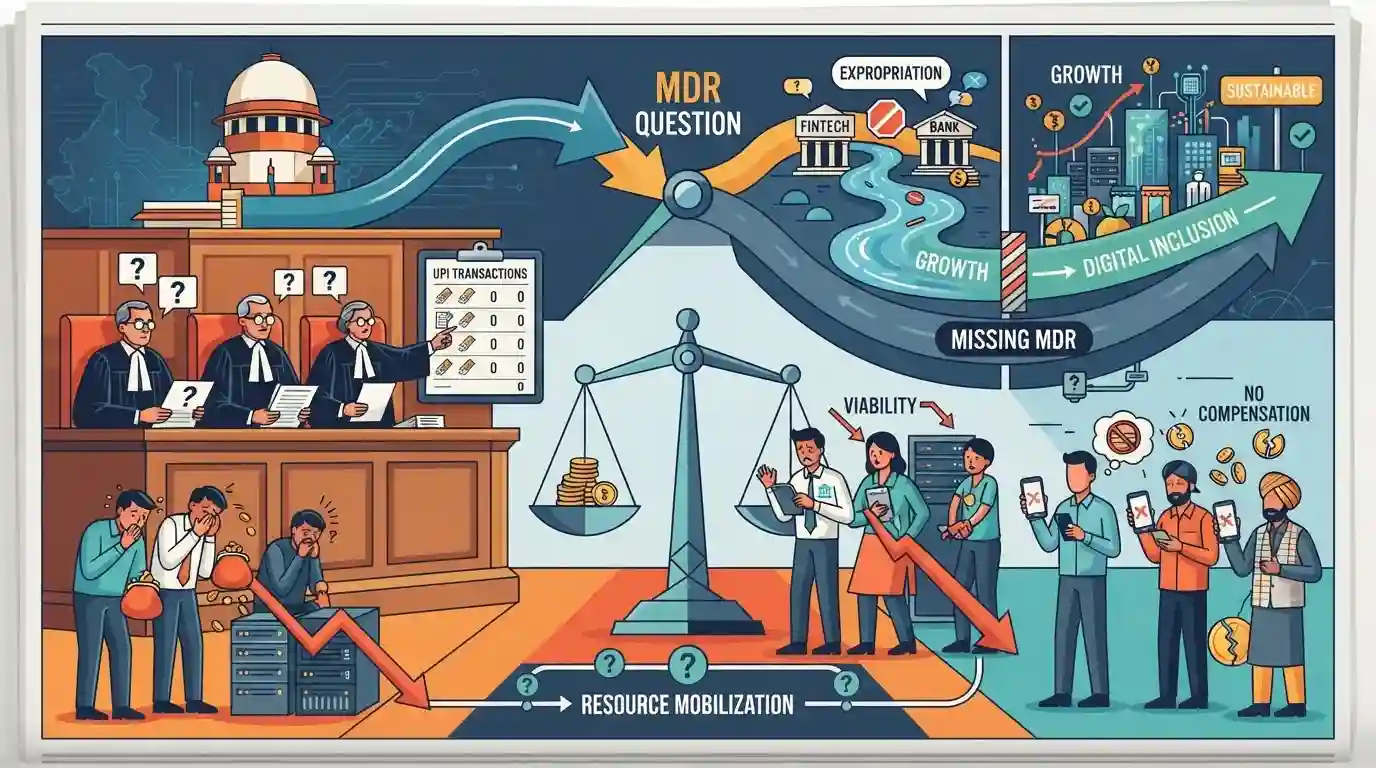
The Supreme Court questioned the Central government regarding the absence of Merchant Discount Rate (MDR) on Unified Payments Interface (UPI) transactions, asking whether forcing service providers to operate without compensation amounts to 'expropriation' when it is neither structured as a tax nor a fee. The legal and economic scrutiny highlights viability concerns for banks and fintech firms sustaining India's massive digital payment ecosystem.
મુખ્ય મુદ્દા
- The Supreme Court questioned the government over the lack of Merchant Discount Rate (MDR) charges for UPI transactions, terming the situation 'expropriation' if it is neither a tax nor a fee.
- The absence of MDR has placed a heavy financial burden on payment aggregators, banks, and fintech companies that sustain the digital infrastructure without compensation.
- The debate underscores the tension between promoting digital public goods (DPGs) for financial inclusion and ensuring the economic viability of private and public entities maintaining payment systems.
મહત્વપૂર્ણ શબ્દો
Unified Payments Interface (UPI)

India's real-time, interoperable digital payment system developed by NPCI, allowing instant fund transfers via mobile apps using a Virtual Payment Address and two-factor authentication.
UPSC context
GS Paper III (Economy - Digital Payments Infrastructure and Financial Inclusion); tests understanding of financial technology, inclusion, and monetary architecture.
Merchant Discount Rate (MDR)
A fee charged to merchants for accepting digital payments from customers, distributed among participating banks, payment gateways, and network providers to cover processing costs.
UPSC context
GS Paper III (Economy - Mobilisation of Resources and Growth); tests understanding of digital transaction economics and bank viability.
પ્રિલિમ્સ ટ્રેપ
UPI transactions are universally free of cost for all stakeholders in the digital ecosystem.
Aspirants often assume UPI is entirely free by nature; however, transaction costs exist and are either subsidized by the government or absorbed by banks/fintechs, not magically non-existent.
સંલગ્ન સ્થિર ખ્યાલો
What is the Merchant Discount Rate (MDR) and how does its regulation impact digital payment systems?
- Definition: Rate charged to a merchant for accepting payments from customers via digital methods (cards, QR codes, UPI).
- Purpose: Compensates banks, payment gateways, and intermediaries for processing transactions and maintaining network infrastructure.
- Economic Impact: A zero-MDR policy promotes user adoption and financial inclusion, but burdens service providers with uncompensated maintenance costs.
આંતર-વિષય પેટર્ન
Digital Public Goods vs Private Commercial Viability
The zero-MDR policy forces private entities to shoulder infrastructure costs, raising legal questions on regulatory takings versus state promotion of digital public goods.
Fintech Unit Economics and Banking Sector Health
Zero-MDR subsidies strain bank balance sheets, directly intersecting with RBI's systemic risk monitoring and financial inclusion targets.

SC scrutiny on UPI zero-MDR will likely be framed as a statement-based question combining digital public infrastructure and constitutional rights.
સંલગ્ન PYQ · 2
સંલગ્ન PYQ · 2
- 2023MainsGS3
What is the status of digitalization in the Indian economy? Examine the problems faced in this regard and suggest improvements.
- 2022MainsGS3
Is inclusive growth possible under market economy ? State the significance of financial inclusion in achieving economic growth in India.
