Fiscal Federalism and Centre State Financial Relations in India
Source:The Hindu ↗
Why It Matters
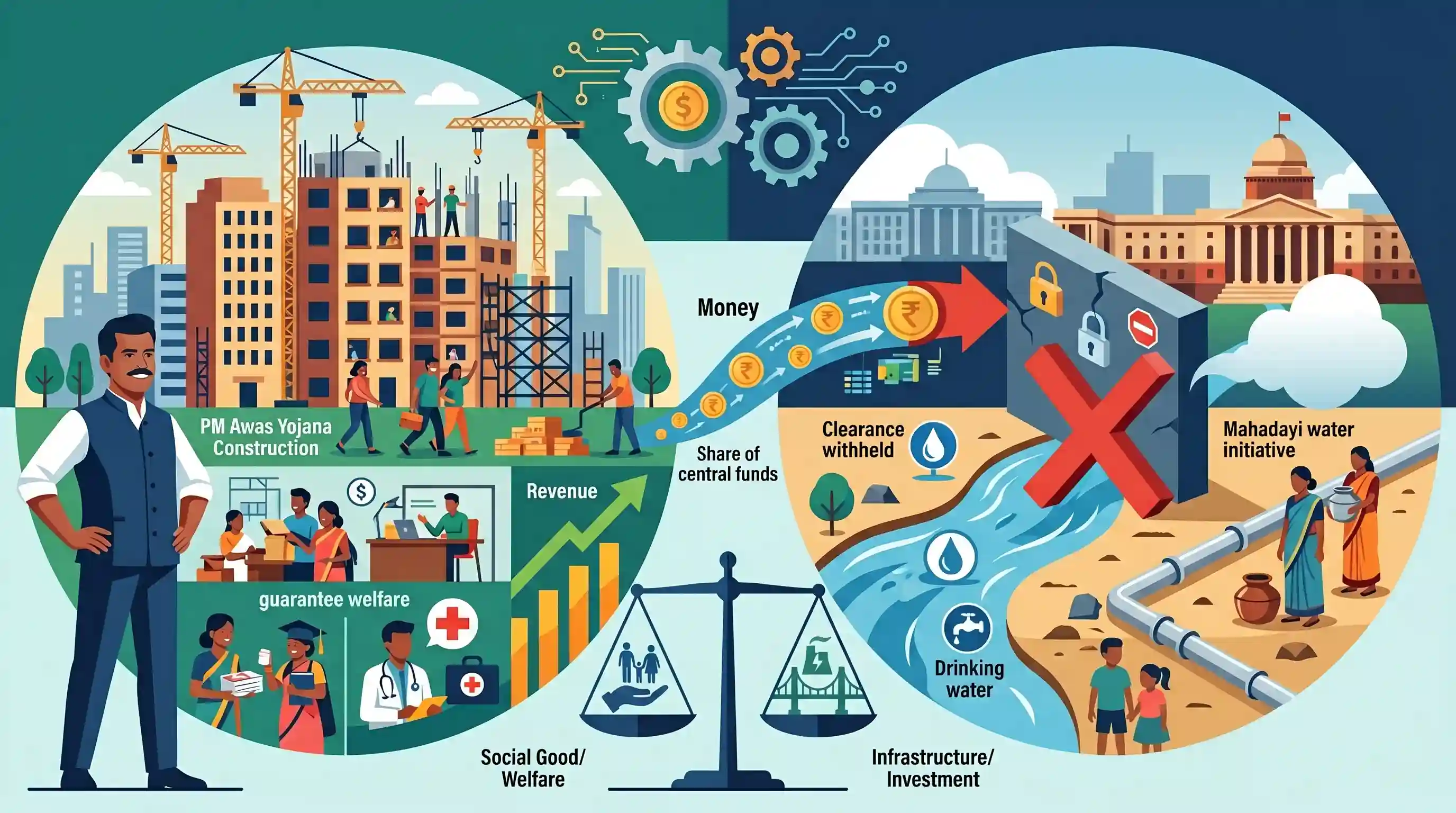
The debate over state funding for welfare schemes (often criticized as 'freebies') versus capital expenditure is a recurring theme in India's political economy. This article provides a real-world case study of a state government defending its fiscal prudence while fulfilling welfare commitments. Furthermore, the friction over reduced central fund devolution and delayed clearances for the Mahadayi project serves as critical material for analyzing challenges in Centre-State relations and evaluating the current health of fiscal federalism in India.
Summary
The Chief Minister of Karnataka, Siddaramaiah, denied allegations that the state government is bankrupt due to heavy expenditure on its 'guarantee' welfare schemes. To demonstrate the state's robust fiscal health, he pointed to uninterrupted progress on major development works, specifically massive housing construction efforts under the PM Awas Yojana and the Karnataka Slum Development Board. Additionally, the Chief Minister underscored ongoing friction in Centre-State relations, criticizing the Union Government for reducing the state's share of central funds (allegedly dropping from ₹60,000 crore to ₹52,000 crore) and for withholding clearances for vital projects like the Mahadayi river drinking water initiative. This development brings up core administrative debates surrounding the balance of welfare spending versus capital expenditure, the dynamics of fiscal federalism, and the political economy of inclusive urbanization.
Key Points
- Karnataka CM Siddaramaiah rebuffed claims that the state government is facing bankruptcy due to expenditure on welfare guarantee schemes, citing the ongoing execution of mega development works.
- He highlighted major housing initiatives undertaken through the PM Awas Yojana and the Karnataka Slum Development Board, asserting that these capital expenditures prove the state's fiscal stability.
- The CM raised concerns over fiscal federalism, pointing out a decline in the devolution of central funds to Karnataka, which reportedly fell from ₹60,000 crore to ₹52,000 crore.
- He criticized the Union Government for withholding crucial clearances for state infrastructure, specifically highlighting delays surrounding the Mahadayi drinking water project.
Important Terms
Fiscal Federalism

The distribution of financial powers and responsibilities between the Union and State governments, governed by Articles 268-293 of the Constitution.
UPSC context
GS Paper 2 (Governance) and Paper 3 (Economy); tests knowledge of Centre-State financial relations and tax devolution mechanisms.
Mahadayi River Dispute
A conflict between Karnataka, Goa, and Maharashtra over the diversion of the Mahadayi river waters to the Malaprabha basin via the Kalasa-Banduri project.
UPSC context
GS Paper 2 (Polity); relates to Inter-State Water Disputes and the role of Tribunals/Supreme Court.
Pradhan Mantri Awas Yojana (PMAY)
A flagship Union government mission launched in 2015 aimed at providing affordable 'Housing for All' through Urban (PMAY-U) and Gramin (PMAY-G) components.
UPSC context
GS Paper 2 (Social Justice); focuses on welfare schemes for vulnerable sections and cooperative federalism in implementation.
Capital Expenditure (CapEx)
Government spending used to create long-term assets (like infrastructure, dams, and housing) or reduce liabilities, as opposed to routine operational expenses.
UPSC context
GS Paper 3 (Economy); critical for understanding budget components, fiscal health, and the quality of government spending.
Inclusive Urbanization
Urban development strategies ensuring that all city dwellers, especially the poor, have access to housing, basic services, and social equity.
UPSC context
GS Paper 1 (Society) and GS Paper 3 (Infrastructure); addresses urban sprawl, slum redevelopment, and SDG Goal 11.
Prelims Trap
All central taxes, cesses, and surcharges form part of the divisible pool shared with states.
Article 270 explicitly excludes cesses and surcharges from the divisible pool. Their increasing share in gross tax revenue reduces actual devolution to states.
Static Concepts Connected
What constitutes the Divisible Pool of taxes under Article 270?
- Inclusions: Net proceeds of union taxes and duties like Income tax, Corporate tax, and CGST.
- Exclusions: Cesses, surcharges (Article 271), and the cost of tax collection are kept exclusively by the Centre.
- Distribution: Shared between the Centre and States strictly based on Finance Commission recommendations (Article 280).
How are inter-state river water disputes adjudicated in India?
- Constitutional Basis: Article 262 empowers Parliament to provide for the adjudication of any dispute regarding the use of inter-state river waters.
- Statutory Mechanism: The Inter-State River Water Disputes Act, 1956 allows the Centre to constitute tribunals for binding adjudication.
- Judicial Review: Though Article 262 bars original Supreme Court jurisdiction, states routinely appeal tribunal awards via Special Leave Petitions (Article 136).
Cross-Topic Patterns
Welfare guarantees vs. FRBM limits
The political economy of 'guarantees' pressures states to increase revenue expenditure, often at the cost of capital asset creation, risking breaches of FRBM Act state-debt targets.
Mahadayi River & Western Ghats Ecology
The Kalasa-Banduri project perfectly links inter-state water disputes (Polity) with environmental governance (Environment), as diverting Mahadayi water threatens the contiguous, sensitive ecology of the Western Ghats.

Expect a 2026 Prelims question linking Article 270 (cess/surcharge exclusion) with the FRBM Act's capital vs revenue expenditure targets.
Linked PYQs · 4
Linked PYQs · 4
- 2025MainsGS2
Examine the evolving pattern of Centre-State financial relations in the context of planned development in India. How far have the recent reforms impacted the fiscal federalism in India?
- 2024MainsGS2
What changes has the Union Government recently introduced in the domain of Centre-State relations ? Suggest measures to be adopted to build the trust between the Centre and the States and for strengthening federalism.
- 2025MainsGS3
Explain how the Fiscal Health Index (FHI) can be used as a tool for assessing the fiscal performance of states in India. In what way would it encourage the states to adopt prudent and sustainable fiscal policies?
- 2023MainsGS1
Does urbanization lead to more segregation and/or marginalization of the poor in Indian metropolises?
