Social Justice 2.0 Paradigm for Targeted Policy Delivery
Source:The Hindu ↗
Why It Matters
Introduces crucial analytical frameworks (Social Justice 2.0, Composite Backwardness Index, 'share of proportional backwardness') that enrich Mains answers on affirmative action, caste census debates, and targeted welfare delivery.
Summary
An Independent Expert Working Group (IEWG) analyzing Telangana's recent caste census has proposed a 'Social Justice 2.0' governance framework. The study advocates shifting away from population-based quotas toward targeted interventions based on a 'share of proportional backwardness.' Using a proposed Composite Backwardness Index (CBI), the framework aims to identify and directly deliver resources to the most marginalized households. Furthermore, the report highlights that since backwardness includes deeply rooted discrimination and lack of dignity, traditional welfare must be supplemented by proportional representation in political power and governance for the bottom-quartile castes.
Key Points
- The IEWG study on Telangana's caste census recommends shifting to a 'Social Justice 2.0' paradigm focused on the 'share of proportional backwardness' instead of mere population share.
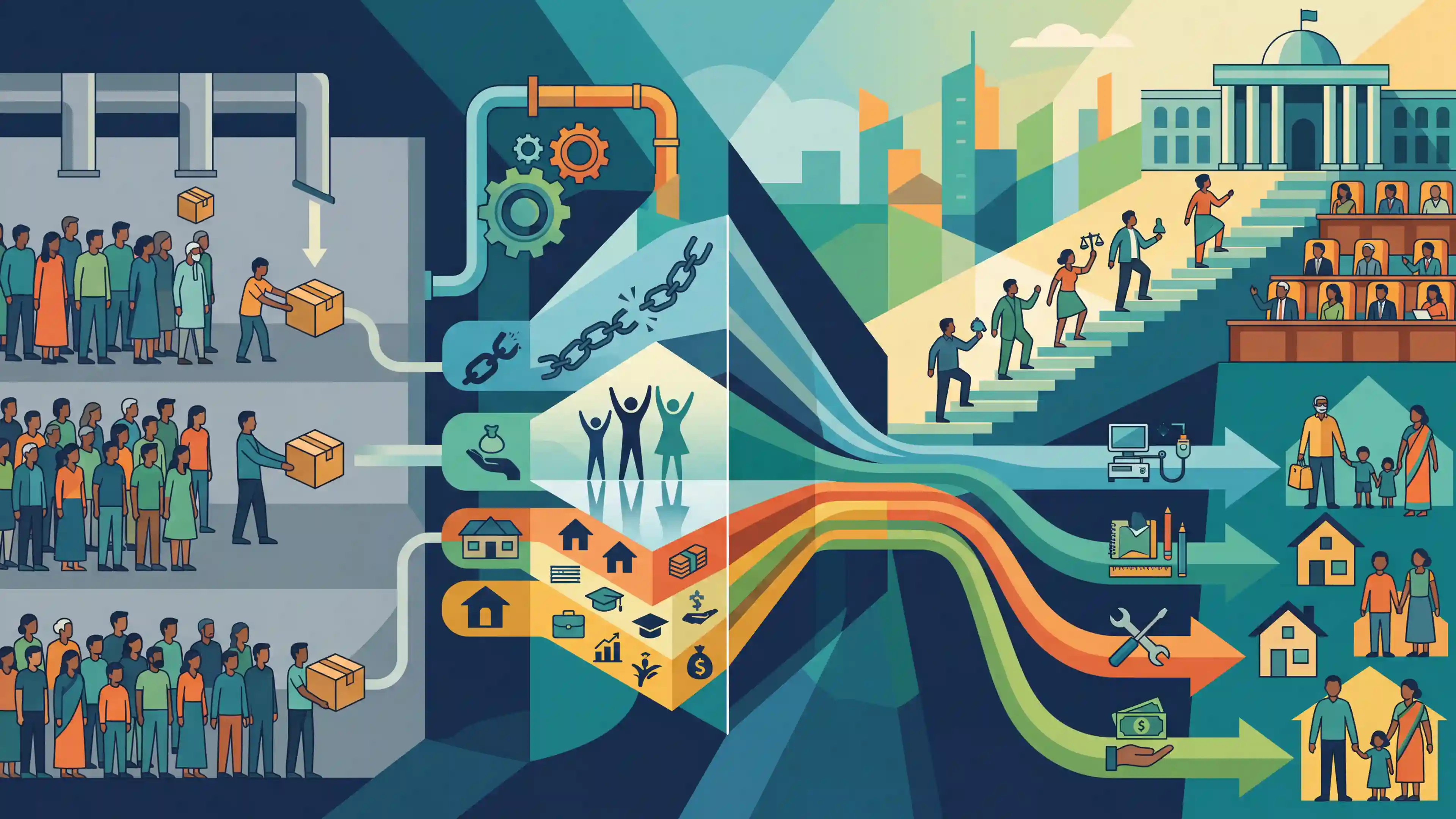
- It proposes using a Composite Backwardness Index (CBI) to deliver resources directly to truly needy households—likened to a 'social justice tap' rather than filling a broad 'social justice well.'
- The report emphasizes that backwardness encompasses discrimination and lack of dignity, asserting that material welfare and reservations alone are insufficient.
- It advocates for creating commensurate political space and governance representation for castes in the bottom quartile of backwardness to truly address social inequality.
Important Terms
Social Justice 2.0

A governance paradigm shifting from population-based quotas to data-driven, targeted social policies. It emphasizes delivering resources directly to the most deprived households using precise metrics to neutralize the "bad birth lottery."
UPSC context
GS Paper II: Social Justice; tests understanding of evolving affirmative action models and shifts toward evidence-based, household-level welfare delivery.
Composite Backwardness Index (CBI)
A multidimensional statistical tool quantifying caste-based deprivation on a scale (0-126). It evaluates 42 parameters across education, income, and discrimination to identify backwardness independently of a community's numerical population size.
UPSC context
GS Paper II: Governance/Social Justice; relevant for modern methodologies in identifying "creamy layer" and sub-categorizing backward classes for targeted interventions.
Independent Expert Working Group (IEWG)
An 11-member body of scholars chaired by Justice B. Sudershan Reddy. It was commissioned to analyze Telangana's caste census data and develop a scientific framework for social justice and political representation.
UPSC context
GS Paper II: Governance; highlights the role of expert committees in translating complex socio-economic data into actionable policy frameworks and legal reforms.
SEEEPC Survey
Telangana’s "Socio-Economic, Educational, Employment, Political and Caste" survey. A comprehensive door-to-door census of 3.55 crore people used to document structural inequalities and provide the empirical basis for the CBI.
UPSC context
GS Paper I & II: Social Issues/Social Justice; central to the national debate on the "Caste Census" and constitutional mandates under Articles 15, 16, and 340.
Share of Proportional Backwardness
A policy principle advocating that welfare resources and political representation should be allocated according to the specific degree of a community's deprivation, rather than just their total numerical strength.
UPSC context
GS Paper II: Social Justice; addresses the conceptual shift from "equality of opportunity" to achieving "equality of outcome" through granular deprivation data.
Prelims Trap
The Composite Backwardness Index (CBI) is a new metric adopted by the National Commission for Backward Classes.
The CBI is a framework proposed by an expert group evaluating Telangana's state-level caste census. It is not a Union government or NCBC metric.
Static Concepts Connected
What constitutional provisions govern backward classes and commissions?
- Article 340: Empowers the President to appoint a commission to investigate the conditions of socially and educationally backward classes (SEBCs).
- Indra Sawhney (1992): Established the 27% OBC quota but mandated the exclusion of the 'creamy layer' to ensure targeted benefits.
- 102nd Amendment: Granted constitutional status to the National Commission for Backward Classes (NCBC), empowering it to hear specific grievances.
What is the Justice G. Rohini Commission?
- Objective: Appointed under Article 340 to examine the equitable sub-categorization of Other Backward Classes (OBCs) in the Central list.
- Core Rationale: To ensure reservation benefits are distributed among the most marginalized sub-castes, directly echoing the 'proportional backwardness' philosophy.
Cross-Topic Patterns
Sub-categorization of OBCs and State Data
Telangana's proposal for targeted interventions mirrors the Justice Rohini Commission's central objective to sub-categorize OBCs, ensuring dominant groups do not monopolize reservation benefits.
Multidimensional Poverty and Caste Indices
The transition from Mandal's 11 indicators to the 42-parameter CBI reflects a broader governance shift, similar to NITI Aayog's multidimensional poverty metrics replacing purely income-based poverty lines.

GS2 Mains 2026 will likely ask how state-level caste census models and indices like CBI challenge traditional national quota architectures.
Linked PYQs · 3
Linked PYQs · 3
- 2024MainsGS1
Despite comprehensive policies for equity and social justice, underprivileged sections are not yet getting the full benefits of affirmative action envisaged by the Constitution. Comment.
- 2023MainsGS2
“Development and welfare schemes for the vulnerable, by its nature, are discriminatory in approach.” Do you agree? Give reasons for your answer.
- 2019MainsGS2
Performance of welfare schemes that are implemented for vulnerable sections is not so effective due to absence of their awareness and active involvement at all stages of policy process. Discuss.
