Strait of Hormuz Blockade and Global Energy Supply Disruption
Source:Indian Express ↗
Why It Matters
The Strait of Hormuz blockade is a textbook case study for UPSC aspirants on maritime chokepoints and global supply chain vulnerabilities. It directly ties into Mains questions on India's energy security, its Middle East foreign policy, the strategic importance of petroleum reserves, and the significance of global bodies like the IEA during crises.
Summary
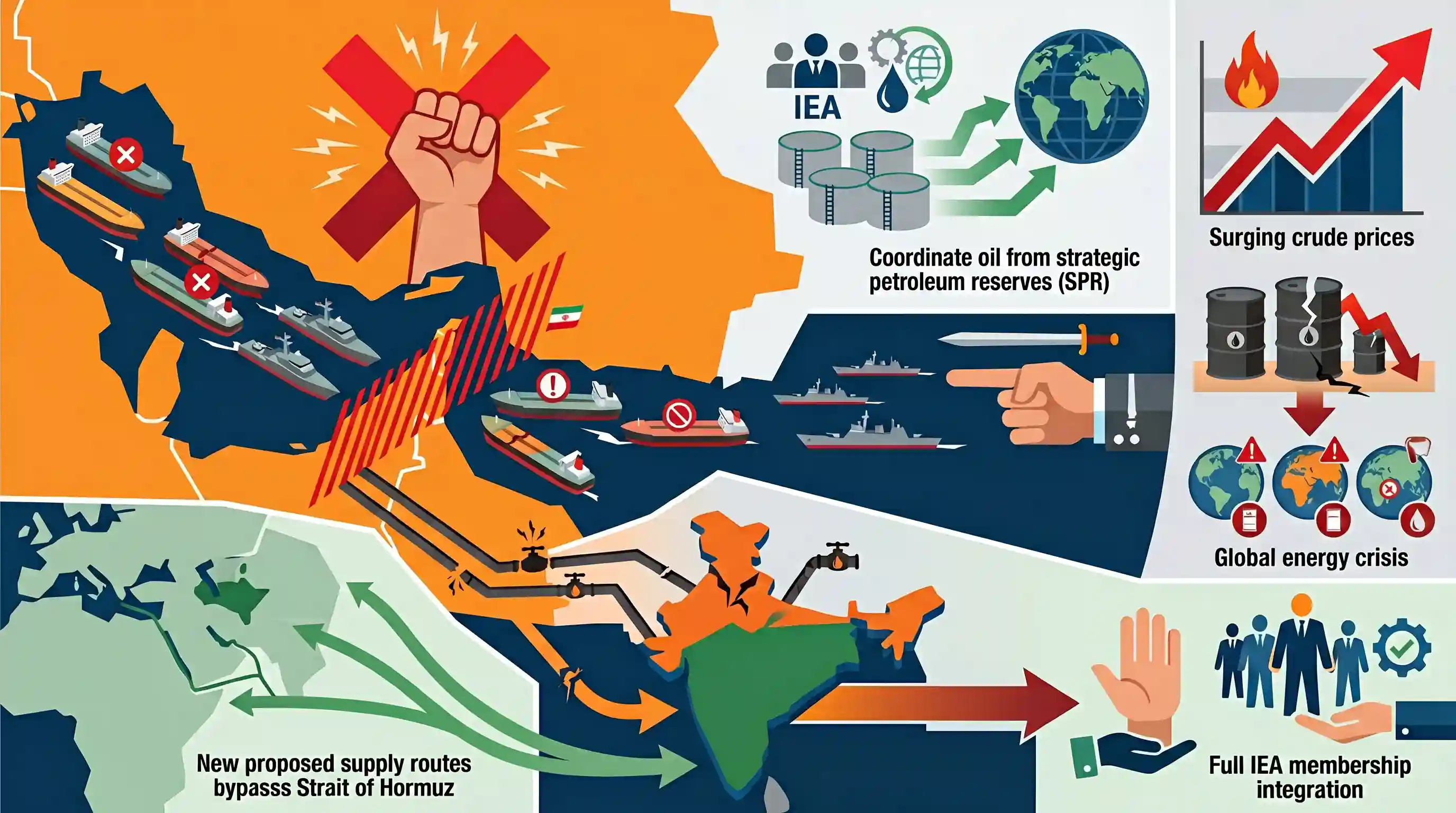
Amid an escalating conflict in West Asia, Iran's blockade of the Strait of Hormuz has triggered an unprecedented global energy crisis. The International Energy Agency (IEA) has coordinated a massive release of strategic petroleum reserves as crude prices surge, while the US has issued military ultimatums. The crisis severely impacts India's energy imports, underscoring its vulnerability to maritime chokepoints and the critical need for alternative supply routes and full IEA membership.
Key Points
- The Strait of Hormuz, a critical maritime chokepoint handling 20% of global energy supplies, has been blockaded by Iran amid the ongoing West Asia conflict.
- IEA Chief Fatih Birol stated the current energy crisis surpasses the 1970s oil shocks and the Ukraine war, with Brent crude hitting nearly $120 per barrel.
- To stabilize markets, the IEA authorized a record 400-million-barrel release from emergency stockpiles, including 172 million barrels from the US Strategic Petroleum Reserve (SPR).
- The US temporarily suspended sanctions on Russian and Iranian crude stranded at sea and issued a 48-hour military ultimatum to Iran to unblock the Strait.
- India is deeply exposed, historically relying on the Strait for 50% of its oil, 60% of LNG, and 90% of LPG imports, accelerating its push for full IEA membership.
- Countries are exploring alternative transit routes to bypass the chokepoint, such as Saudi Arabia's Yanbu terminal on the Red Sea and proposed pipelines across the Arabian Peninsula.
Important Terms
International Energy Agency (IEA)

A Paris-based autonomous intergovernmental organization (est. 1974) focused on global energy security. India is an Associate Member and formally applied for full membership in 2023.
UPSC context
GS Paper 2 (International Institutions) and GS Paper 3 (Energy). Tests knowledge of India's membership status and OECD requirements.
Strait of Hormuz
A critical waterway between Iran and Oman connecting the Persian Gulf to the Arabian Sea. It is the world's most vital oil chokepoint, handling ~20-30% of global consumption.
UPSC context
GS Paper 2 (International Relations) and GS Paper 1 (Geography/Maps). Tests understanding of West Asian maritime security and trade.
Strategic Petroleum Reserves (SPR)
Emergency crude oil stockpiles maintained by governments in underground rock caverns to guard against supply disruptions. India's operational sites include Visakhapatnam, Mangaluru, and Padur.
UPSC context
GS Paper 3 (Infrastructure/Energy). Tests knowledge of Phase I/II locations and energy crisis mitigation strategies.
Maritime Chokepoint
Narrow geographical features like straits or canals along global shipping routes that constrain maritime traffic. They are highly sensitive flashpoints for energy and economic security.
UPSC context
GS Paper 1, 2, and 3. Tests spatial geography and its impact on global trade and supply chains.
Energy Security
The uninterrupted availability of energy sources at an affordable price. It includes availability, accessibility, affordability, and acceptability, especially regarding India's high oil import dependency.
UPSC context
GS Paper 3 (Economic Development). Tests understanding of India's 85% oil import reliance and strategic autonomy.
Prelims Trap
"India is a full member of the International Energy Agency (IEA) and coordinates emergency petroleum stockpile releases."
India is only an 'Associate Member'. Full IEA membership strictly requires a country to be an OECD member and maintain emergency reserves equivalent to 90 days of net imports.
Static Concepts Connected
What are the criteria for full IEA membership?
- OECD requirement: A candidate country must already be a member of the Organisation for Economic Co-operation and Development (OECD).
- 90-day reserve: Must maintain crude oil and/or product reserves equivalent to at least 90 days of the previous year's net imports.
- Demand restraint: Must have domestic programs ready to reduce national oil consumption by up to 10% during a severe global supply disruption.
Where are India's Strategic Petroleum Reserves (SPR) located?
- Phase I locations: Built in unlined underground rock caverns at Visakhapatnam (Andhra Pradesh), Mangaluru (Karnataka), and Padur (Karnataka).
- Phase II expansion: Additional commercial-cum-strategic facilities are approved for Chandikhol (Odisha) and a further expansion at Padur under a Public-Private Partnership model.
- Capacity constraints: Current operational SPR capacity only covers about 9.5 days of India's crude oil requirements, falling significantly short of the 90-day IEA mandate.
Cross-Topic Patterns
Chokepoints & the IMEC Alternative
Disruption in Hormuz elevates the strategic premium on the India-Middle East-Europe Economic Corridor (IMEC) and overland pipelines (like Saudi's Petroline) that bypass vulnerable maritime bottlenecks.
Energy Shocks & Green Hydrogen Mission
Just as the 1970s oil shocks birthed the IEA, severe maritime blockades aggressively accelerate domestic energy transition imperatives, shifting the National Green Hydrogen Mission from environmental to geo-strategic.

Map-based matching questions pairing West Asian chokepoints with specific bypass infrastructure (Yanbu port, ADCOP pipeline) are highly likely.
Linked PYQs · 3
Linked PYQs · 3
- 2025MainsGS2
"Energy security constitutes the dominant kingpin of India's foreign policy, and is linked with India's overarching influence in Middle Eastern countries.” How would you integrate energy security with India's foreign policy trajectories in the coming years?
- 2017MainsGS2
The question of India's Energy Security constitutes the most important part of India's economic progress. Analyze India's energy policy cooperation with West Asian countries.
- 2024PrelimsGS1
Consider the following statements : Statement-I : Sumed pipeline is a strategic route for Persian Gulf oil and natural gas shipments to Europe. Statement-II : Sumed pipeline connects the Red Sea with the Mediterranean Sea. Which one of the following is correct in respect of the above statements?
