IDFC First Bank Financial Fraud and Money Trail
Source:Indian Express ↗
Why It Matters
This case serves as a vital example for UPSC aspirants of white-collar crime and the nexus between public administration and private banking. It underscores the importance of robust internal audits, corporate governance in the banking sector, and the necessity of strict financial propriety in managing public funds.
Summary
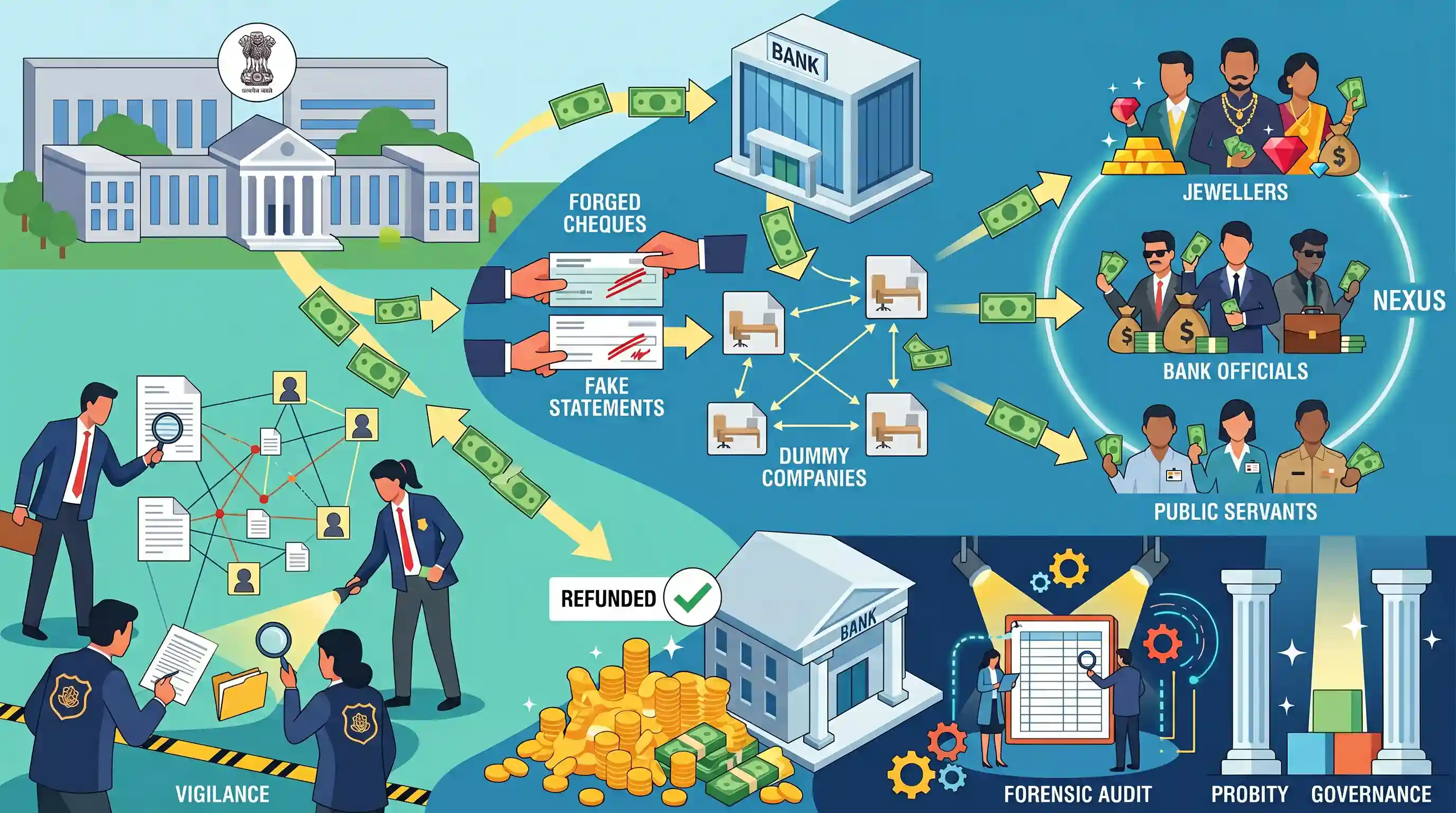
A Rs 590-crore banking fraud in Haryana has exposed systemic vulnerabilities in both public fund management and corporate banking controls. Funds from various government departments, including the Development and Panchayat Department and State Pollution Control Board, were siphoned off from IDFC First Bank. Scammers utilized forged cheques and fake bank statements to route money through dummy companies, distributing the proceeds among jewellers, bank officials, and public servants. The Haryana State Vigilance and Anti-Corruption Bureau is investigating the nexus. While the bank has refunded the money and ordered a forensic audit, the incident highlights critical lapses in financial propriety, internal banking audits, and ethical governance.
Key Points
- A massive Rs 590-crore financial fraud involved the siphoning of funds from multiple Haryana government departments deposited in IDFC First Bank.
- The scam was executed through forged cheques, fraudulent RTGS transfers, and fabricated bank statements presented to government officials.
- Investigations by the SV & ACB revealed a corrupt nexus between public servants, bank employees, and private dummy companies used to route the illicit funds.
- Siphoned public money meant for schemes like the Mukhyamantri Gramin Awas Yojana was diverted to jewellers, private individuals, and real estate.
- In response, IDFC First Bank refunded the principal and interest to the state government and initiated an independent forensic audit.
Important Terms
Haryana State Vigilance and Anti-Corruption Bureau (SV & ACB)

Haryana's primary investigative agency for curbing corruption, fraud, and revenue leakage involving public servants. It was rebranded from the State Vigilance Bureau in February 2023.
UPSC context
GS II: Governance, Transparency & Accountability. GS IV: Ethics and Probity. Tests knowledge of state-level anti-corruption institutional frameworks.
Mukhyamantri Gramin Awas Yojana (MGAY)
A state welfare scheme providing financial assistance and affordable housing plots to landless, economically weaker sections (EWS) in rural areas of Haryana.
UPSC context
GS II: Social Justice. Tests understanding of welfare schemes for vulnerable sections and rural development initiatives.
State Pollution Control Board (SPCB)
A statutory body established under the Water Act (1974) and Air Act (1981) to implement environmental laws and regulate pollution within a state's jurisdiction.
UPSC context
GS III: Environment & Ecology. GS II: Statutory Bodies. Relevant for questions on institutional constraints in environmental governance.
Haryana School Shiksha Pariyojna Parishad (HSSPP)
A registered society under the Haryana Government responsible for implementing flagship universal education programs like Samagra Shiksha (formerly SSA and RMSA) within the state.
UPSC context
GS II: Issues relating to development and management of Social Sector/Services relating to Education. Tests institutional delivery of education.
Haryana Safai Karamchari Ayog
A state-level body constituted to safeguard the rights and interests of sanitation workers and ensure the effective implementation of welfare schemes for them.
UPSC context
GS II: Mechanisms, laws, institutions and Bodies constituted for the protection and betterment of vulnerable sections.
Development and Panchayat Department
The state administrative arm responsible for overseeing Panchayati Raj Institutions (PRIs), rural infrastructure development, and the implementation of rural governance reforms.
UPSC context
GS II: Local Self-Government (Panchayati Raj). Tests knowledge of administrative structures supporting decentralized governance.
Prelims Trap
"Investing siphoned public funds into jewellery and real estate represents the 'layering' stage of money laundering."
This is the "integration" stage. Layering involves complex multi-bank transactions to obscure the trail, while integration is the final absorption into the legitimate economy.
Static Concepts Connected
What are the three standard stages of money laundering?
- Placement: Injecting illicit or dirty money directly into the formal financial system for the first time.
- Layering: Obscuring the audit trail through a series of complex financial transactions, often using dummy companies and offshore accounts.
- Integration: Re-entering the laundered funds into the legitimate economy through investments like real estate, luxury goods, or jewellery.
What is the Public Financial Management System (PFMS)?
- Nodal Agency: It is administered by the Office of the Controller General of Accounts (CGA) under the Ministry of Finance.
- Core Function: It provides a financial management platform for all plan schemes, enabling real-time tracking of funds released by the government.
- DBT Integration: It serves as the central portal for routing Direct Benefit Transfers (DBT) directly into beneficiaries' bank accounts.
Cross-Topic Patterns
Collusive corruption & institutional trust
Bank frauds involving public servants and banking officials highlight "collusive corruption", a frequent GS-4 case study theme where systemic loopholes are exploited from within rather than hacked from outside.
PFMS blind spots in commercial banks
Parking public scheme funds in commercial bank accounts without strict integration into the Single Nodal Agency (SNA) framework creates blind spots, defeating PFMS's real-time tracking goals.

Prelims 2026 could feature a multi-statement question testing PFMS architecture, Treasury Single Account (TSA), and agency bank rules.
Linked PYQs · 4
Linked PYQs · 4
- 2021MainsGS3
Discuss how emerging technologies and globalisation contribute to money laundering. Elaborate measures to tackle the problem of money laundering both at national and international levels.
- 2019MainsGS4
What do you understand by probity in governance ? Based on your understanding of the term, suggest measures for ensuring probity in government.
- 2019MainsGS4
"Non-performance of duty by a public servant is a form of corruption". Do you agree with this view? Justify your answer.
- 2024MainsGS2
“The duty of the Comptroller and Auditor General is not merely to ensure the legality of expenditure but also its propriety.” Comment.
