CIMP Patna Concludes International Public Policy Conference
Source:patnapress ↗
Why It Matters
The article touches upon critical aspects of state capacity, decentralized local governance, federal collaboration with think tanks like NITI Aayog, and regional environmental conservation efforts in Bihar.
Summary
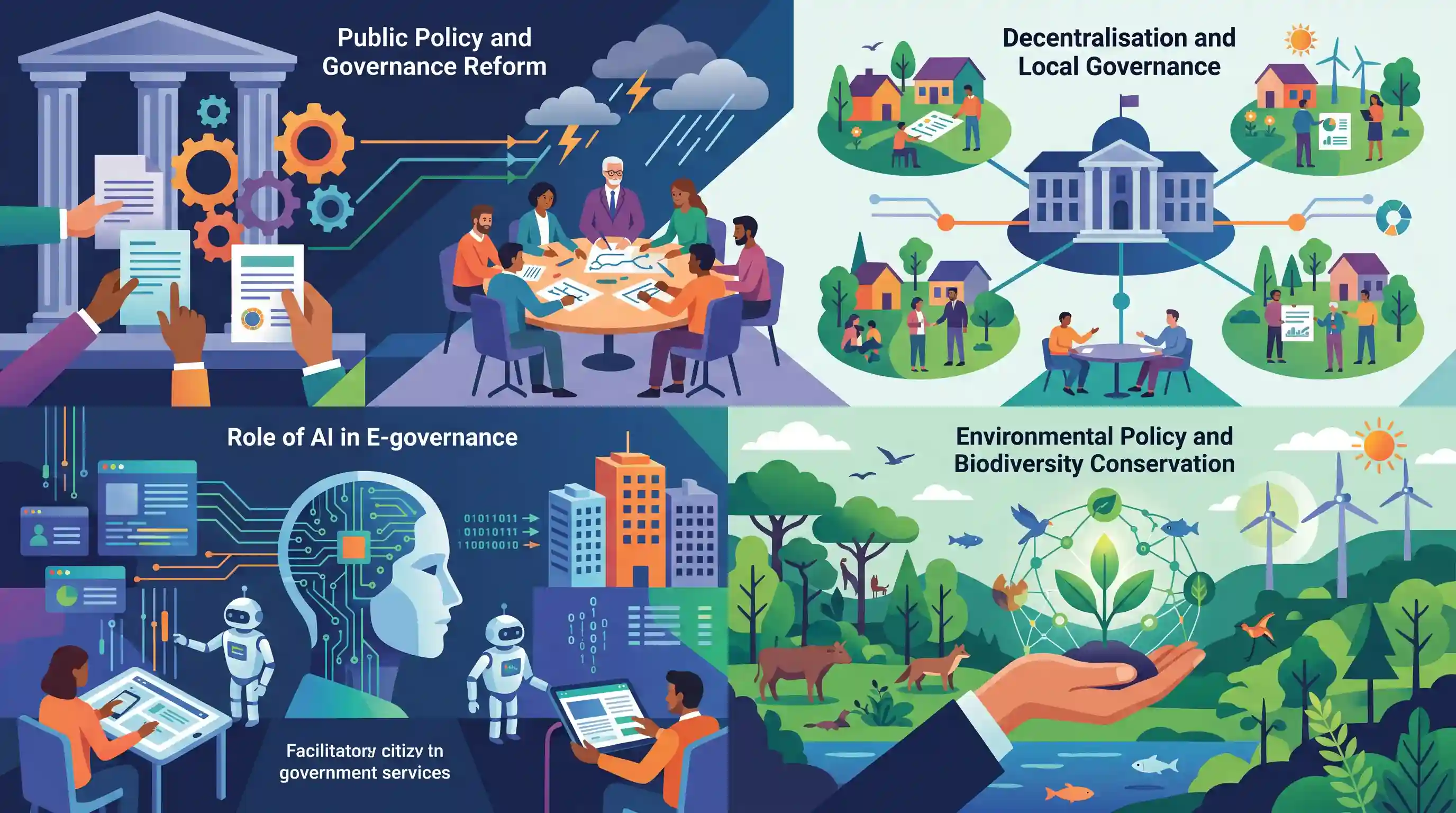
The 4th International Conference on Public Policy and Management (ICPPM–2026) concluded at the Chandragupt Institute of Management Patna (CIMP) in Bihar. Organised in collaboration with Georgia State University and supported by NITI Aayog, the event focused on governance reform, climate resilience, and public policy during polycrises. Key sessions highlighted local decentralization, AI-driven public administration, and biodiversity conservation in partnership with the Bihar State Biodiversity Board.
Key Points
- Chandragupt Institute of Management Patna (CIMP) concluded the 4th International Conference on Public Policy and Management (ICPPM-2026) on July 3, 2026.
- The conference theme was 'Public Policy in Times of Polycrisis: Rethinking Governance, Evidence and Equity', jointly organized by CIMP's Centre for Public Policy and Georgia State University's Public Finance Research Cluster, with support from NITI Aayog.
- Technical sessions addressed local decentralization, climate change resilience, AI's role in public policy and administration, and the blueprint for 'Viksit Bihar'.
- A special collaborative session with the Bihar State Biodiversity Board (BSBB) focused on 'Environment Policy, Governance and Biodiversity Conservation: Institution, Society and Community', highlighting science-based and community-driven ecological conservation.
Important Terms
NITI Aayog

The premier policy think tank of India that replaced the Planning Commission, designed to achieve sustainable development goals and enhance cooperative federalism through a bottom-up approach.
UPSC context
GS Paper II: Statutory, regulatory, and quasi-judicial bodies; GS Paper III: Planning, resource mobilization, and growth.
Bihar State Biodiversity Board (BSBB)
A statutory body established under the Biological Diversity Act, 2002, tasked with conservation, sustainable use, and equitable sharing of biological resources within the state of Bihar.
UPSC context
GS Paper III: Environmental conservation, biodiversity protection, and statutory ecological bodies.
Indira Gandhi National Forest Academy (IGNFA)
India's premier national staff college in Dehradun, Uttarakhand, responsible for training newly recruited and in-service officers of the Indian Forest Service (IFS) in sustainable forest management.
UPSC context
GS Paper III: Environmental conservation, institutional capacity building, and administrative structures of the Indian Forest Service.
Viksit Bihar
A socio-economic development vision aligned with 'Viksit Bharat @ 2047' aiming to transform Bihar into a developed, progressive, and self-reliant state by leveraging infrastructure, education, and inclusive governance.
UPSC context
GS Paper II: State-level development models and policies; GS Paper III: Regional disparities, planning, and economic growth.
Chandragupt Institute of Management Patna (CIMP)
An autonomous management institute established in 2008 by the Government of Bihar, modelled on IIMs, to foster excellence in management education, policy research, and capacity building.
UPSC context
GS Paper II: Governance, state-sponsored institutions of excellence, and public sector administrative training.
Centre for Public Policy
A specialized research wing and think tank at CIMP established to conduct evidence-based policy research, facilitate participatory governance, and train administrators for sustainable development in Bihar.
UPSC context
GS Paper II: Civil services role, evidence-based policymaking, public administration, and capacity-building frameworks.
Prelims Trap
State Biodiversity Boards (SBBs) are statutory bodies constituted under the Wildlife Protection Act, 1972, to regulate access to biological resources.
Candidates often associate environmental conservation bodies with the Wildlife Protection Act, 1972, or the Environment Protection Act, 1986, rather than the Biological Diversity Act, 2002.
Static Concepts Connected
What is the mandate of State Biodiversity Boards (SBBs) and Biodiversity Management Committees (BMCs)?
- SBB Legal Status: Established under Section 22 of the Biological Diversity Act, 2002, to advise state governments on conservation and equitable benefit sharing.
- BMCs and PBRs: Mandated under Section 41, local bodies set up BMCs to promote conservation and document local resources in People’s Biodiversity Registers (PBRs).
- Jurisdiction Limit: SBBs regulate commercial utilization of bio-resources by Indian citizens, while the National Biodiversity Authority (NBA) handles foreign approvals.
How does NITI Aayog's State Support Mission (SSM) function?
- Core Objective: Aims to reinvigorate state-level planning and build institutional capacity to help states achieve structured socio-economic targets.
- Knowledge Partners: Partners with local premier think tanks and academic institutions (such as CIMP in Bihar) to localize national development goals and policy blueprints.
- Federal Alignment: Strengthens cooperative federalism by helping states draft 2047 development visions and build resilient public policy infrastructure.
Cross-Topic Patterns
AI in E-Governance vs Digital Divide
Integrating AI in grassroots governance (like Gram Panchayats) risks deepening regional digital divides unless matched by robust rural connectivity and localized language models.
Ecological Fiscal Federalism
Linking local conservation efforts (via BMCs) to devolution of state funds using ecological indicators in finance commission criteria creates fiscal incentives for conservation.

Convergence of local self-government (73rd Amendment) with statutory biodiversity management (BMCs) is a high-yield 2026 GS-2/GS-3 theme.
Linked PYQs · 4
Linked PYQs · 4
- 2025BPSC_PRELIMSGS1
Which organisation recognized the Nagi bird sanctuary Site as an Important Bird and Biodiversity Area (IBA)?
- 2025BPSC_PRELIMSGS1
What is the main purpose of Panchayati Raj?
- 2018BPSC_PRELIMSGS1
In Government of India's NITI Aayog, which is an economic policy-making think tank, what is the full form of NITI?
- 2024-IBPSC_PRELIMSGS1
What is the system of governance in the Panchayat Raj set-up?
