ICMR study on shorter tuberculosis treatment and public health
Source:Indian Express ↗
Why It Matters
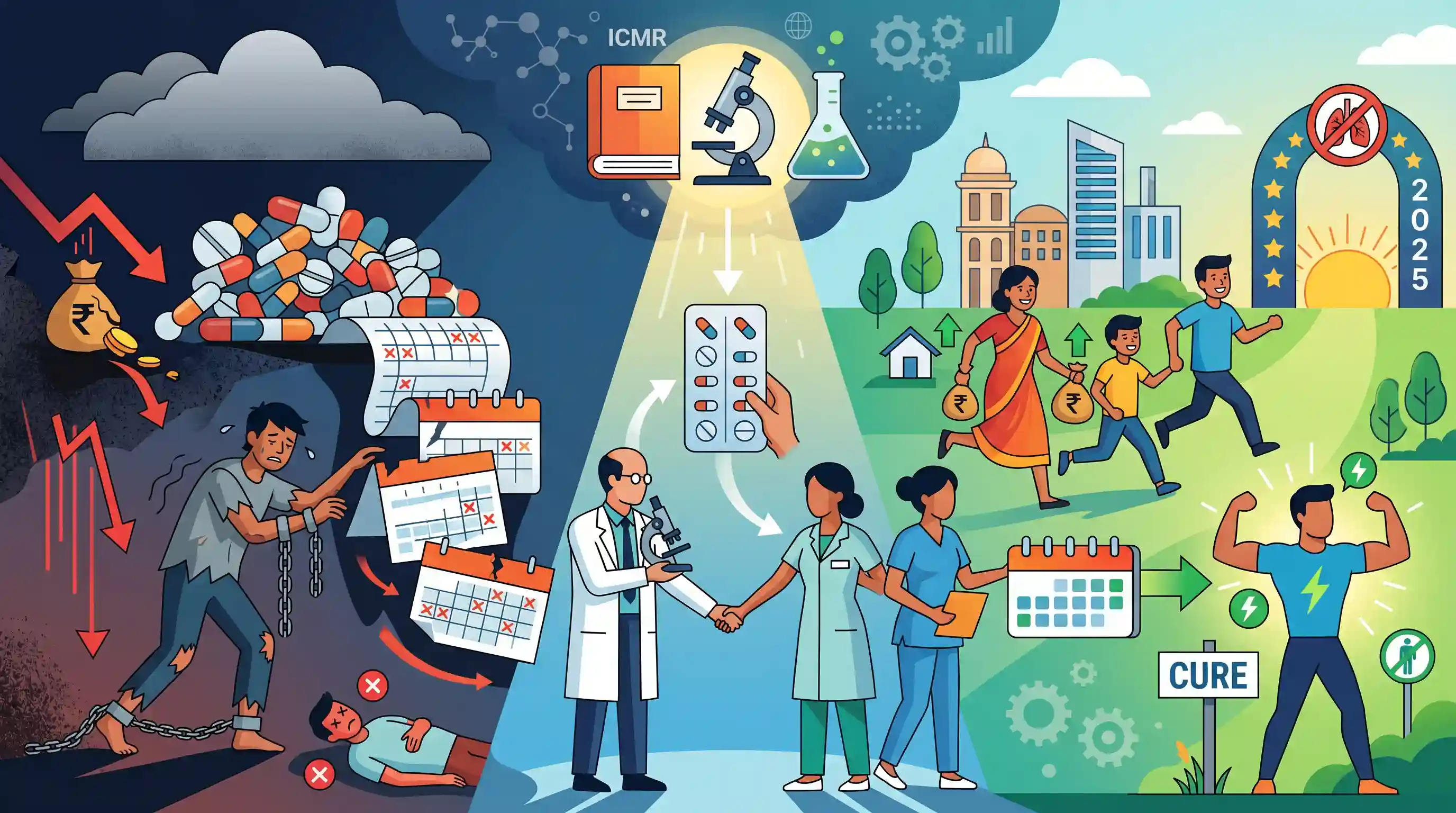
Tuberculosis remains a major public health challenge in India, accounting for a significant portion of the global TB burden. The transition to shorter, safer, and cost-effective therapies is crucial for tackling Multi-Drug Resistant TB (MDR-TB) and aligns directly with India's goal to eliminate TB by 2025. It underscores the intersection of healthcare economics, clinical research, and public health policy.
Summary
A recent study by the Indian Council of Medical Research (ICMR) has demonstrated that shorter treatment regimens for Tuberculosis (TB), particularly Multi-Drug Resistant TB (MDR-TB), significantly reduce treatment costs, minimize adverse side effects, and lower the risk of death. Traditional MDR-TB treatments typically last 18 to 24 months, leading to poor patient compliance due to high toxicity and economic strain. By transitioning to a condensed regimen (such as the 6-month BPaLM therapy), patients experience better health outcomes, higher cure rates, and less financial hardship. This evidence-based shift in treatment protocols is a critical enabler for India's National TB Elimination Programme (NTEP), which aims to eradicate the disease by 2025, addressing both the public health crisis of antimicrobial resistance and healthcare affordability.
Key Points
- An ICMR study highlights that a shorter treatment regimen for Tuberculosis (TB), especially multi-drug resistant strains (MDR-TB), is highly effective compared to traditional long-term therapies.
- The conventional treatment for MDR-TB lasts 18-24 months, whereas shorter regimens (such as the 6-month BPaLM regimen) significantly improve patient compliance and treatment outcomes.
- The shorter therapy drastically cuts down out-of-pocket expenditure for patients and reduces the financial burden on the public healthcare system.
- Patients experience fewer severe side effects and a significantly reduced risk of mortality, making the treatment safer and more tolerable.
- This clinical evidence provides a critical boost to India's ambitious goal of eliminating TB by 2025, five years ahead of the global Sustainable Development Goal (SDG) target.
Important Terms
National Strategic Plan (NSP) for TB Elimination

A 2017-2025 framework by the Ministry of Health aiming to eliminate tuberculosis in India by 2025. It employs a "Detect, Treat, Prevent, Build" strategy to drastically reduce incidence and mortality.
UPSC context
GS Paper II (Social Sector/Health). Tests knowledge of national health missions and specific targets for communicable disease eradication.
National TB Elimination Programme (NTEP)
Formerly the RNTCP, this flagship initiative manages India's TB control. It provides free diagnostics, standardized treatment protocols, and financial incentives like the Ni-kshay Poshan Yojana to ensure patient compliance.
UPSC context
GS Paper II (Governance). Relevant for understanding the institutional framework and schemes achieving Universal Health Coverage.
BPaLM Regimen
A condensed 6-month, all-oral treatment for drug-resistant TB comprising Bedaquiline, Pretomanid, Linezolid, and Moxifloxacin. It replaces longer, toxic 18-month regimens, improving cure rates and reducing costs.
UPSC context
GS Paper III (Science & Tech). Tests awareness of medical innovations and the management of antimicrobial resistance (AMR).
Multi-Drug Resistant TB (MDR-TB)
A form of tuberculosis resistant to at least Isoniazid and Rifampicin, the primary first-line drugs. It represents a significant public health challenge due to its complex and expensive treatment.
UPSC context
GS Paper III (Health/S&T). Core topic regarding public health crises and evolution of drug-resistant disease protocols.
Indian Council of Medical Research (ICMR)
The apex Indian body for biomedical research. It coordinates clinical trials and economic evaluations, like the BPaLM study, to provide evidence-based recommendations for national health policies.
UPSC context
GS Paper III (S&T). Relevant for institutional roles in indigenous research and evidence-based policy making.
World Health Organization (WHO)
The United Nations agency for international public health. It established the "End TB Strategy" and global treatment standards that India aims to meet five years ahead of schedule.
UPSC context
GS Paper II (International Relations). Tests knowledge of global health governance and alignment with Sustainable Development Goals.
Prelims Trap
India's national target to eliminate Tuberculosis is aligned exactly with the global Sustainable Development Goal (SDG) target of 2030.
India's National TB Elimination Programme (NTEP) targets eradication by 2025. This is exactly five years ahead of the global SDG 2030 target. Do not conflate the two deadlines.
Static Concepts Connected
What is the difference between MDR-TB and XDR-TB?
- MDR-TB: Occurs when the bacteria develop resistance to at least Isoniazid and Rifampicin, the two most potent first-line anti-TB drugs.
- XDR-TB: Resistance to Isoniazid and Rifampicin, plus resistance to any fluoroquinolone and at least one second-line injectable drug (like amikacin).
What are the key interventions under India's National TB Elimination Programme (NTEP)?
- Ni-kshay Poshan Yojana: Provides Rs 500 per month via Direct Benefit Transfer (DBT) to TB patients to meet their nutritional requirements during treatment.
- Universal Drug Testing: Mandates testing all diagnosed TB patients for drug resistance upfront to ensure early initiation of appropriate MDR-TB regimens.
- Ni-kshay Portal: Real-time, web-enabled TB surveillance system to track patients, treatment adherence, and DBT disbursements across India.
Cross-Topic Patterns
Health Economics & AMR Link
Prolonged TB treatment causes catastrophic Out-of-Pocket Expenditure (OOPE). This economic burden drives treatment dropouts, which in turn fuels the broader Antimicrobial Resistance (AMR) crisis.
IPR laws vs Public Health
The shorter BPaLM regimen relies on Bedaquiline. The recent Indian patent office rejection of its secondary patent (evergreening) highlights the tension between IPR laws and public health affordability.

MDR/XDR-TB definitions, the BPaLM regimen, and India's 2025 elimination deadline will likely form a multi-statement Prelims question in 2026.
Linked PYQs · 3
Linked PYQs · 3
- 2019PrelimsGS1
Which of the following are the reasons for the occurrence of multi-drug resistance in microbial pathogens in India? 1. Genetic predisposition of some people 2. Taking incorrect doses of antibiotics to cure diseases 3. Using antibiotics in livestock farming 4. Multiple chronic diseases in some people Select the correct answer using the code given below.
- 2014MainsGS3
Can overuse and free availability of antibiotics without Doctor's prescription, be contributors to the emergence of drug-resistant diseases in India? What are the available mechanisms for monitoring and control? Critically discuss the various issues involved.
- 2024MainsGS2
In a crucial domain like the public healthcare system the Indian State should play a vital role to contain the adverse impact of marketisation of the system. Suggest some measures through which the State can enhance the reach of public healthcare at the grassroots level.
