Mobile biosafety laboratories and public health outbreak preparedness
Source:The Hindu ↗
Why It Matters
Provides a concrete example of how India is upgrading its public health infrastructure to manage zoonotic disease outbreaks and health crises, directly relevant to GS2 (health governance/PM-ABHIM) and GS3 (biotechnology applications/disaster response).
Summary
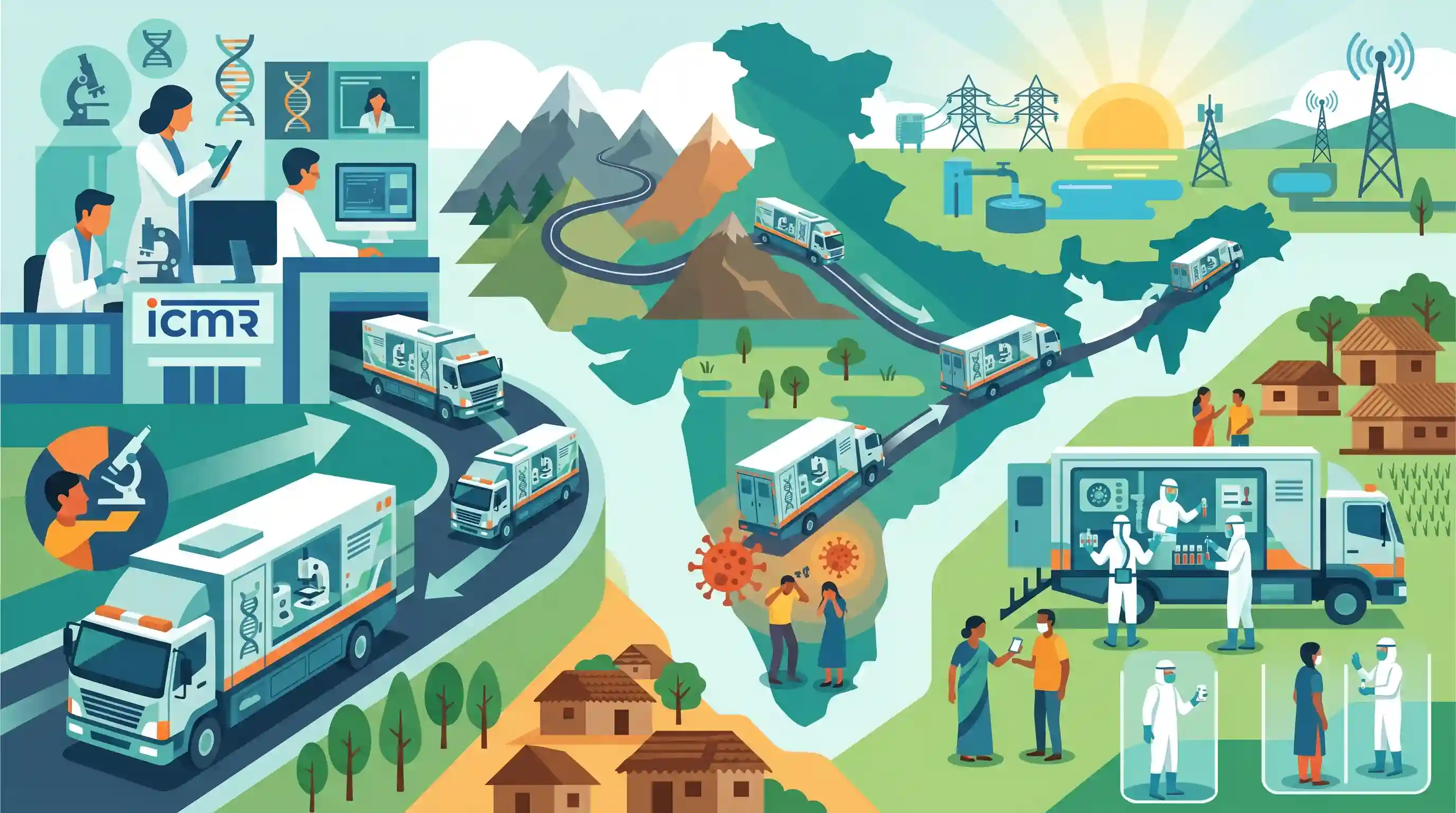
The Indian Council of Medical Research (ICMR) is ramping up its Mobile Biosafety Level-3 (BSL-3) laboratory capacity to bolster India's rapid response capabilities against infectious disease outbreaks. Known as RAMBAAN, these state-of-the-art mobile units are designed to reach remote areas and function as Type-IV Rapid Response Mobile Laboratories. Deployed successfully during recent Nipah virus outbreaks in Kerala, these indigenous labs are a crucial public health infrastructure upgrade developed under the Pradhan Mantri Ayushman Bharat Health Infrastructure Mission (PM-ABHIM).
Key Points
- The ICMR is expanding its mobile BSL-3 laboratory fleet, known as RAMBAAN, to enhance rapid pathogen surveillance and outbreak response in remote areas.
- The initiative is a core component of the 'Advanced Augmented Network' under the Pradhan Mantri Ayushman Bharat Health Infrastructure Mission (PM-ABHIM).
- The indigenous laboratories feature advanced containment technologies like negative air pressure, HEPA filters, and biological liquid effluent decontamination (BLED).
- The existing mobile units have already proven effective, having been deployed during the Nipah virus outbreaks in Kozhikode (2023) and Malappuram (2024).
Important Terms
Pradhan Mantri Ayushman Bharat Health Infrastructure Mission (PM-ABHIM)

India's largest pan-national health infrastructure scheme launched in 2021. It aims to strengthen primary, secondary, and tertiary healthcare systems, improve disease surveillance, and bolster pandemic preparedness across all districts.
UPSC context
GS-2: Social Justice/Health; GS-3: Disaster Management. Key for questions on public health reforms and resilient infrastructure.
RAMBAAN (Rapid Action Mobile BSL-3 laboratory)
India's first indigenous, mobile Biosafety Level-3 (BSL-3) laboratory. Designed for rapid on-site diagnosis of high-risk pathogens like Nipah, it functions as a 'laboratory on wheels' for remote areas.
UPSC context
GS-3: Science & Technology. Relevant for indigenous technological innovations and emergency outbreak response mechanisms.
Indian Council of Medical Research (ICMR)
The apex body in India for the formulation, coordination, and promotion of biomedical research. It functions under the Department of Health Research, Ministry of Health and Family Welfare.
UPSC context
GS-2: Governance; GS-3: Science & Tech institutions. Tests knowledge of premier national research bodies and policy formulation.
ICMR-National Institute of Virology (ICMR-NIV)
A premier research institute under ICMR focusing on viral diseases. It provides critical diagnostic support, leads national viral surveillance, and manages high-containment (BSL-3/BSL-4) facilities.
UPSC context
GS-3: Science & Technology. Essential for understanding India's virological research and containment strategies for emerging infectious threats.
Global Outbreak Alert and Response Network (GOARN)
A WHO-coordinated global technical partnership that mobilizes experts and resources for rapid identification, confirmation, and response to international public health emergencies and outbreaks.
UPSC context
GS-2: International Relations. Relevant for global health governance and international collaboration during health crises.
Prelims Trap
BSL-3 containment laboratories utilize positive air pressure systems to prevent pathogens from contaminating the environment.
BSL-3 labs strictly use negative air pressure. This ensures air only flows INTO the lab, preventing deadly airborne pathogens from escaping into the outside environment.
Static Concepts Connected
What are the core technical requirements of a Biosafety Level-3 (BSL-3) laboratory?
- Negative Air Pressure: Maintains continuous inward directional airflow so that contaminated air cannot escape the laboratory into adjacent areas.
- HEPA Filtration: All exhaust air is filtered through High-Efficiency Particulate Air (HEPA) filters to trap infectious microscopic agents before release.
- Effluent Decontamination: Uses Biological Liquid Effluent Decontamination (BLED) systems to rigorously sterilize all liquid waste before environmental discharge.
- Pathogen Profile: Designed specifically to handle indigenous or exotic microbes that cause serious or potentially lethal diseases through inhalation (e.g., Nipah, Tuberculosis).
What are the major components of PM Ayushman Bharat Health Infrastructure Mission (PM-ABHIM)?
- Diagnostic Networks: Establishing Integrated Public Health Labs (IPHLs) in all districts and setting up block public health units to decentralized testing.
- Critical Care: Creating exclusive critical care hospital blocks in districts with over 5 lakh population to handle severe outbreaks.
- Surveillance Infrastructure: Setting up a National Institution for One Health, four regional virology labs, and mobile BSL-3 networks for rapid response.
Cross-Topic Patterns
Zoonoses + One Health Approach
The recurrent Nipah outbreaks emphasize the GS3 overlap between environmental degradation (bat habitat loss) and public health, central to the National One Health Mission.
Biological Disasters + NDMA Guidelines
Under GS3 Disaster Management, biological emergencies require specialized rapid deployment infrastructure like RAMBAAN, aligning with NDMA guidelines for managing biological disasters and pandemics.

Expect a 2026 Prelims question combining PM-ABHIM's institutional framework with BSL-3 technical specifications like negative pressure.
Linked PYQs · 3
Linked PYQs · 3
- 2024MainsGS2
In a crucial domain like the public healthcare system the Indian State should play a vital role to contain the adverse impact of marketisation of the system. Suggest some measures through which the State can enhance the reach of public healthcare at the grassroots level.
- 2024PrelimsGS1
With reference to monoclonal antibodies, often mentioned in news, consider the following statements : I. They are man-made proteins. II. They stimulate immunological function due to their ability to bind to specific antigens. III. They are used in treating viral infections like that of Nipah virus. Which of the statements given above are correct?
- 2021MainsGS2
“Besides being a moral imperative of a Welfare State, primary health structure is a necessary precondition for sustainable development.” Analyze.
