ICMR Grant for Breast Cancer Drug Discovery and Therapy Resistance
Source:Indian Express ↗
Why It Matters
The article demonstrates practical progress in India's medical research sector, particularly regarding non-communicable diseases like cancer. It touches on domestic R&D capabilities, intellectual property (patents) in drug discovery, and addressing specific healthcare gaps (therapy resistance in post-menopausal women), all of which are relevant to GS3 (Science & Tech, IPR) and GS2 (Health).
Summary
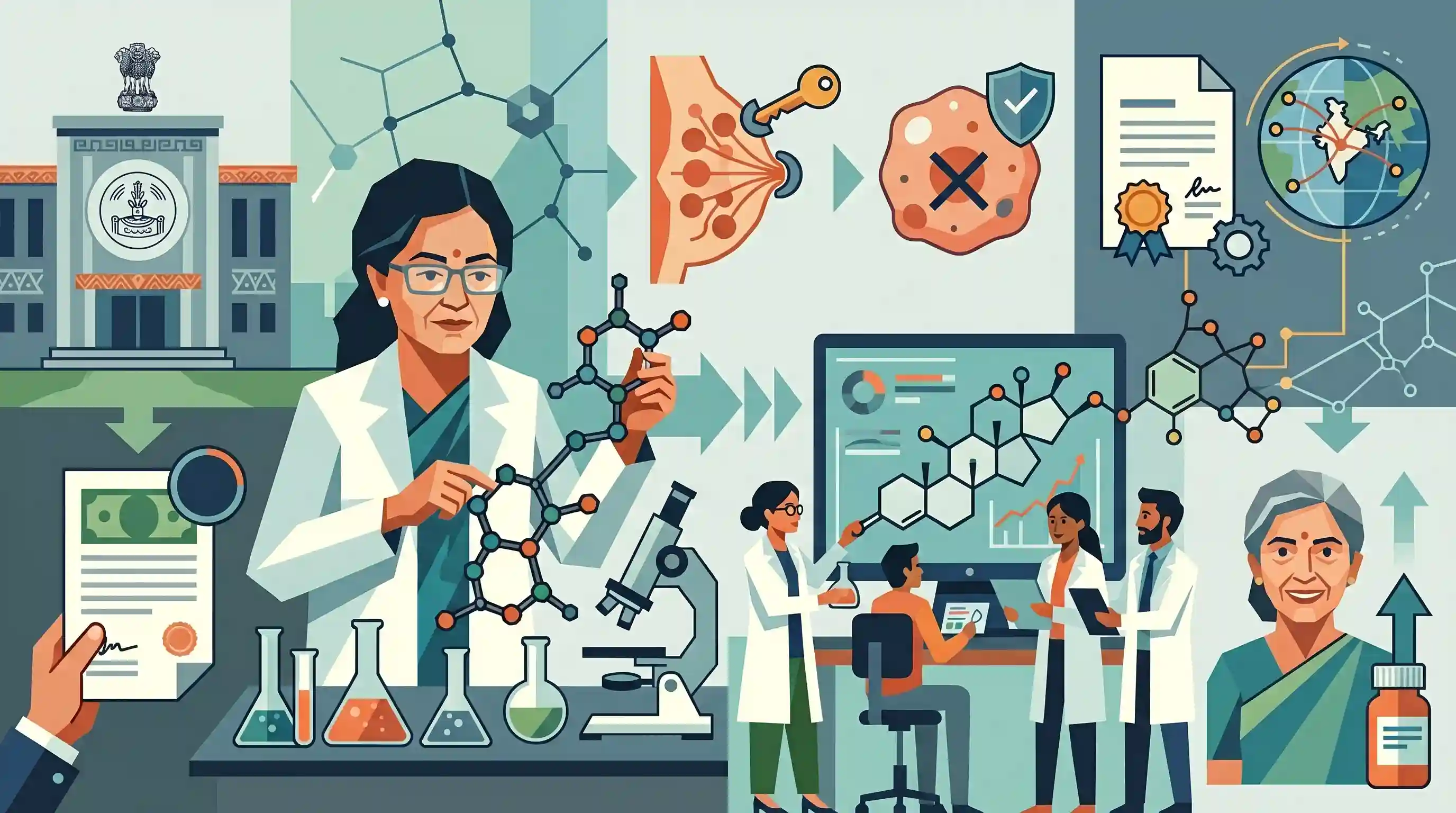
The Indian Council of Medical Research (ICMR) has awarded a Rs 65-lakh grant to Professor Ranju Bansal of Panjab University for a three-year research project focused on breast cancer. The initiative aims to develop novel steroidal drug molecules that can overcome therapy resistance, a common issue for post-menopausal women who initially respond to hormone-blocking treatments. The project highlights India's ongoing efforts in advanced medicinal chemistry and domestic drug development, building on Prof. Bansal's prior successes in creating internationally patented anti-cancer compounds.
Key Points
- The ICMR has granted Rs 65 lakh to Panjab University for a three-year research project on breast cancer drug development.
- Led by Professor Ranju Bansal, the project aims to design novel steroidal drug molecules to overcome therapy resistance.
- The research targets post-menopausal women who develop resistance to hormone-blocking medicines over time, addressing a major gap in breast cancer care.
- The drug compounds will undergo testing across multiple cancer cell lines and validation in animal models.
- Professor Bansal previously discovered potent aromatase inhibitors for cancer treatment, which are secured by international patents in the US, Europe, and Japan.
Important Terms
Indian Council of Medical Research (ICMR)

The apex body in India for formulating, coordinating, and promoting biomedical research, operating under the Department of Health Research (Ministry of Health and Family Welfare).
UPSC context
GS Paper 2 & 3; tests institutional framework for health research and scientific policy in India.
Indigenization of Technology
The domestic development, adaptation, and production of technology to reduce reliance on imports and enhance strategic autonomy and self-reliance.
UPSC context
GS Paper 3 (S&T syllabus); tests knowledge of domestic R&D and 'Atmanirbhar Bharat' initiatives.
Therapy Resistance
A condition where cancer cells adapt and survive medical treatments, leading to treatment failure; a primary focus of advanced medicinal chemistry research.
UPSC context
GS Paper 2 (Health) & GS Paper 3 (S&T); evaluates understanding of biological challenges in oncology.
Medicinal Chemistry
An interdisciplinary field combining chemistry, biology, and pharmacology to design, synthesize, and optimize pharmaceutical drugs for therapeutic purposes.
UPSC context
GS Paper 3 (S&T); relevant for "Achievements of Indians in Science & Technology" and pharmaceutical innovation.
Intellectual Property Rights (IPR)
Legal rights protecting mental creations; in pharma, specifically pharmaceutical patents under the Patents Act, 1970, which incentivize the development of new drug molecules.
UPSC context
GS Paper 3 (IPR issues); tests knowledge of patent regimes, TRIPS compliance, and innovation incentives.
Prelims Trap
Aromatase inhibitors are broad-spectrum chemotherapy drugs effective against all stages and types of breast cancer.
They are highly targeted therapies designed to block estrogen production specifically in hormone-receptor-positive breast cancer for post-menopausal women, not a broad-spectrum cure.
Static Concepts Connected
What differentiates targeted cancer therapy from traditional chemotherapy?
- Cellular Targeting: Targeted drugs identify specific proteins or genes in cancer cells, whereas traditional chemotherapy attacks all rapidly dividing cells, including healthy tissue like hair follicles and GI tract cells.
- Mechanism of Action: Targeted therapies often act cytostatically (blocking tumor-fueling hormones or enzymes like aromatase to halt proliferation), unlike chemotherapy which is typically cytotoxic (aiming to kill cells outright).
How does the Patent Cooperation Treaty (PCT) aid Indian drug discoveries globally?
- Unified Filing: It provides a unified procedure allowing inventors to file a single international patent application to seek protection simultaneously in over 150 contracting states.
- Territorial Grant: Despite the international filing, patents remain strictly territorial. The actual granting of the patent is decided by individual national offices (like USPTO or EPO) during the 'national phase'.
Cross-Topic Patterns
Shift toward indigenous bio-discovery and IPR
Securing global patents for Indian academic research highlights the critical evolution of India's pharmaceutical sector from bulk generic drug manufacturing toward New Chemical Entities (NCE) and novel drug discovery.
Women's Health & Late-stage Diagnostics
Breast cancer care in India faces systemic health-infrastructure hurdles. Unlike high-income nations, over 60% of cases are diagnosed at late stages, elevating the need for advanced treatments tackling therapy resistance.

Expect a 2026 Prelims question differentiating oncology 'therapy resistance' from AMR, and identifying mechanisms of targeted therapies.
Linked PYQs · 4
Linked PYQs · 4
- 2014MainsGS3
In a globalized world, Intellectual Property Rights assume significance and are a source of litigation. Broadly distinguish between the terms-Copyrights, Patents and Trade Secrets.
- 2019PrelimsGS1
'RNA interference (RNAi)' technology has gained popularity in the last few years. Why? 1. It is used in developing gene silencing therapies. 2. It can be used in developing therapies for the treatment of cancer. 3. It can be used to develop hormone replacement therapies. 4. It can be used to produce crop plants that are resistant to viral pathogens. Select the correct answer using the code given below.
- 2020PrelimsGS1
With reference to carbon nanotubes, consider the following statements: 1. They can be used as carriers of drugs and antigens in the human body. 2. They can be made into artificial blood capillaries for an injured part of human body. 3. They can be used in biochemical sensors. 4. Carbon nanotubes are biodegradable. Which of the statements given above are correct?
- 2020MainsGS2
In order to enhance the prospects of social development, sound and adequate health care policies are needed particularly in the fields of geriatric and maternal health care. Discuss.
