ICMR study highlights social media impact on adolescent behavior
Source:Indian Express ↗
Why It Matters
This article serves as an excellent contemporary case study for mains answers related to the impact of technology on society, socialization of children, and changing cultural values. It provides concrete examples (normalization of alcohol, risky sexual behaviors, decline in family bonding) that directly address UPSC questions on mobile phones replacing 'child cuddling' (GS1) and internet expansion conflicting with traditional values (GS4).
Summary
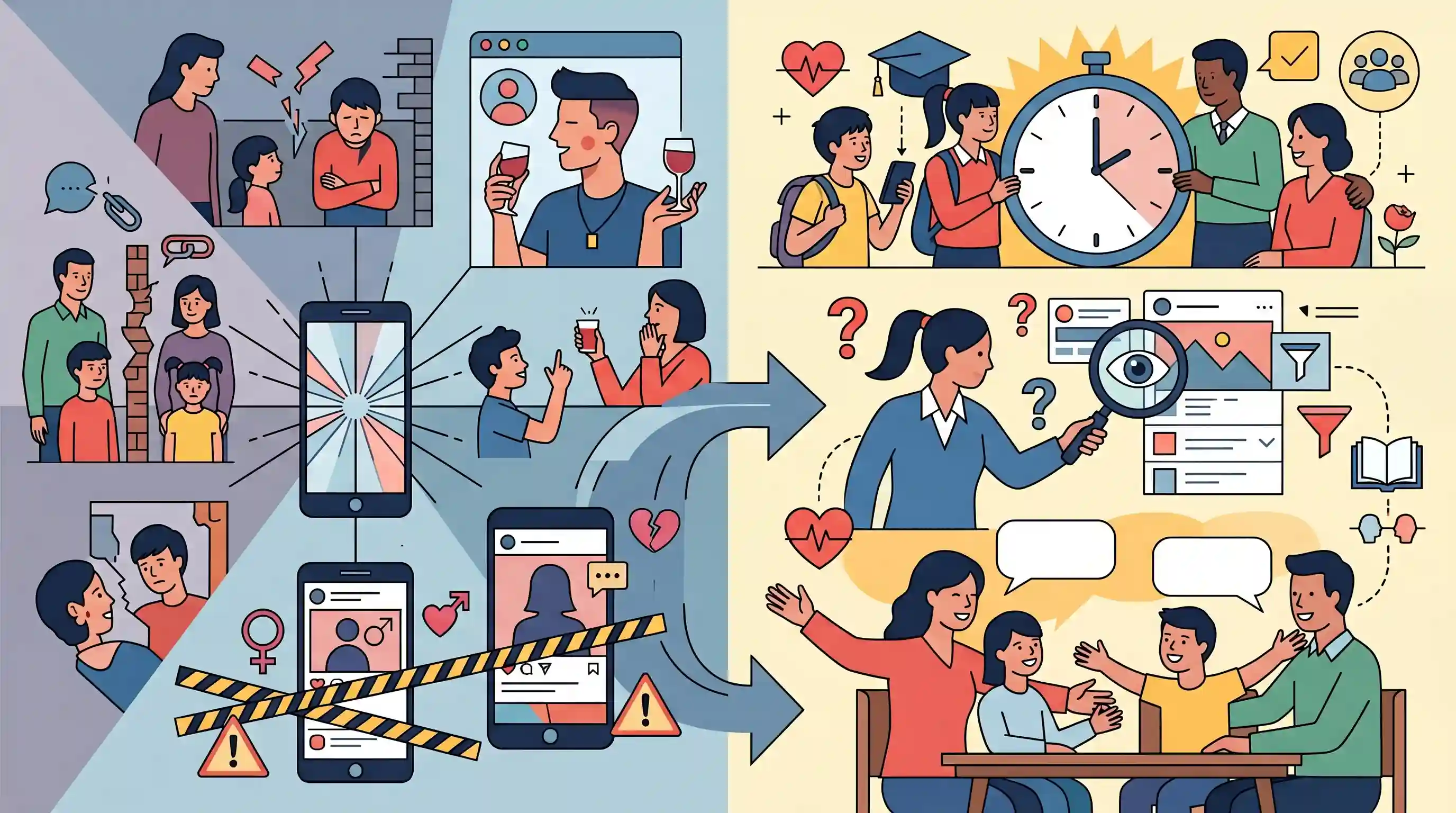
An ICMR-funded study conducted by PGIMER, Chandigarh has initiated a social media safety intervention for adolescents in Panchkula after observing concerning trends. The study found that excessive social media usage is severely damaging child-family relationships and emotional bonding. Furthermore, influencer culture and online peer pressure are normalizing underage alcohol consumption, while unfiltered access to sexualized content and dating platforms is driving risky sexual behaviors. The intervention aims to educate students, teachers, and parents on setting screen-time boundaries, evaluating online content critically, and fostering open, real-life communication to mitigate cyber risks and mental health challenges.
Key Points
- An ICMR-funded study by PGI Chandigarh exposes the detrimental impacts of social media on adolescents, identifying it as a catalyst for normalizing underage alcohol consumption and risky sexual behaviors.
- The study highlights that excessive screen time weakens child-family communication, replacing real-life emotional bonding with superficial online connections and increasing vulnerability to psychological distress.
- Social media influencer culture, surrogate advertising, and FOMO (Fear Of Missing Out) are playing major roles in driving substance abuse among youth.
- Exposure to unfiltered sexualized content and unregulated dating apps has escalated instances of cyber-intimacy, misinformation regarding consent, and associated risks like blackmail or harassment.
- To combat these issues, researchers launched a social media safety intervention in Panchkula focusing on establishing screen-time boundaries, content filtering, educating on digital footprints, and promoting open parent-child dialogues.
Important Terms
Indian Council of Medical Research (ICMR)

India's apex body for the formulation, coordination, and promotion of biomedical research. It functions under the Department of Health Research, Ministry of Health and Family Welfare.
UPSC context
GS II: Statutory, regulatory and various quasi-judicial bodies; Health-related policy and research governance.
PGIMER Chandigarh
A premier public medical university in Chandigarh and an 'Institute of National Importance.' It is a leading tertiary care provider and research hub in Northern India.
UPSC context
GS II: Issues relating to development and management of Social Sector/Services relating to Health and Education.
Social Media Safety Intervention
Targeted educational programs designed to protect youth from online risks like cyberbullying, digital addiction, and inappropriate content while promoting responsible screen-time boundaries.
UPSC context
GS II & III: Social empowerment, mental health, and challenges to internal security through communication networks.
Adolescent Health
A developmental stage (ages 10-19) characterized by vulnerability to mental health issues, peer pressure, and risk-taking behaviors, often exacerbated by digital overexposure in modern society.
UPSC context
GS I & II: Salient features of Indian Society; Issues relating to children and human resources.
Digital Literacy
The ability to find, evaluate, and communicate information through various digital platforms, crucial for adolescents to critically assess influencer marketing and unfiltered online content.
UPSC context
GS II: Education and Human Resources; essential for mitigating cyber risks and misinformation.
Influencer Culture
The pervasive lifestyle and economic system where individuals leverage social media following to shape public opinion, which often normalizes risky behaviors like underage drinking among youth.
UPSC context
GS I: Impact of globalization on Indian society; Role of social media in value-formation.
Prelims Trap
ICMR's mandate is restricted exclusively to clinical biomedical research and epidemic management.
Aspirants often assume ICMR only handles virology and clinical trials. ICMR actively funds broad public health, socio-behavioral studies, and psychosocial interventions.
Static Concepts Connected
What constitutes surrogate advertising and how is it regulated in India?
- Definition: Promoting restricted goods (alcohol/tobacco) under the guise of identical-looking permitted products like club sodas, packaged water, or music CDs.
- Legal Framework: Explicitly banned under the Consumer Protection Act 2019 via CCPA guidelines (Prevention of Misleading Advertisements), alongside the Cable Television Networks (Regulation) Act, 1995.
- Influencer Guidelines: The ASCI (Advertising Standards Council of India) sets self-regulatory codes requiring social media influencers to disclose paid partnerships and avoid promoting prohibited items.
What are the standard agents of socialization in Indian society?
- Primary Agents: The family unit, which is traditionally responsible for foundational emotional bonding, initial ethical baselines, and cultural continuity.
- Secondary Agents: Educational institutions and peer groups that introduce formal civic values, structured discipline, and broader societal norms.
- Emerging Agents: Mass media and digital platforms, which increasingly act as dominant forces, sometimes overriding traditional values with globalized, consumer-driven lifestyles.
Cross-Topic Patterns
Behavioral vulnerability as a cyber threat
The overlap between screen addiction and cyber-intimacy risks highlights how psychological vulnerabilities directly feed into cybercrimes like grooming, sextortion, and blackmail.
Influencer accountability and CCPA guidelines
Normalizing underage drinking via influencers links public health with governance, invoking the Central Consumer Protection Authority's (CCPA) recent guidelines against surrogate advertising.

Expect a GS1/GS4 Mains question evaluating social media as a dominant 'tertiary socializing agent' eroding traditional family value systems.
Linked PYQs · 2
Linked PYQs · 2
- 2023MainsGS1
Child cuddling is now being replaced by mobile phones. Discuss its impact on the socialization of children.
- 2020MainsGS4
‘The current internet expansion has instilled a different set of cultural values which are often in conflict with traditional values.’ Discuss.
