Rising Global Temperatures Trigger First Mosquito Sightings in Iceland
Source:Indian Express ↗
Why It Matters
The article serves as a tangible, real-world case study of how climate change and global warming alter ecosystems and species distribution. It is highly relevant for UPSC questions dealing with the ecological consequences of climate change, vector-borne diseases, and invasive species in vulnerable environments like the Arctic.
Summary
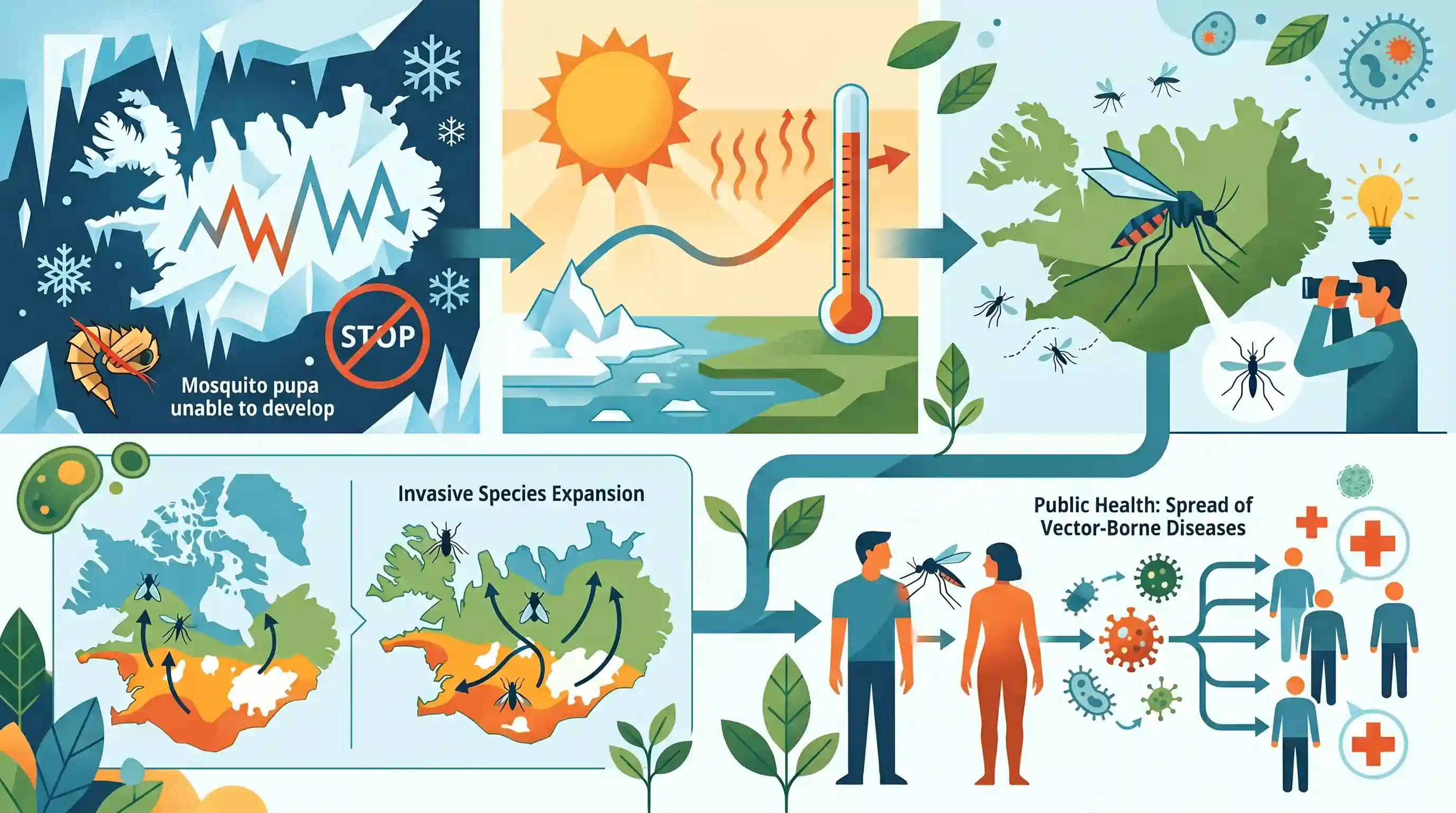
Iceland, historically one of the few places on Earth devoid of mosquitoes, has recently recorded its first sightings of the insect. For centuries, Iceland's highly volatile climate—featuring rapid, unpredictable cycles of freezing and thawing—prevented mosquitoes from completing their aquatic pupal stage before freezing over. However, escalating global warming is stabilizing temperatures and causing milder winters in the sub-Arctic. This climatic shift is altering fragile northern ecosystems, allowing previously absent insect vectors to establish populations. The arrival of mosquitoes in Iceland underscores the broader ecological consequences of climate change, including the geographical expansion of invasive species and the potential spread of vector-borne diseases into new territories.
Key Points
- Iceland has historically been mosquito-free due to its rapid, unpredictable freeze-thaw cycles that prevented the insect from completing its life cycle.
- The first recent sightings of mosquitoes in Iceland highlight significant ecological shifts driven by global warming.
- Rising global temperatures and milder, more stable winters are making previously inhospitable sub-Arctic and Arctic regions viable for insect vectors.
- This event serves as an indicator of broader climate change consequences, including the range expansion of invasive species and potential vector-borne diseases.
Prelims Trap
Iceland remained mosquito-free historically solely because of its extreme cold climate.
The barrier was Iceland's unpredictable freeze-thaw cycles disrupting the pupal stage, not just extreme cold. Other Arctic regions like Siberia have vast summer mosquito swarms.
Static Concepts Connected
What drives Arctic Amplification, making the region warm faster than the global average?
- Albedo effect: Melting of white ice and snow exposes dark ocean or land mass, which absorbs more solar radiation.
- Lapse rate feedback: The Arctic atmosphere is highly stratified; near-surface warming gets trapped rather than mixing upward into the troposphere.
Which global body monitors and databases Invasive Alien Species?
- IUCN SSC: The Invasive Species Specialist Group operates under the Species Survival Commission of the IUCN.
- GISD: They manage the Global Invasive Species Database, tracking the threat of alien species worldwide.
Cross-Topic Patterns
Climate Change & Vector Geographies
Shifting isotherms are pushing vector-borne diseases like dengue and malaria into higher latitudes (e.g., Europe) and higher altitudes (e.g., the Himalayas), creating novel public health crises.
Arctic Amplification & Albedo
The rapid warming of the sub-Arctic connects to positive feedback loops, where melting ice lowers albedo, linking biodiversity shifts directly to fundamental climatology concepts.

Expect a multi-statement question linking Arctic amplification, shifting isotherms, and the latitudinal/altitudinal expansion of vector diseases.
Linked PYQs · 3
Linked PYQs · 3
- 2022MainsGS3
Discuss global warming and mention its effects on the global climate. Explain the control measures to bring down the level of greenhouse gases which cause global warming, in the light of the Kyoto Protocol, 1997.
- 2023PrelimsGS1
'Invasive Species Specialist Group' (that develops Global Invasive Species Database) belongs to which one of the following organizations?
- 2017MainsGS3
'Climate change' is a global problem. How India will be affected by climate change? How Himalayan and coastal states of India will be affected by climate change?
