Ice age relict species rediscovery in the Western Ghats ecosystem
Source:The Hindu ↗
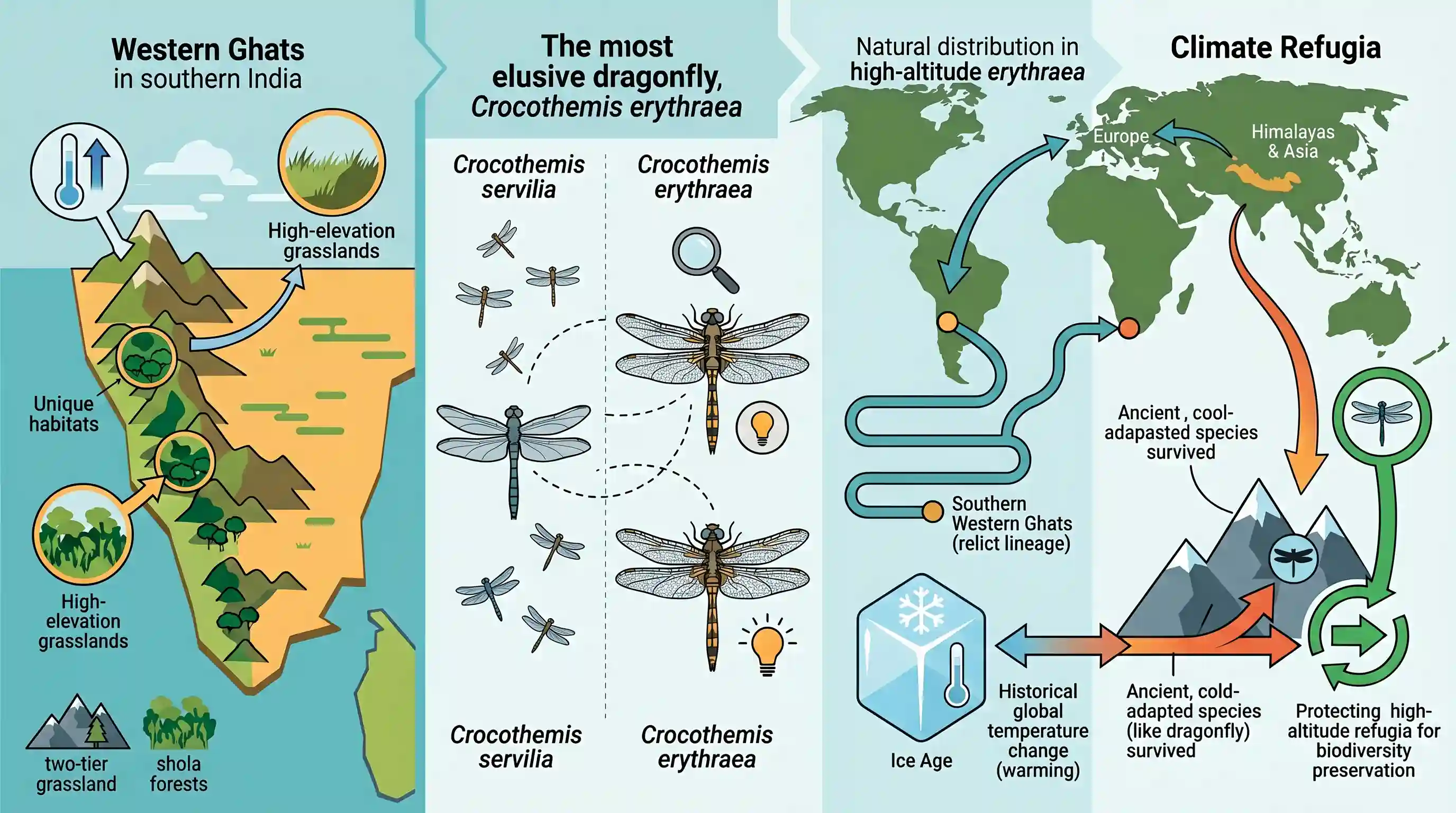
Why It Matters
Highlights the ecological significance of high-altitude habitats in the Western Ghats as climate refugia for ancient species (relicts). It is highly relevant for Prelims (species habitat, endemic vs. relict species) and Mains (conservation of unique micro-climates against modern climate change).
Summary
The elusive dragonfly species *Crocothemis erythraea* has been rediscovered in the high-elevation regions of the southern Western Ghats, functioning as a biogeographical 'ice age relic'. Previously misidentified due to its resemblance to the common lowland species *Crocothemis servilia*, this dragonfly is otherwise restricted to high-altitude habitats in the Himalayas, Europe, and Asia. Its isolated presence in southern India underscores the importance of the Western Ghats' elevated ecosystems—such as shola-grasslands—as vital climate refugia that harbor ancient, relict lineages which became isolated following historical global temperature changes.
Key Points
- Odonatologists reconfirmed the presence of the dragonfly species Crocothemis erythraea in the high-elevation regions of the southern Western Ghats.
- The dragonfly is considered an 'ice age relic', having found refuge in the cooler, high-altitude environments of the Western Ghats after past glacial periods.
- It was previously misidentified or overlooked due to its close visual resemblance to the widespread lowland species, Crocothemis servilia.
- While C. servilia is common in lowlands, C. erythraea is otherwise known only from high-elevation habitats in parts of Europe, Asia, and the Himalayas.
- The rediscovery emphasizes the critical role of the Western Ghats' high-altitude ecosystems as climate refugia that preserve isolated, ancient genetic lineages.
Prelims Trap
"Crocothemis erythraea is a newly discovered dragonfly species that is endemic to the Western Ghats."
It is a globally distributed high-altitude species (Europe, Asia, Himalayas) that exists in the Ghats as a disjunct, isolated 'relict' population. It is not endemic.
Static Concepts Connected
What are the key ecological features of Shola-grassland ecosystems?
- Altitude & Location: Stunted tropical montane evergreen forests found typically above 1500m in the southern Western Ghats (e.g., Nilgiris, Anamalais).
- Topography: Forests are confined to sheltered valleys and depressions, while frost-resistant rolling grasslands cover the exposed hilltops.
- Sky Islands: They harbor immense endemism and act as 'sky islands' providing distinct, cooler micro-climates for isolated species.
What is a 'relict species' in biogeography?
- Definition: A surviving remnant population of an organism that was widespread during a previous geological era but is now geographically restricted.
- Disjunct Distribution: Occurs when populations of the same species are separated by vast distances (e.g., isolated in both the Himalayas and Western Ghats).
- Cause: Past climatic shifts, like Pleistocene glaciations, forced species to retreat into isolated, stable environments called refugia.
Cross-Topic Patterns
Shola forests & Pleistocene glaciations
The evolutionary history of the Western Ghats links directly to Pleistocene glaciations. These 'sky islands' preserve Himalayan-affinity flora/fauna, frequently tested in UPSC biogeography questions.
Micro-climates & climate change resilience
Identifying 'climate refugia' is increasingly central to contemporary conservation strategies, shifting the focus from standard protected areas to securing climate-resilient landscapes against global warming.

2026 Prelims will likely feature a multi-statement question pairing Shola forest ecology with the concept of climate refugia/relict species.
Linked PYQs · 3
Linked PYQs · 3
- 2011PrelimsGS1
Three of the following criteria have contributed to the recognition of Western Ghats-Sri Lanka and Indo-Burma regions as hotspots of biodiversity: 1. Species richness 2. Vegetation density 3. Endemism 4. Ethno-botanical importance 5. Threat perception 6. Adaptation of flora and fauna to warm and humid conditions Which three of the above are correct criteria in this context?
- 2023PrelimsGS1
Which of the following organisms perform waggle dance for others of their kin to indicate the direction and the distance to a source of their food?
- 2017PrelimsGS1
From the ecological point of view, which one of the following assumes importance in being a good link between the Eastern Ghats and the Western Ghats?
