International Criminal Court Warrants for Gender Persecution
Source:The Hindu ↗
কেন এটি গুরুত্বপূর্ণ
It provides an essential context for aspirants studying international human rights law, the jurisdiction and enforcement challenges of the International Criminal Court (ICC), and the systematic deprivation of women's rights under the Taliban regime in Afghanistan.
সারসংক্ষেপ
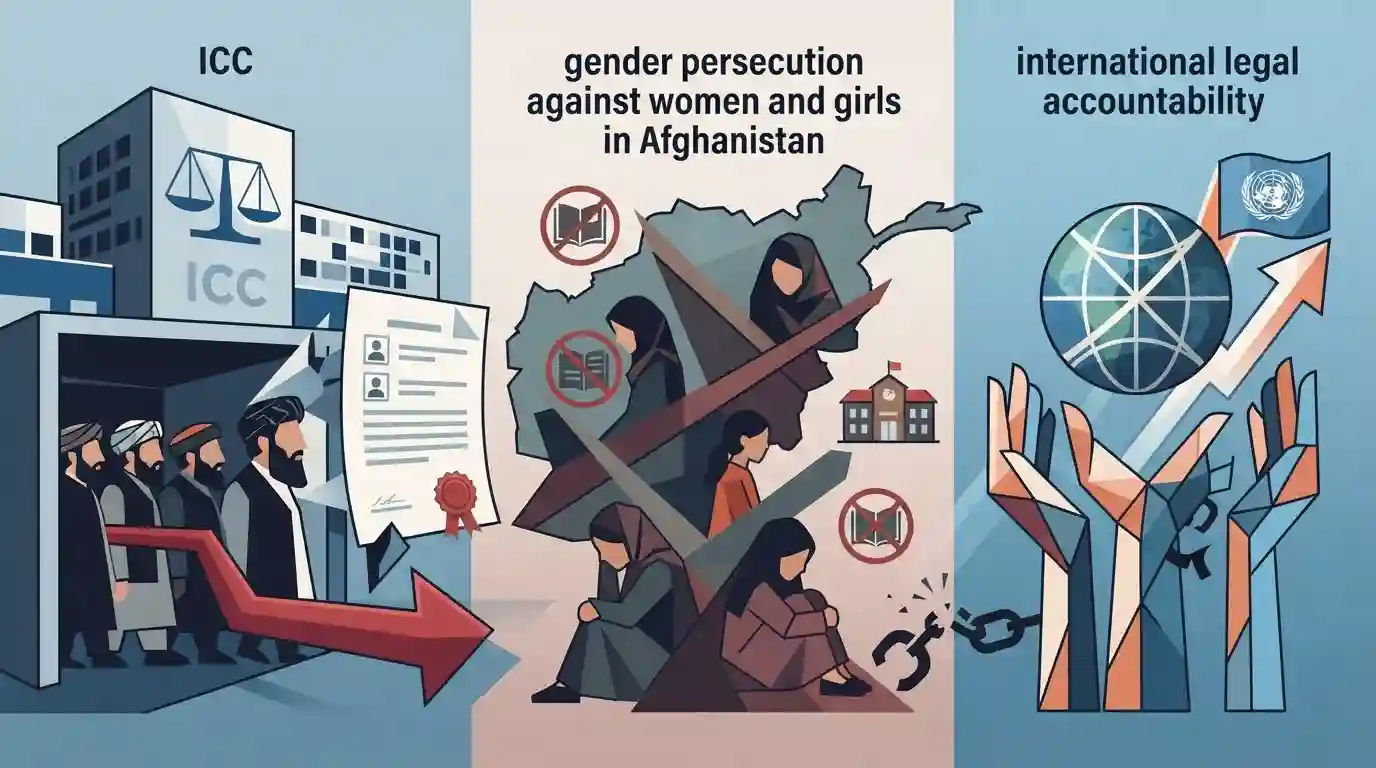
The International Criminal Court (ICC) has unsealed arrest warrants for four Taliban leaders, targeting them for gender persecution against women and girls in Afghanistan. This historic move underscores international legal accountability for systemic human rights abuses and gender-based oppression by the Taliban regime.
মূল বিষয়
- The International Criminal Court (ICC) has unsealed arrest warrants for four Taliban leaders.
- The warrants are issued on charges of gender persecution against women and girls in Afghanistan.
- This marks a critical legal development addressing systemic suppression, erasure, and human rights violations under Taliban rule.
- Highlights the role of international tribunals in prosecuting gender-based persecution as a crime against humanity.
গুরুত্বপূর্ণ শব্দ
Rome Statute

The founding treaty of the International Criminal Court, signed in 1998, which defines international crimes such as genocide, crimes against humanity, war crimes, and the crime of aggression.
UPSC context
Important for GS Paper II (International Relations, Global Governance, and International Conventions/Treaties).
International Criminal Court
A permanent international tribunal located in The Hague, established by the Rome Statute to prosecute individuals for international crimes including genocide, war crimes, and crimes against humanity.
UPSC context
Relevant for GS Paper II (International Organizations, Global Governance, and Accountability).
Taliban
An Islamist fundamentalist and militant political movement that currently governs Afghanistan, known for severe curbs on human rights, particularly women's rights.
UPSC context
Important for GS Paper II (International Relations, India's Neighborhood, and Regional Security).
সংযুক্ত স্থির ধারণা
What are the core jurisdictional triggers of the International Criminal Court (ICC) under the Rome Statute?
- Territorial Jurisdiction: Refers to crimes committed on the territory of a State Party (e.g., Afghanistan), regardless of the perpetrator's nationality.
- Personal Jurisdiction: Refers to crimes committed by nationals of a State Party anywhere in the world.
- UNSC Referral: The UN Security Council can refer a situation in a non-State party to the ICC under Chapter VII powers.
- Ad Hoc Declaration: A non-State party can submit a formal declaration accepting the ad hoc jurisdiction of the ICC.
আন্তঃবিষয় প্যাটার্ন
ICC Jurisdiction vs De Facto Regimes
The ICC's territorial jurisdiction in Afghanistan despite non-recognition echoes debates on how international courts navigate de facto authorities and customary international law without state recognition.
Gender Persecution and Crimes Against Humanity
Classifying systemic exclusion of women from public life as a crime against humanity links international criminal law with core GS-1 and GS-2 gender justice mandates.

ICC jurisdiction over non-State actors / non-recognized regimes under the Rome Statute is a prime multi-statement prelims trap.
সংযুক্ত PYQ · 3
সংযুক্ত PYQ · 3
- 2023MainsGS2
Explain the constitutional perspectives of Gender Justice with the help of relevant Constitutional Provisions and case laws.
- 2021MainsGS2
Discuss the desirability of greater representation to women in the higher judiciary to ensure diversity, equity and inclusiveness.
- 2015MainsGS2
Khap Panchayats have been in the news for functioning as extra-constitutional authorities, often delivering pronouncements amounting to human rights violations. Discuss critically the actions taken by the legislative, executive and the judiciary to set the things right in this regard.
