ICAR VPKAS Almora Organizes Khet Bachao Abhiyan for Hill Farmers
Source:icar.org.in ↗
Why It Matters
UKPSC PCS Prelims frequently asks questions matching central research institutes in Uttarakhand with their respective locations (e.g., ICAR-VPKAS in Almora). Understanding sustainable mountain agriculture, soil health schemes, and state-specific agricultural missions like the Kiwi Mission is highly relevant for both state-specific and general science/economy papers.
Summary
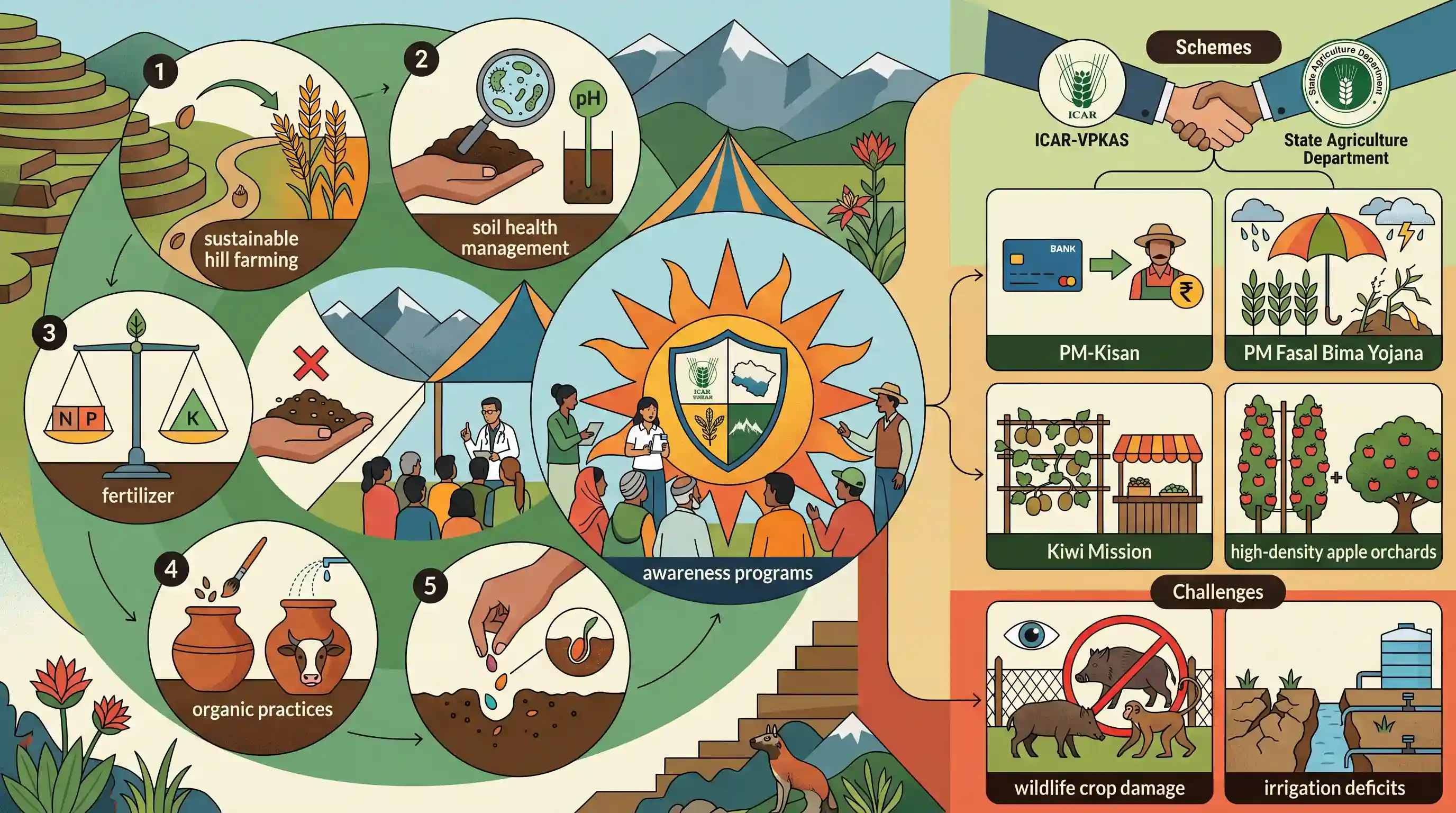
The ICAR-Vivekananda Parvatiya Krishi Anusandhan Sansthan (ICAR-VPKAS), Almora, organized the 'Khet Bachao Abhiyan' farmer awareness campaign across multiple villages in Almora district, Uttarakhand. Under the guidance of Dr. Lakshmi Kant, the initiative aimed to train farmers in sustainable hill farming, soil health management, balanced NPK fertilizer use, organic practices (like Jeevamrut and Beejamrut), and seed treatment. Additionally, a joint effort with the State Agriculture Department introduced farmers to various beneficial central and state schemes, including PM-Kisan, PM Fasal Bima Yojana, the Kiwi Mission, and high-density apple orchards, while addressing local challenges such as wildlife crop damage and irrigation deficits.
Key Points
- The 'Khet Bachao Abhiyan' was organized by ICAR-Vivekananda Parvatiya Krishi Anusandhan Sansthan (ICAR-VPKAS), Almora, in several villages of Almora district, Uttarakhand (including Tarikhet and Bhikiyasain blocks).
- The campaign, conducted under the guidance of Dr. Lakshmi Kant, empowered over 100 farmers with scientific and sustainable hill agricultural practices, aiming to improve livelihood security.
- Emphasis was placed on soil-test-based nutrient management, reducing indiscriminate use of chemical fertilizers, and the balanced application of Nitrogen, Phosphorus, and Potash (NPK) to check soil degradation.
- Farmers were trained on organic and natural farming methodologies, including the preparation and use of bio-fertilizers, bio-pesticides, and traditional formulations like Jeevamrut and Beejamrut.
- A collaborative session with the State Agriculture Department raised awareness on major schemes, including PM-Kisan Samman Nidhi, PM Fasal Bima Yojana, the Oilseed Mission, and horticulture initiatives like the Kiwi Mission and High-Density Apple Orchards.
- The scientists addressed unique hill agriculture challenges brought up by local farmers, such as irrigation scarcity, crop damage by wild animals, and market accessibility.
Important Terms
PM-Kisan Samman Nidhi

A Central Sector Scheme launched in 2019 that provides direct income support of ₹6,000 per year in three equal installments to all landholding farmer families across India.
UPSC context
GS Paper III (Agriculture); tests understanding of direct benefit transfers, financial support, and welfare schemes for landholding farmers.
PM Fasal Bima Yojana
A flagship crop insurance scheme launched in 2016 offering comprehensive risk coverage to farmers against non-preventable crop damage from pre-sowing to post-harvest, with highly subsidized, uniform premium rates.
UPSC context
GS Paper III (Agriculture); tests knowledge of crop insurance models, agricultural risk mitigation, and central schemes protecting rural livelihoods.
Indian Council of Agricultural Research
An autonomous apex body established in 1929 under the Ministry of Agriculture and Farmers Welfare that coordinates, guides, and manages agricultural research, education, and extension services across India.
UPSC context
GS Paper III (Agriculture); tests awareness of institutional frameworks, scientific research setups, and technology transfer mechanisms in Indian farming.
ICAR–Vivekananda Parvatiya Krishi Anusandhan Sansthan
A premier multidisciplinary research institute under ICAR, located in Almora, Uttarakhand, dedicated to developing sustainable agricultural, horticultural, and livestock technologies specifically tailored for the North-Western Himalayan region.
UPSC context
GS Paper III (Agriculture); tests understanding of regional agricultural research organizations addressing challenges specific to hill farming and ecology.
Kiwi Mission
A specialized agricultural policy aiming to transform regional economies by promoting high-value kiwi cultivation, setting up processing hubs, and enhancing farmers' livelihoods.
UPSC context
GS Paper III (Agriculture); tests understanding of crop diversification, high-value horticulture, and initiatives driving economic growth in hill regions.
Prelims Trap
Beejamrut is a fermented soil-application liquid to boost crop nutrition, while Jeevamrut is used specifically for seed treatment.
UPSC often swaps natural farming terms. Remember that 'Beej' means seed (hence Beejamrut is for seed treatment), while 'Jeevamrut' is applied to the soil to stimulate microbial life.
Static Concepts Connected
What are the four pillars of Zero Budget Natural Farming (ZBNF)?
- Jeevamrut: A fermented microbial formulation of cow dung, urine, jaggery, pulse flour, and soil used to stimulate soil microbial activity.
- Beejamrut: A biological mix of cow dung, urine, lime, and soil used as a seed treatment to protect young roots from soil-borne fungi.
- Acchadana: The practice of mulching the soil surface with crop residue or cover crops to conserve moisture and suppress weeds.
- Whapasa: Enhancing soil aeration and water-vapor balance to reduce dependence on heavy irrigation.
What is the ideal NPK ratio for Indian soils, and what are the effects of its distortion?
- Ideal Ratio: The ideal ratio of Nitrogen (N), Phosphorus (P), and Potassium (K) recommended for Indian soil health is 4:2:1.
- Subsidy Distortion: Due to heavily subsidized urea, the ratio is highly skewed towards Nitrogen (frequently exceeding 6:2.4:1 nationally).
- Ecological Impact: Excessive chemical Nitrogen leads to soil acidification, micronutrient deficiencies, ground-water nitrate pollution, and increased vulnerability of crops to pests.
Cross-Topic Patterns
Natural Farming + Fertilizer Subsidies
Scaling up natural farming formulations like Jeevamrut directly reduces the fiscal burden of the fertilizer subsidy bill, helping correct the highly skewed chemical NPK ratio in Indian soils.
Hill Agriculture + Climate Adaptation
Developing early-maturing, climate-resilient millets for fragile mountain ecosystems aligns directly with India's National Action Plan on Climate Change (NAPCC) and sustainable hill development.

UPSC may contrast Jeevamrut/Beejamrut functions or test the bio-input resource centers (BRCs) model under the National Mission on Natural Farming.
Linked PYQs · 2
Linked PYQs · 2
- 2025UKPSC_PRELIMSGS1
Which of the following is incorrectly matched about Central Government Institutes located in Uttarakhand?
- 2011UKPSC_PRELIMSGS1
The rotation of crops is essential for
