ICAR NBAIM Mau organizes farmer awareness program in Uttar Pradesh
Source:icar ↗
Why It Matters
UPPSC PCS Prelims regularly features questions matching national agricultural research institutes located in Uttar Pradesh to their respective cities (e.g., ICAR-NBAIM in Mau, IGFRI in Jhansi, IISR in Lucknow, and IIVR in Varanasi). Additionally, questions regarding biological nitrogen fixation, biofertilizers (such as Azolla and blue-green algae), and the environmental degradation caused by chemical fertilizers are extremely common in the Science & Tech, Environment, and Economy sections.
Summary
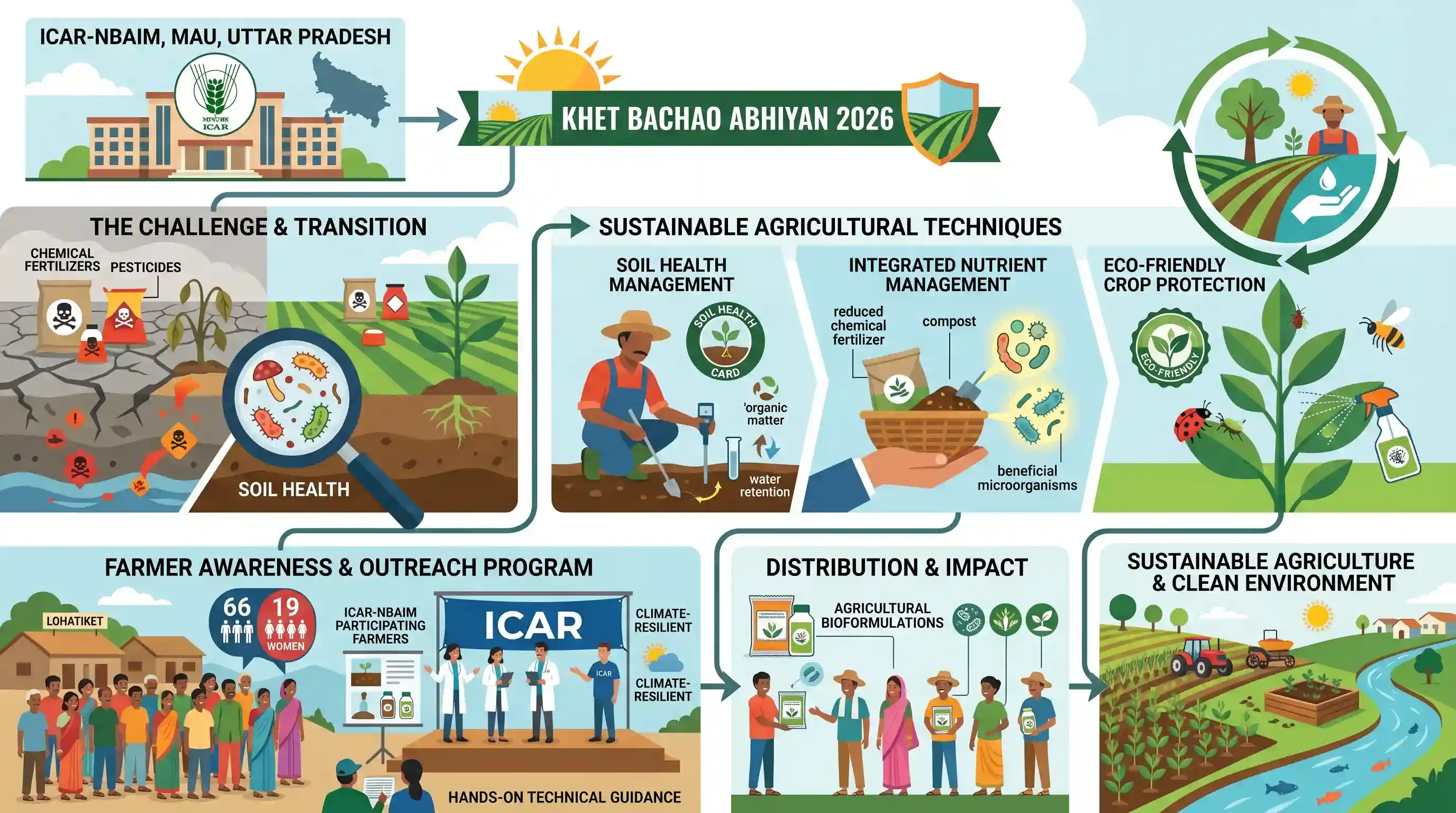
The ICAR-National Bureau of Agriculturally Important Microorganisms (ICAR-NBAIM), located in Mau, Uttar Pradesh, organized a major farmer awareness and outreach program under its 'Khet Bachao Abhiyan 2026' on June 3, 2026. Held at Lohatiket village in the Pardaha block of Mau district, the programme focused on disseminating climate-resilient and sustainable farming techniques. It provided local farmers with hands-on technical guidance on soil health management, integrated nutrient management, and eco-friendly crop protection. To minimize dependence on chemical fertilizers, the bureau distributed beneficial agricultural bioformulations to the 66 participating farmers (including 19 women), addressing their queries on soil testing and crop productivity.
Key Points
- ICAR-National Bureau of Agriculturally Important Microorganisms (ICAR-NBAIM) organized a farmer awareness and outreach programme under the 'Khet Bachao Abhiyan 2026' on June 3, 2026.
- The program was held at Lohatiket village, located in the Pardaha block of Mau district, Uttar Pradesh.
- The initiative aims to promote climate-resilient and environmentally sustainable agriculture by creating awareness about the benefits of microbial technologies and reducing dependency on chemical fertilizers.
- Key topics addressed included soil health management, integrated nutrient management, eco-friendly crop protection strategies, and soil testing.
- Farmers were provided with specific agricultural bioformulations to enhance nutrient-use efficiency and improve the physical and biological properties of the soil.
- A total of 66 farmers (47 men and 19 women) attended the workshop, gaining technical guidance on resolving queries regarding crop productivity.
- Note on Location: Although the source press release ended with a typo citing 'Mau, Madhya Pradesh', the National Bureau of Agriculturally Important Microorganisms (NBAIM) is located in Mau, Uttar Pradesh. This distinction is crucial for UPPSC location-matching questions.
Important Terms
Khet Bachao Abhiyan 2026

A nationwide, month-long agricultural campaign launched by the Ministry of Agriculture and Farmers Welfare to promote soil health, encourage scientific farming, restrict chemical fertilizer overuse, and foster sustainable agricultural practices across India.
UPSC context
GS Paper III (Agriculture); tests knowledge of government initiatives aimed at preserving soil health, sustainability, and reducing fertilizer dependence.
ICAR-National Bureau of Agriculturally Important Microorganisms
A premier research institution under the ICAR located in Mau, Uttar Pradesh, specializing in the collection, conservation, and utilization of beneficial agricultural microorganisms to improve soil health and crop productivity.
UPSC context
GS Paper III (Science & Tech/Agriculture); tests awareness of national institutes developing microbial inputs and biological technologies for farming.
Indian Council of Agricultural Research
The apex autonomous organization under India's Ministry of Agriculture and Farmers Welfare, responsible for coordinating, guiding, and managing research, education, and extension services in agriculture, horticulture, fisheries, and animal sciences.
UPSC context
GS Paper III (Agriculture); tests knowledge of institutional frameworks driving agricultural R&D and technology transfer in India.
Integrated Nutrient Management
A sustainable farming system that optimizes the combined use of chemical fertilizers, organic manures, and biofertilizers to maintain soil fertility and nutrient balance while minimizing environmental degradation.
UPSC context
GS Paper III (Agriculture); crucial for questions on soil degradation, sustainable farm-level input optimization, and eco-friendly farming systems.
Biofertilizers
Formulations containing living or latent beneficial microorganisms that colonize plant tissues or the rhizosphere, making essential soil/atmospheric nutrients like nitrogen and phosphorus available to plants through biological processes.
UPSC context
GS Paper III (Agriculture/Science & Tech); frequently tested under biotechnology, organic farming, and government efforts to reduce subsidy burdens.
Prelims Trap
The Budapest Treaty, under which NAIMCC is designated, is an international convention protecting transboundary wetlands and migratory waterfowl.
The Budapest Treaty (administered by WIPO) deals exclusively with the deposit of microorganisms for patent procedures, whereas wetlands are protected under the Ramsar Convention.
Static Concepts Connected
What is the Budapest Treaty and its relevance to microbial patents?
- Core Purpose: It governs the international recognition of the deposit of microorganisms for the purpose of patent procedures, eliminating the need to deposit in multiple countries.
- WIPO Administration: Administered by the World Intellectual Property Organization (WIPO), it establishes 'International Depositary Authorities' (IDAs) to hold and preserve biological samples safely.
- Indian Status: India is a member; key IDAs include MTCC (Chandigarh), MCC (Pune), and the agriculturally focused NAIMCC (Mau, UP) designated in 2020.
What are National Repositories under the Biological Diversity Act, 2002?
- Legal Mandate: Section 39 of the Biological Diversity Act empowers the National Biodiversity Authority to designate national repositories for safe custody of biological resources.
- Access Rules: These repositories house type-specimens and regulate access to India's unique genetic resources, preventing bio-piracy and ensuring equitable benefit sharing.
Cross-Topic Patterns
Microbial bio-decomposers vs. Air pollution
Fungal consortia like Kush Bio-Fast connect agricultural residue management to air quality targets, showcasing biological solutions to the seasonal crop-residue burning crises in Indo-Gangetic plains.
Sovereignty vs. Patent Harmonisation
The overlap between the Biological Diversity Act (sovereign resource protection) and the Budapest Treaty (patent deposits) highlights the complex balancing of national biodiversity laws with international IP regimes.

GS-3 could link microbial bio-formulations with soil-health schemes and Budapest Treaty patent rules in a single 2026 question.
Linked PYQs · 5
Linked PYQs · 5
- 2017UPPSC_PRELIMSGS1
Match List-I with List-II and select the correct answer using the code given below the lists: List-I (City): (A) Forest (B) Indian (C) Central Arid (D) Indian List-II (Institute): 1. Jodhpur Research Institute 2. New Delhi Grassland and Fodder Research Institute 3. Dehradun Zone Research Institute 4. Jhansi Agricultural Research Institute
- 2021UPPSC_PRELIMSGS1
Which of the following is NOT correctly matched?
- 2016UPPSC_PRELIMSGS1
Indiscriminate use of fertilizers have led to
- 2019UPPSC_PRELIMSGS1
Which of the following is associated with biological nitrogen fixation?
- 2001UPPSC_PRELIMSGS1
Which of the following is/are used as biofertilizers? Select the correct answer from the codes given below: 1. Azolla 2. Blue Green Algae 3. Alfalfa 4. Nitrolin
