ICAR IISWC And SARRA Sign MoU For Kamal Ganga River Rejuvenation
Source:icar ↗
Why It Matters
Water stress, drying up of mountain springs, and river degradation are prominent environmental challenges in the Himalayan state of Uttarakhand. State-led initiatives like 'One District-One River' managed by SARRA, combined with the technical expertise of central institutions like ICAR-IISWC, represent key institutional mechanisms for ecological conservation. Understanding these regional river systems, institutional locations, and state policies is highly relevant for UKPSC PCS Prelims.
Summary
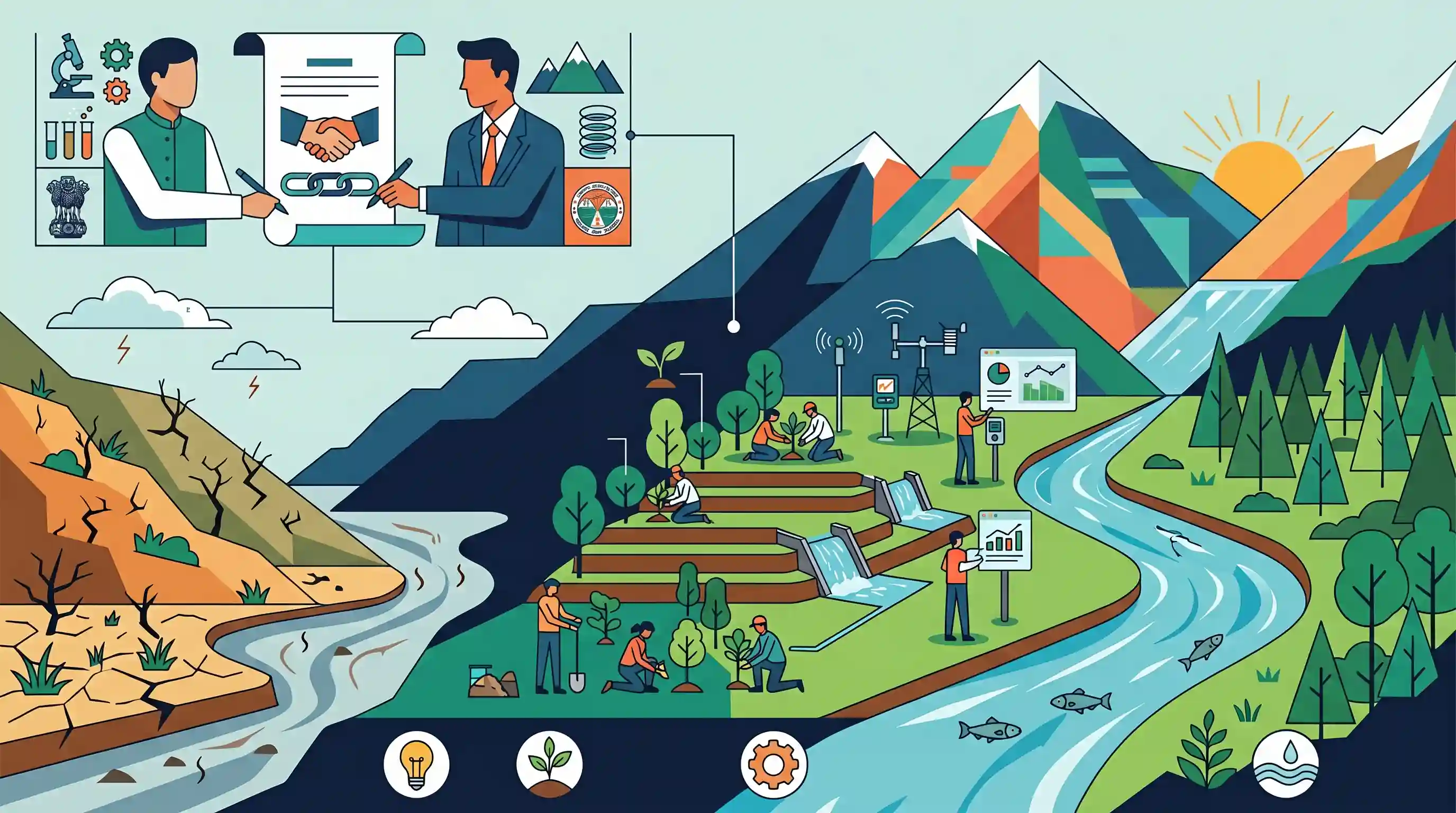
On June 3, 2026, ICAR-IISWC, Dehradun and the Spring and River Rejuvenation Authority (SARRA) of Uttarakhand signed an MoU to develop a comprehensive scientific rejuvenation plan for River Kamal Ganga in the Purola Block of Uttarkashi district. Operating under the 'One District–One River' initiative, the collaboration leverages integrated watershed management and scientific field assessments to counter ecological degradation and restore river health in the climate-vulnerable Himalayan region.
Key Points
- An MoU was signed on June 3, 2026, between the ICAR-Indian Institute of Soil and Water Conservation (IISWC), Dehradun, and the Spring and River Rejuvenation Authority (SARRA), Watershed Management Directorate, Government of Uttarakhand.
- The MoU initiates a project titled 'Prioritization and Rejuvenation Planning of Selected Rivers (River Kamal Ganga, Purola)' under the state's 'One District–One River' initiative.
- The primary objective is to build a scientific, data-driven framework for rejuvenating the River Kamal Ganga in the Purola Block of Uttarkashi district.
- Key project activities include evaluating watershed characteristics, pinpointing critical environmental degradation hotspots, and assessing hydrological and ecological conditions.
- This integrated watershed management model aims to restore local ecosystem services, enhance water availability, and serve as a blueprint for sustainable river restoration across other districts in Uttarakhand.
Important Terms
One District-One River Initiative

A flagship state-level initiative aiming for the holistic rejuvenation, conservation, and sustainable management of one prioritized local river in each district using scientific, data-driven planning and participatory approaches.
UPSC context
GS Paper III (Environment/Water Resources); tests knowledge of decentralized watershed conservation, river rejuvenation policies, and ecological restoration.
ICAR-Indian Institute of Soil and Water Conservation (IISWC)
A premier research institution established in 1974 under ICAR in Dehradun, dedicated to soil and water conservation, watershed technology, and combating land degradation.
UPSC context
GS Paper III (Agriculture/Environment); tests research institutes' roles in natural resource management and climate-resilient farming.
Spring and River Rejuvenation Authority (SARRA)
Uttarakhand's state-level apex authority created to unify water conservation, revive drying mountain springs (dharas/naulas), and execute integrated watershed-based river rejuvenation projects.
UPSC context
GS Paper III (Environment/Disaster Management); tests state-level groundwater recharge initiatives, spring hydrology, and Himalayan climate resilience.
Watershed Management Directorate, Government of Uttarakhand
The nodal administrative body in Uttarakhand responsible for formulating, implementing, and coordinating sustainable watershed development, soil conservation, and community-driven resource management.
UPSC context
GS Paper III (Resources/Environment); tests decentralized watershed management models, ecological protection, and mountain livelihood schemes.
Indian Council of Agricultural Research (ICAR)
An autonomous apex body under India's Ministry of Agriculture and Farmers Welfare, responsible for coordinating, guiding, and managing agricultural research, education, and extension nationwide.
UPSC context
GS Paper III (Agriculture/S&T); tests national bodies driving agricultural innovations, food security, and sustainable farming.
Prelims Trap
Kamal Ganga is a direct tributary of the Ganga (Bhagirathi) River in Uttarkashi.
Despite the name containing "Ganga", the Kamal Ganga (or Kamal Nadi) is actually a tributary of the Yamuna River system, draining the Purola region of Uttarkashi.
Static Concepts Connected
What are traditional Himalayan water harvesting systems?
- Naulas: Stone-lined, temple-like reservoir tanks built to harvest water from subterranean seepages in hill slopes.
- Dharas: Drinking water spouts where natural spring water is channelled through stone-carved outlets (often shaped like animal mouths).
What is the significance of the Tons River?
- Origin: A major Himalayan river formed by the confluence of the Rupin and Supin rivers at Naitwar in Uttarkashi.
- Hydrological Status: It is the largest tributary of the Yamuna, carrying a greater volume of water than the main Yamuna river at their confluence.
Cross-Topic Patterns
Agro-biodiversity + Watershed Management
Cultivation of Himalayan red rice in the Kamal Ganga valley links geographic indicators (GI) and agro-ecology directly to micro-watershed conservation and river-flow maintenance.
Springshed Management + Climate Resilience
Reviving traditional springs (Naulas) aligns with NITI Aayog’s springshed development framework to mitigate climate-induced water stress and landslides in the Himalayas.

State-led micro-river rejuvenation projects and traditional Himalayan aquifers (Naulas) are highly probable targets for geography-policy questions.
Linked PYQs · 3
Linked PYQs · 3
- 2025UKPSC_PRELIMSGS1
Which of the following is incorrectly matched about Central Government Institutes located in Uttarakhand?
- 2025UKPSC_PRELIMSGS1
Which of the following is the correct order of rivers from west to east in Uttarakhand?
- 2025UKPSC_PRELIMSGS1
Consider the following statements and select the correct answer from the options given below : Statement 1 : Uttarakhand is highly vulnerable to climate change. Statement 2 : Climate change is causing water stress and depleting biodiversity in Uttarakhand.
