ICAR CIBA Breakthrough in Blue Swimmer Crab Farming
Source:The Hindu ↗
Why It Matters
This is highly relevant for GS-3 (Economics of Animal-Rearing and Agriculture) as it introduces a new, scalable avenue for aquaculture diversification, reducing the sector's dependence on shrimp. It is also relevant for GS-2 (SHGs and vulnerable sections) due to the successful integration of SCSP and women SHGs in the technology demonstration phase.
Summary
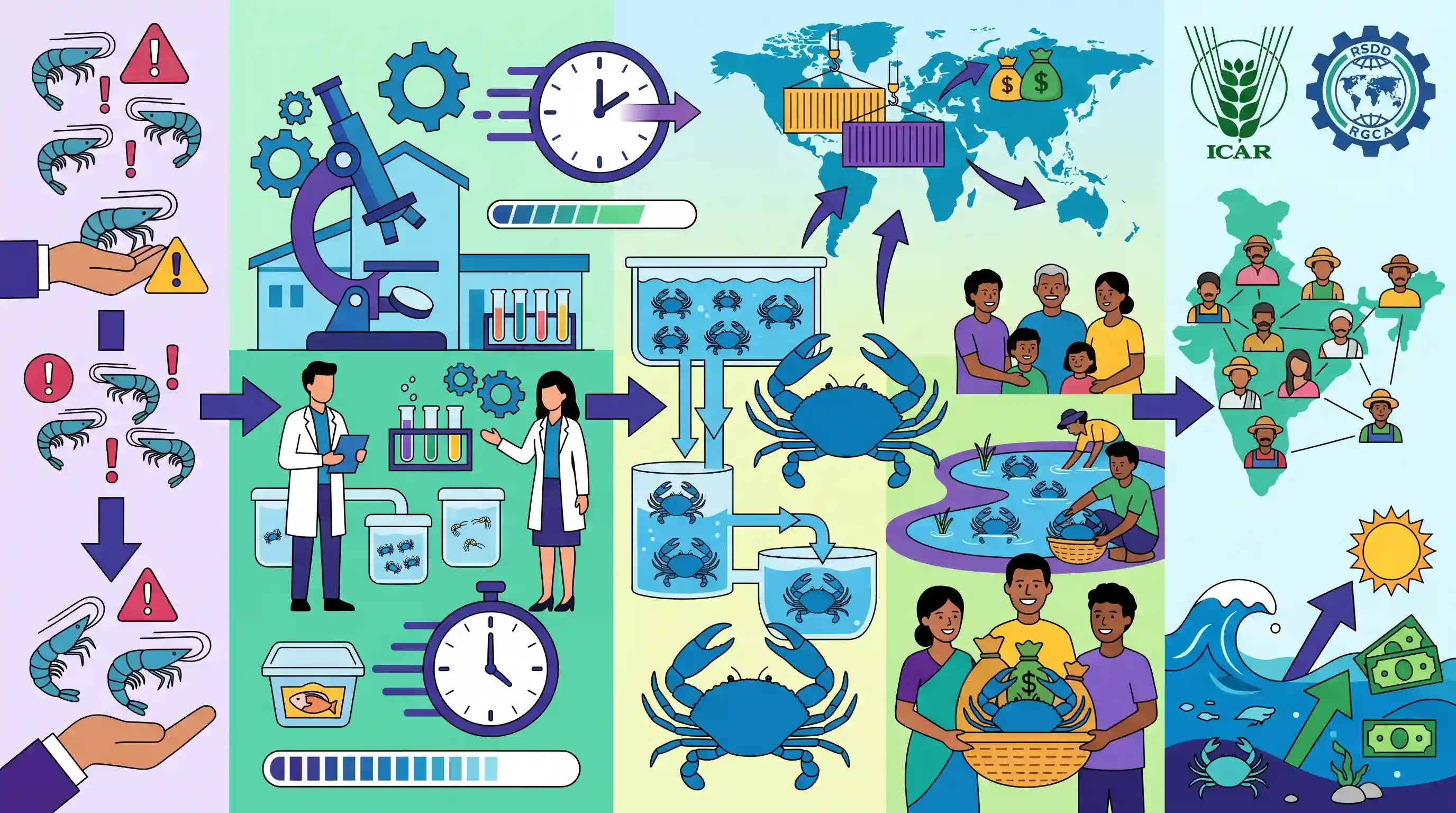
The ICAR-Central Institute of Brackishwater Aquaculture (CIBA) in Chennai has achieved a significant breakthrough by successfully farming the Blue Swimmer Crab using hatchery-produced seeds and formulated pellet feed. This development presents a viable diversification option for Indian aquaculture, reducing over-reliance on shrimp farming. The crab features a short production cycle and high export demand. Demonstrated through a local Self-Help Group under the Scheduled Caste Sub-Plan, the project also highlights inclusive economic empowerment. The technology is slated for wider transfer to farmers via the Rajiv Gandhi Centre for Aquaculture (RGCA) under MPEDA, thereby supporting India's marine exports and the Blue Economy.
Key Points
- ICAR-CIBA successfully reared and harvested the Blue Swimmer Crab for the first time in India using hatchery-produced seeds and formulated pellet feed (BSCrabPlus).
- The breakthrough offers a lucrative alternative and diversification option to traditional shrimp farming in India's brackishwater aquaculture sector.
- The Blue Swimmer Crab has a short production cycle, lower cannibalism compared to mud crabs, and high demand in domestic and international markets.
- The initiative integrated inclusive growth by involving the 'Success Self-Help Group' through the Scheduled Caste Sub-Plan (SCSP) program.
- RGCA under MPEDA will play a crucial role in transferring this crab farming technology to farmers to boost marine exports.
Important Terms
Marine Products Export Development Authority (MPEDA)

A statutory body under the Ministry of Commerce and Industry, established in 1972 to regulate and promote the export of Indian marine products.
UPSC context
GS-3: Economics (Exports) and Agriculture. Relevant for statutory bodies, trade promotion, and blue economy strategies.
Scheduled Caste Sub-Plan (SCSP)
A budgetary mechanism (now known as Scheduled Caste Component) requiring ministries to allocate funds for the welfare of Scheduled Castes in proportion to their population.
UPSC context
GS-2: Social Justice; GS-3: Inclusive Growth. Tests knowledge of equity-based budgeting and welfare mechanisms for marginalized communities.
ICAR-Central Institute of Brackishwater Aquaculture (CIBA)
The nodal research institute under ICAR for brackishwater aquaculture, focused on developing sustainable and techno-economically viable culture systems for finfish and shellfish.
UPSC context
GS-3: Agriculture and Science & Technology. Important for research-led agricultural diversification and indigenous technology development.
Rajiv Gandhi Centre for Aquaculture (RGCA)
The dedicated Research and Development arm of MPEDA, functioning as a society to develop and transfer sustainable aquaculture technologies for export-oriented species.
UPSC context
GS-3: Science and Economics. Relevant for R&D infrastructure and technology transfer in the primary sector.
Blue Swimmer Crab
A commercially significant crab species (Portunus pelagicus) known for its short production cycle and high export value, recently pioneered for hatchery-based farming in India.
UPSC context
GS-3: Agriculture/Economics. Example of crop/species diversification to reduce risk (over-reliance on shrimp) and enhance farmer income.
Blue Economy
A sustainable development framework for the oceans, focusing on economic growth through marine resources while ensuring ecosystem health and socio-economic inclusion.
UPSC context
GS-3: Infrastructure and Environment. A major policy focus for maritime growth, resource management, and coastal livelihoods.
Prelims Trap
"The Marine Products Export Development Authority (MPEDA) functions under the Ministry of Fisheries, Animal Husbandry and Dairying."
MPEDA is a statutory body under the Ministry of Commerce and Industry. Aspirants wrongly assume marine and aquaculture export bodies automatically fall under the Fisheries ministry.
Static Concepts Connected
What is the Marine Products Export Development Authority (MPEDA)?
- Statutory Body: Established under the MPEDA Act 1972 to promote the export of marine products from India.
- Nodal Ministry: Functions under the Department of Commerce, Ministry of Commerce and Industry, not the Ministry of Fisheries.
- Key Mandate: Standardizes aquaculture practices, conducts international market promotion, and extends technical and financial assistance to farmers.
How does the Scheduled Caste Sub-Plan (SCSP) function in policy formulation?
- Proportionate Funding: An umbrella strategy mandating that Ministries/Departments allocate plan funds in proportion to the SC population (roughly 16.6%).
- Direct Benefit: Funds must be strictly channeled to schemes yielding direct economic, educational, or physical benefits to SC individuals, families, or hamlets.
Cross-Topic Patterns
Aquaculture & Export Diversification
Much like agricultural diversification away from water-intensive crops, aquaculture is shifting from monoculture (Pacific white shrimp) to crabs to mitigate ecological risks, disease outbreaks, and global market shocks.
SHGs as Tech-Adoption Conduits
Utilizing SHGs for ICAR technology transfer demonstrates their evolution from pure micro-credit/savings groups into primary production hubs driving scientific adoption and the Blue Economy.

Expect a 2026 Prelims question mixing MPEDA's nodal ministry (Commerce, not Fisheries) with recent ICAR breakthroughs in marine exports.
Linked PYQs · 3
Linked PYQs · 3
- 2017MainsGS3
Explain various types of revolutions, took place in Agriculture after independence in India. How these revolutions have helped in poverty alleviation and food security in India?
- 2020MainsGS2
Micro-Finance as an anti-poverty vaccine, is aimed at asset creation and income security of the rural poor in India". Evaluate the role of the Self Help Groups in achieving the twin objectives along with empowering women in rural India.
- 2014MainsGS2
The penetration of Self Help Groups (SHGs) in rural areas in promoting participation in development programmes is facing socio-cultural hurdles. Examine.
