ICAO observer to participate in Air India crash investigation
Source:Indian Express ↗
Why It Matters
For UPSC aspirants, this highlights the functional role of UN specialized agencies (ICAO) in domestic regulatory mechanisms. It is relevant for GS2 (International Organizations) and GS3 (Infrastructure - Aviation and Disaster Management) where international cooperation sets the benchmark for safety protocols.
Summary
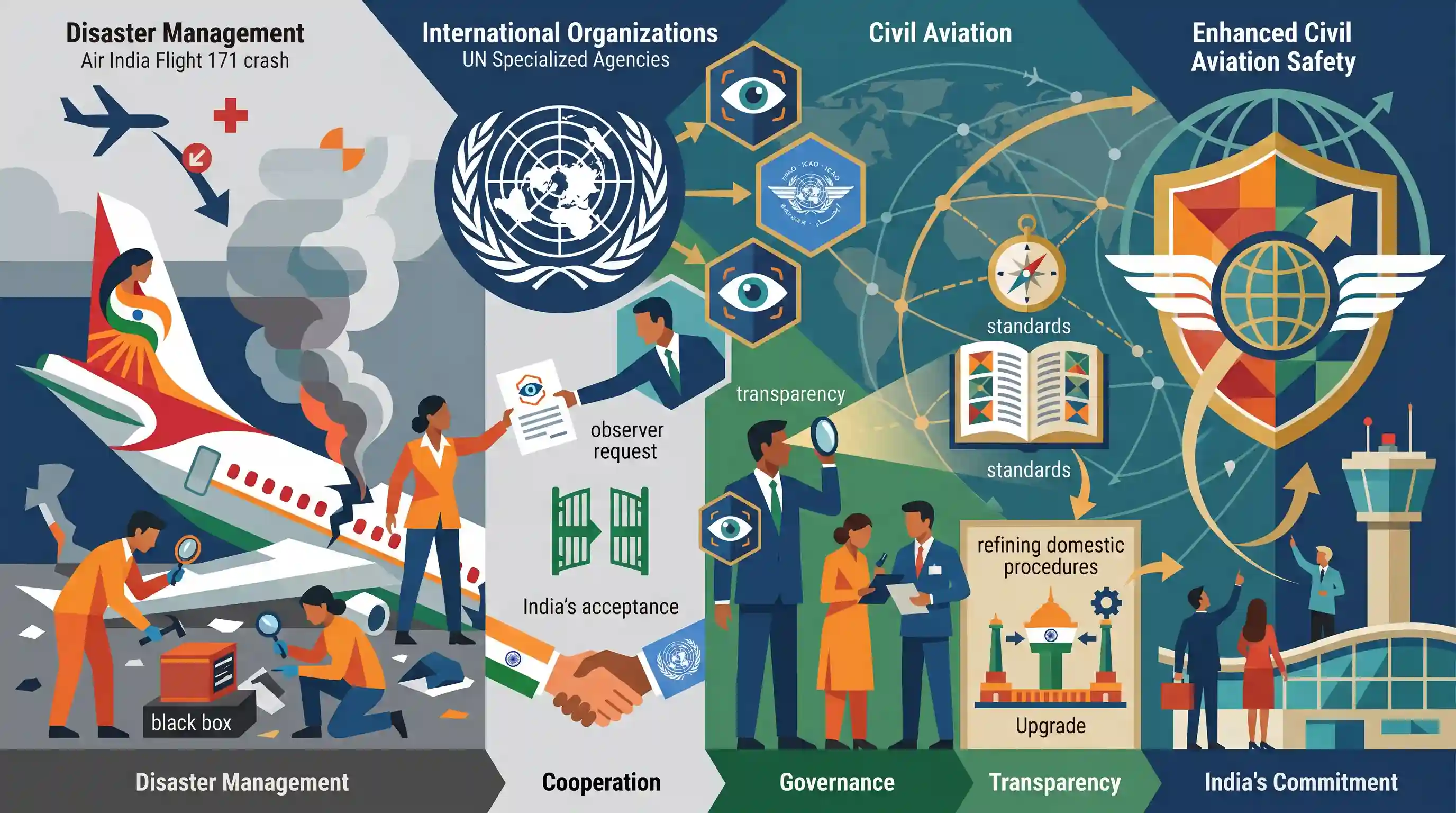
The International Civil Aviation Organization (ICAO), a specialized agency of the United Nations, requested to have an observer participate in the ongoing probe into the Air India Flight 171 crash. Indian authorities have reportedly accepted the request. The inclusion of an ICAO observer ensures that the investigation aligns with international safety and transparency standards, such as those established under the Chicago Convention. This development underscores India’s commitment to cooperating with global regulatory bodies to enhance civil aviation safety and refine domestic accident investigation procedures.
Key Points
- The UN aviation watchdog, International Civil Aviation Organization (ICAO), requested to place an observer in the investigation of the Air India Flight 171 crash.
- Indian authorities have reportedly accepted the request, ensuring international oversight in the accident investigation.
- ICAO’s involvement aligns with global aviation accident investigation protocols, typically guided by Annex 13 of the Chicago Convention.
- The inclusion of an ICAO observer emphasizes India's commitment to transparency, objective investigations, and adherence to international safety standards in civil aviation.
Important Terms
International Civil Aviation Organization (ICAO)

A specialized United Nations agency, established in 1944, that coordinates international air navigation and sets safety, security, and environmental standards for global civil aviation.
UPSC context
GS Paper II (International Organizations) and GS Paper III (Infrastructure). Tests knowledge of UN specialized agencies and global transport governance.
Chicago Convention
Formally the 'Convention on International Civil Aviation' (1944), it is the landmark treaty that established ICAO and the core legal framework for international aviation safety and airspace.
UPSC context
GS Paper II (International Treaties). Crucial for understanding the legal foundation of international civil aviation and sovereign airspace rights.
Annex 13
A specific set of international standards and recommended practices (SARPs) under the Chicago Convention that outlines the protocols for investigating aircraft accidents and serious incidents.
UPSC context
GS Paper III (Infrastructure/Disaster Management). Tests technical expertise regarding international safety protocols and investigative transparency in aviation.
Aircraft Accident Investigation Bureau (AAIB)
A statutory body under India's Ministry of Civil Aviation responsible for investigating accidents and serious incidents involving civil aircraft in Indian airspace.
UPSC context
GS Paper III (Security and Governance). Tests understanding of domestic institutional frameworks for transportation safety and disaster management.
Standards and Recommended Practices (SARPs)
Technical specifications and procedures adopted by ICAO to ensure worldwide uniformity in aviation operations, safety, and security.
UPSC context
GS Paper III (Infrastructure). Relevant for topics on regulatory compliance and India’s adherence to global safety benchmarks.
Directorate General of Civil Aviation (DGCA)
India's principal regulatory body for civil aviation, responsible for safety oversight, licensing, and enforcing standards across the industry.
UPSC context
GS Paper III (Infrastructure and Governance). Essential for questions on civil aviation regulation, safety oversight, and executive bodies.
Prelims Trap
ICAO has the mandate to lead and conduct investigations of major international civil aviation accidents.
Under the Chicago Convention, the 'State of Occurrence' leads the investigation. ICAO only sets standards and participates as an observer; it does not lead or conduct the probe.
Static Concepts Connected
What is the International Civil Aviation Organization (ICAO)?
- UN Agency: A specialized agency of the United Nations, established by the 1944 Chicago Convention.
- Core Mandate: Sets Standards and Recommended Practices (SARPs) for international air transport safety, security, and efficiency.
- Annex 13: Lays down global protocols for investigating aircraft accidents, mandating the 'State of Occurrence' to lead investigations.
Why is India's AAIB independent of the DGCA?
- Conflict of Interest: Separating the investigator (AAIB) from the regulator (DGCA) ensures impartial probes into potential regulatory or systemic failures.
- ICAO Compliance: This institutional separation directly aligns with ICAO's global standards for objective and transparent aviation accident investigations.
Cross-Topic Patterns
Space tech meets aviation safety
India’s GAGAN system (jointly developed by ISRO and AAI) was specifically designed to provide civil aeronautical navigation signals that comply with ICAO’s Standards and Recommended Practices (SARPs).
Institutional independence in safety
Similar to the Commission of Railway Safety operating under the Ministry of Civil Aviation rather than Railways, the AAIB is kept separate from the primary regulator (DGCA) to ensure unbiased probes.

Expect a prelims statement combining ICAO's UN specialized agency status, the Chicago Convention, and ISRO's GAGAN alignment.
Linked PYQs · 2
Linked PYQs · 2
- 2023MainsGS2
‘Sea is an important Component of the Cosmos’ Discuss in the light of the above statement the role of the IMO (International Maritime Organisation) in protecting environment and enhancing maritime safety and security.
- 2025PrelimsGS1
GPS-Aided Geo Augmented Navigation (GAGAN) uses a system of ground stations to provide necessary augmentation. Which of the following statements is/are correct in respect of GAGAN? I. It is designed to provide additional accuracy and integrity. II. It will allow more uniform and high quality air traffic management. III. It will provide benefits only in aviation but not in other modes of transportation. Select the correct answer using the code given below.
