Himachal Plans All India Services Cadre Restructuring to Curb Waste
Source:whispersinthecorridors ↗
Why It Matters
Cadre restructuring at the state level highlights key governance challenges such as bureaucratic bloat and the efficient utilization of All India Services. It serves as a practical example of administrative reforms aimed at optimizing human resources within the government structure.
Summary
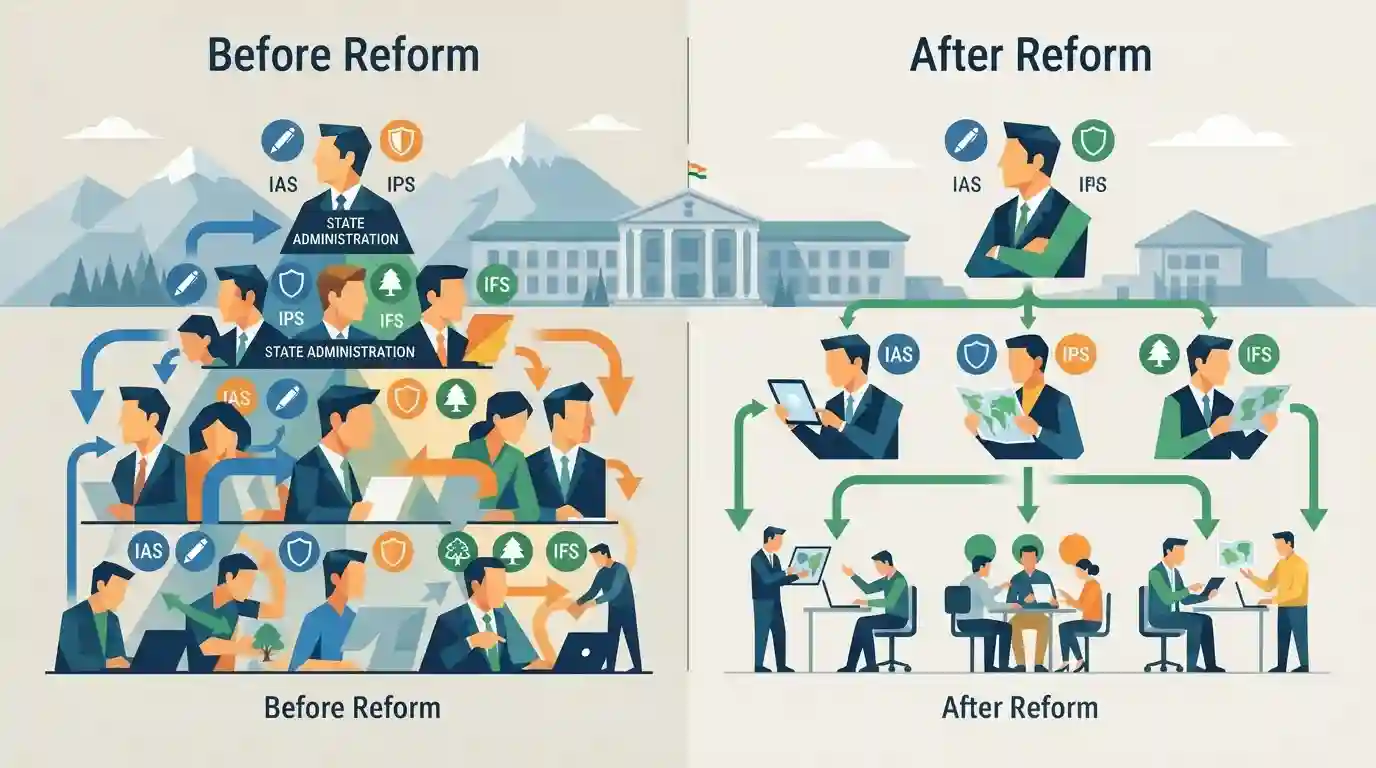
The Himachal Pradesh government has initiated steps to cut the positions of Indian Administrative Service (IAS), Indian Police Service (IPS), and Indian Forest Service (IFS) officers. This administrative reform is intended to eliminate the underutilization of senior bureaucrats, ensuring that the deployment of All India Services officers is optimized for state governance. The move reflects an effort to streamline the bureaucracy and improve administrative efficiency in the state.
Key Points
- The Himachal Pradesh government plans to reduce the cadre strength of All India Services, including IAS, IPS, and IFS officers in the state.
- The decision is driven by the need to eliminate underutilization of officers and streamline state administrative functions.
- The restructuring points toward a focus on administrative efficiency, rationalizing bureaucratic deployment, and curbing unnecessary administrative expenditure.
Important Terms
Indian Administrative Service (IAS)

The premier All India Service serving as India's administrative backbone. Himachal Pradesh recently proposed reducing its state IAS cadre strength from 153 to 130 to curb expenditure and eliminate the underutilization of senior officers.
UPSC context
GS Paper 2 (Role of Civil Services). Tests knowledge of cadre management, state finances, and administrative efficiency.
Indian Forest Service (IFS)
An All India Service tasked with managing the country's environment and forests. Himachal Pradesh proposed reducing its sanctioned IFS strength from 118 to 83 to ensure better deployment and cut administrative costs.
UPSC context
GS Paper 2 (Governance) and GS Paper 3. Tests understanding of environmental administration and optimal state bureaucracy sizing.
Indian Police Service (IPS)
An All India Service responsible for maintaining public order and enforcing laws. Himachal Pradesh is reviewing its sanctioned IPS cadre posts for downsizing to ease the financial burden on the state exchequer.
UPSC context
GS Paper 2 (State Administration). Highlights the ongoing debates over optimal police cadre strength and governance reforms.
Himachal Pradesh Government
The state-level executive authority headed by the Chief Minister. It recently initiated a major administrative restructuring to cut the sanctioned strength of All India Services officers to reduce the state's financial burden.
UPSC context
GS Paper 2 (State Administration). Tests understanding of state executive powers, financial management, and bureaucratic reforms.
Prelims Trap
State Governments have the exclusive power to unilaterally reduce the sanctioned cadre strength of All India Services.
While states propose reductions, the Central Government ultimately determines and approves cadre strength under the AIS (Cadre) Rules, 1954, in consultation with the State.
Static Concepts Connected
What are the core constitutional provisions governing All India Services?
- Article 312: Vests exclusive power in the Rajya Sabha to authorize the creation of new All India Services via a two-thirds majority resolution.
- Article 309: Empowers Parliament and State Legislatures to regulate the recruitment and conditions of service of persons appointed to public services.
- Article 311: Provides safeguards to civil servants against arbitrary dismissal, removal, or reduction in rank by an authority subordinate to the appointing authority.
How is the cadre strength of All India Services managed?
- Cadre Rules 1954: The Central Government determines cadre strength and conducts a review for each state ordinarily every five years, consulting the respective state.
- AIS Act 1951: The Central Government acts as the ultimate cadre-controlling authority under this Act (DoPT for IAS, MHA for IPS, MoEFCC for IFS).
- Cadre Allocation Policy: Allocates successful candidates to 26 state/joint cadres divided into five zones to ensure national integration and balanced regional representation.
Cross-Topic Patterns
Fiscal stress driving admin reforms
HP's cadre reduction links directly to GS-3 state finance management, reflecting broader efforts to curb non-plan administrative expenditure and manage the state's escalating debt burden.
Federalism and All India Services
While HP proposes cadre cuts, ultimate control rests with the Centre. This mirrors recent federal friction over AIS deputation rules and the balance of power in bureaucratic deployment.

Expect a multi-statement Prelims question combining Art 312, the AIS Act 1951, and the respective powers of State vs Centre in cadre review.
Linked PYQs · 1
Linked PYQs · 1
- 2020HPAS_PRELIMSGS1
Match List I with List II and choose the correct answer from the given options. | List-I Constitution Articles | List-II Area of reservations | |---|---| | A. Article 15 (4) and 16 (4) | 1. Lok Sabha Seats | | B. Article 15 (6) and 16 (6) | 2. Panchayati Raj Institutions | | C. Article 243 D | 3. Other Backward Classes (OBCs) | | D. Article 330 | 4. Economically Weaker Sections (EWS) | Code: A B C D
