Indian Air Force AN-32 Transport Aircraft Crashes in Assam
Source:The Hindu ↗
Why It Matters
The crash brings to light the operational risks faced by the armed forces and raises questions about the maintenance and modernization of India's military aviation fleet. The involvement of Agniveervayu casualties also draws attention to the real-world deployment of recruits under the Agnipath scheme.
Summary
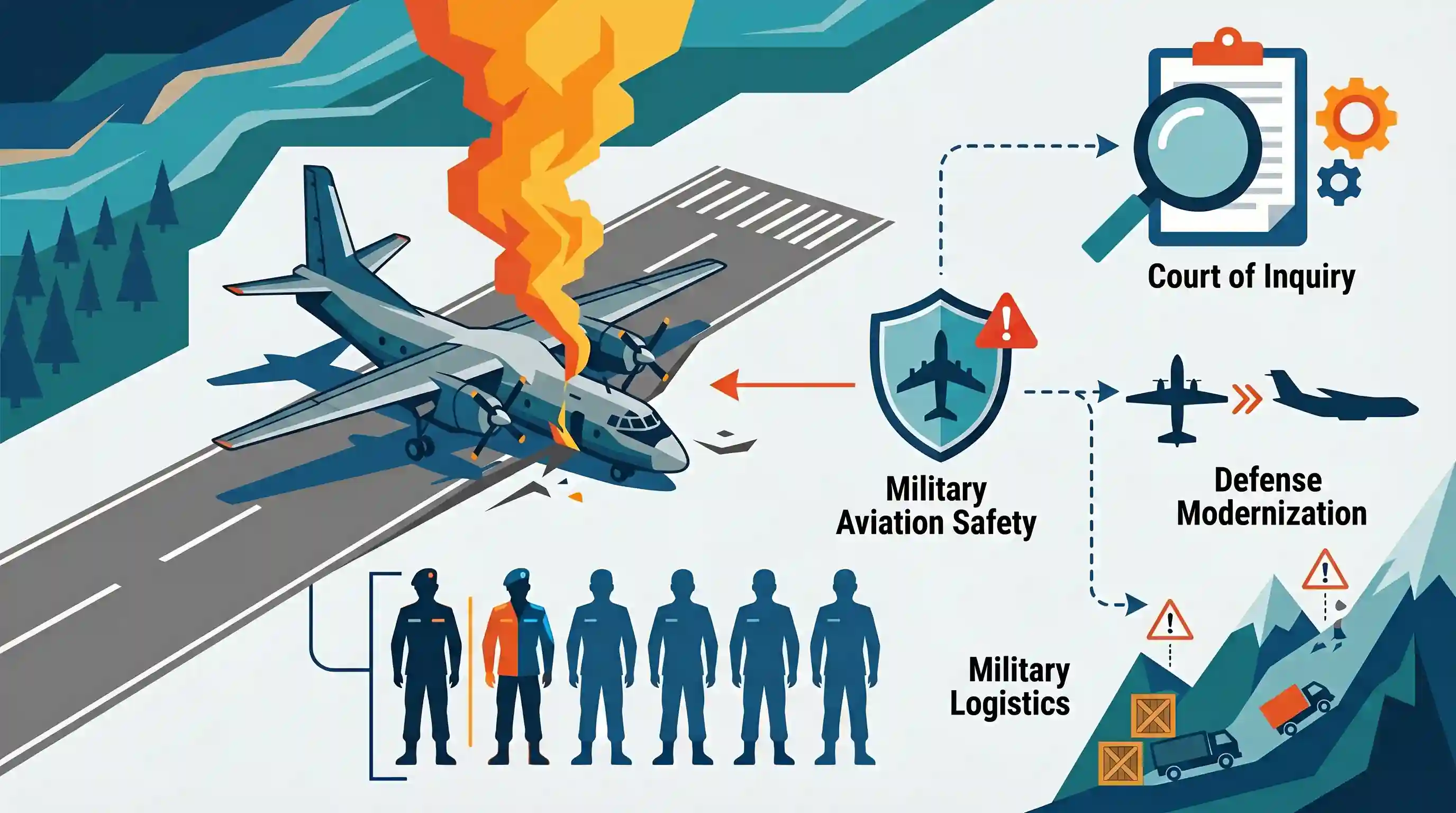
Five Indian Air Force personnel, including two Agniveervayu recruits, were killed when an AN-32 cargo aircraft belonging to the 43 Squadron crashed during landing at the Jorhat airbase in Assam. A court of inquiry has been constituted to investigate the cause of the accident, which underscores critical issues related to military aviation safety, defense modernization, and the operational hazards associated with military logistics in India's Northeast.
Key Points
- An Indian Air Force AN-32 cargo aircraft crashed while landing at the Jorhat airbase in Assam, killing five personnel.
- The deceased included officers, a sergeant, and two Agniveervayu recruits, reflecting the operational deployment of Agnipath scheme inductees.
- The aircraft belonged to the 43 Squadron of the IAF, and the crash occurred in the Rowriah area of Jorhat.
- A court of inquiry has been constituted to ascertain the exact cause of the accident.
- The incident highlights ongoing concerns regarding military aviation safety and defense logistics in Northeast India.
Important Terms
Agnipath Scheme

A transformative recruitment model for the Indian Armed Forces where youth serve for four years, aiming for a younger, tech-savvy force while reducing the defense pension bill.
UPSC context
GS II & III; tests understanding of defense recruitment reforms and their impact on national security and economy.
AN-32 Aircraft
A Soviet-origin (Ukrainian) twin-engine turboprop tactical transport aircraft; it serves as the IAF's workhorse for logistics and troop movement in challenging high-altitude and border terrains.
UPSC context
GS III; relevant for questions on aging military assets, logistical connectivity, and defense procurement in border areas.
Agniveervayu
The specific designation given to recruits entering the Indian Air Force under the Agnipath Scheme for a fixed four-year engagement.
UPSC context
GS II; pertains to government policies, human resource management in defense, and youth employment schemes.
Court of Inquiry
A formal military fact-finding board established to investigate incidents like accidents or operational lapses to gather evidence and recommend corrective actions.
UPSC context
GS III; tests knowledge of military administrative law and accountability mechanisms within the Indian Armed Forces.
Defense Modernization
The strategic process of upgrading military hardware and technology—such as replacing legacy AN-32 aircraft—to enhance operational readiness and promote indigenization (Aatmanirbharta).
UPSC context
GS III; key for essays and questions on technology induction, internal security, and self-reliance in defense.
Prelims Trap
Agnipath scheme recruits are placed exclusively in non-combat or non-operational training roles.
The tragic involvement of Agniveervayu recruits in a tactical cargo flight confirms that Agnipath inductees are deployed in operational and active-duty missions.
Static Concepts Connected
What are the core provisions of the Agnipath Scheme?
- Tenure and Age: Recruits youth aged 17.5 to 21 years for a strict four-year short-service tenure across the Army, Navy, and Air Force.
- Retention Policy: After four years, up to 25% of each batch is permanently enrolled in the regular cadre based on organizational requirements and merit.
- Financial Benefits: Exiting Agniveers receive a tax-free, one-time 'Seva Nidhi' package, but do not receive gratuity or lifelong pension benefits.
How is India modernizing its tactical transport fleet?
- C-295 Replacement: India is phasing out aging legacy aircraft like the AN-32 and Avro by procuring 56 Airbus C-295 turboprop military transport aircraft.
- Private Indigenization: While 16 are imported, 40 will be manufactured domestically by Tata Advanced Systems in Vadodara, breaking the public sector monopoly on military aircraft assembly.
- Turboprop Advantages: Turboprop engines offer superior Short Take-Off and Landing (STOL) performance, which is crucial for operating on rough, high-altitude border airfields.
Cross-Topic Patterns
First private sector aircraft manufacturing
The aging AN-32 fleet's replacement via the C-295 project represents a structural shift from HAL-dominated public manufacturing to private sector (Tata) final assembly lines in defense aviation.
Northeast ALGs and LAC logistics
Assam airbases like Jorhat are critical logistics nodes for the Eastern Air Command, enabling STOL aircraft to supply high-altitude Advanced Landing Grounds (ALGs) along the LAC in Arunachal Pradesh.

Expect a multi-statement Prelims question testing the C-295 project's private-sector model alongside specific tenure rules of Agnipath.
Linked PYQs · 2
Linked PYQs · 2
- 2025PrelimsGS1
With reference to India's defence, consider the following pairs : Aircraft type Description I. Dornier-228 : Maritime patrol aircraft II. IL-76 : Supersonic combat aircraft III. C-17 Globemaster III : Military transport aircraft How many of the pairs given above are correctly matched?
- 2024PrelimsGS1
Which of the following is/are correctly matched in terms of equivalent rank in the three services of Indian Defence forces? (Army — Airforce — Navy) 1. Brigadier — Air Commodore — Commodore 2. Major General — Air Vice Marshal — Vice Admiral 3. Major — Squadron Leader — Lieutenant Commander 4. Lieutenant Colonel — Group Captain — Captain Select the correct answer using the code given below:
