Supreme Court Adjourns ED Plea Regarding Investigation Interference
Source:The Hindu ↗
Why It Matters
The case is important for UPSC aspirants as it illustrates practical challenges and political conflicts in India's federal structure, specifically regarding the functioning, jurisdiction, and perceived independence of central investigative agencies like the ED and CBI within states.
Summary
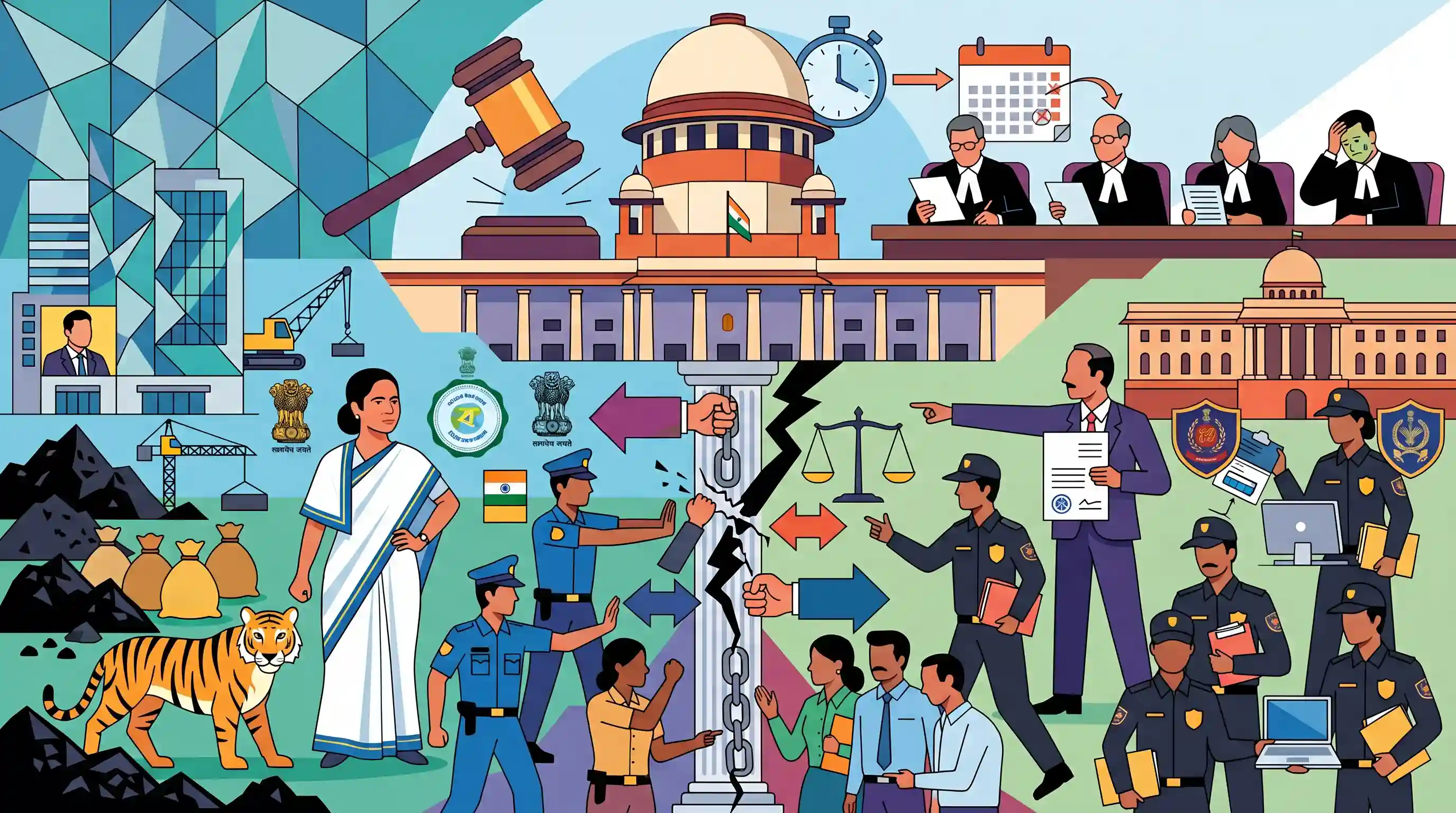
The Supreme Court has adjourned the hearing on a petition by the Enforcement Directorate (ED) seeking a CBI probe into alleged obstruction by West Bengal Chief Minister Mamata Banerjee. The ED claims interference occurred during its search operations at the I-PAC office and the premises of its director, Pratik Jain, in connection with an alleged coal pilferage scam. The hearing was postponed to February 18, 2026, due to the ill health of West Bengal's lead counsel, Kapil Sibal. The dispute highlights the ongoing tensions between central investigative agencies and state governments.
Key Points
- The Enforcement Directorate (ED) filed a petition in the Supreme Court seeking a CBI probe into alleged obstruction by West Bengal CM Mamata Banerjee.
- The alleged interference took place during ED raids at the I-PAC office and the premises of its director, Pratik Jain.
- The search operations were part of an ongoing investigation into a coal pilferage scam.
- The Supreme Court adjourned the hearing to February 18, 2026, following a request due to the illness of West Bengal's lead counsel, Kapil Sibal.
- The issue reflects the broader ongoing friction and jurisdictional disputes between central investigative agencies and state governments in India.
Important Terms
Federal Structure

The constitutional distribution of powers between the Union and States under the Seventh Schedule. It ensures both tiers function independently within their spheres.
UPSC context
GS Paper 2: Functions and responsibilities of the Union and the States; issues and challenges pertaining to the federal structure.
Enforcement Directorate (ED)
A specialized financial probe agency under the Ministry of Finance that enforces the Prevention of Money Laundering Act (PMLA) and FEMA.
UPSC context
GS Paper 2 & 3: Statutory, regulatory and various quasi-judicial bodies; money laundering and its prevention.
Central Bureau of Investigation (CBI)
India’s premier anti-corruption agency, deriving its powers from the Delhi Special Police Establishment (DSPE) Act, 1946. It requires state consent for investigations.
UPSC context
GS Paper 2: Role of civil services in a democracy; institutional autonomy and federal frictions.
I-PAC (Indian Political Action Committee)
A professional political consultancy that provides data-driven election strategies. It represents a non-state actor influencing the modern democratic process.
UPSC context
GS Paper 2: Pressure groups and formal/informal associations and their role in the Polity.
Supreme Court
The highest judicial body in India, possessing the authority to resolve disputes between the Union and States and order central probes.
UPSC context
GS Paper 2: Separation of powers; structure, organization and functioning of the Judiciary.
Prelims Trap
"The Enforcement Directorate can suo motu register a money laundering case anywhere in India."
The ED cannot initiate an investigation on its own. It strictly requires a pre-existing "Predicate/Scheduled Offence" registered by another agency (like State Police or CBI).
Static Concepts Connected
How does CBI jurisdiction differ from ED within states?
- CBI (DSPE Act): Under Section 6 of the DSPE Act, the CBI requires explicit general or specific consent from the State Government.
- ED (PMLA): Under PMLA, 2002, the ED has pan-India jurisdiction and does not need state consent for searches or arrests.
- Judicial Override: The Supreme Court and High Courts can order a CBI probe in any state without its consent under Articles 32/226.
What defines the Supreme Court's Original Jurisdiction under Article 131?
- Federal Parties: Exclusively covers disputes between the Union and States, or between two or more States.
- Legal Right: The dispute must involve a question of law or fact on which the existence or extent of a legal right depends.
- Exceptions: It does not extend to purely political disputes, private citizen petitions, or pre-constitution treaties.
Cross-Topic Patterns
Article 131 vs Agency Overreach
States are increasingly invoking Article 131 to sue the Union government over the deployment of central agencies (CBI/ED), attempting to reframe criminal investigations as federal disputes.
GS2 Federalism + GS4 Probity
The alleged politicization of central agencies and state police forces directly connects GS2 (Federalism) with GS4 (Probity, civil service neutrality, and ethical law enforcement).

Expect a 2026 prelims question contrasting the statutory origins, state consent rules, and territorial limits of the CBI vs ED.
Linked PYQs · 4
Linked PYQs · 4
- 2021MainsGS2
The jurisdiction of the Central Bureau of Investigation (CBI) regarding lodging an FIR and conducting probe within a particular State is being questioned by various States. However, the power of the States to withhold consent to the CBI is not absolute. Explain with special reference to the federal character of India.
- 2019MainsGS2
“The Central Administrative Tribunal which was established for redressal of grievances and complaints by or against central government employees, nowadays is exercising its powers as an independent judicial authority.” Explain.
- 2024MainsGS2
What changes has the Union Government recently introduced in the domain of Centre-State relations ? Suggest measures to be adopted to build the trust between the Centre and the States and for strengthening federalism.
- 2022MainsGS2
“While the national political parties in India favour centralisation, the regional parties are in favour of State autonomy.” Comment.
