India US Strategic Partnership and Energy Security Cooperation
Source:Indian Express ↗
Why It Matters
Highlights the ongoing trajectory and resilience of the India-US Comprehensive Global Strategic Partnership, efforts to address bilateral friction points, and the geopolitical dimensions of India's energy security amid West Asian instability.
Summary
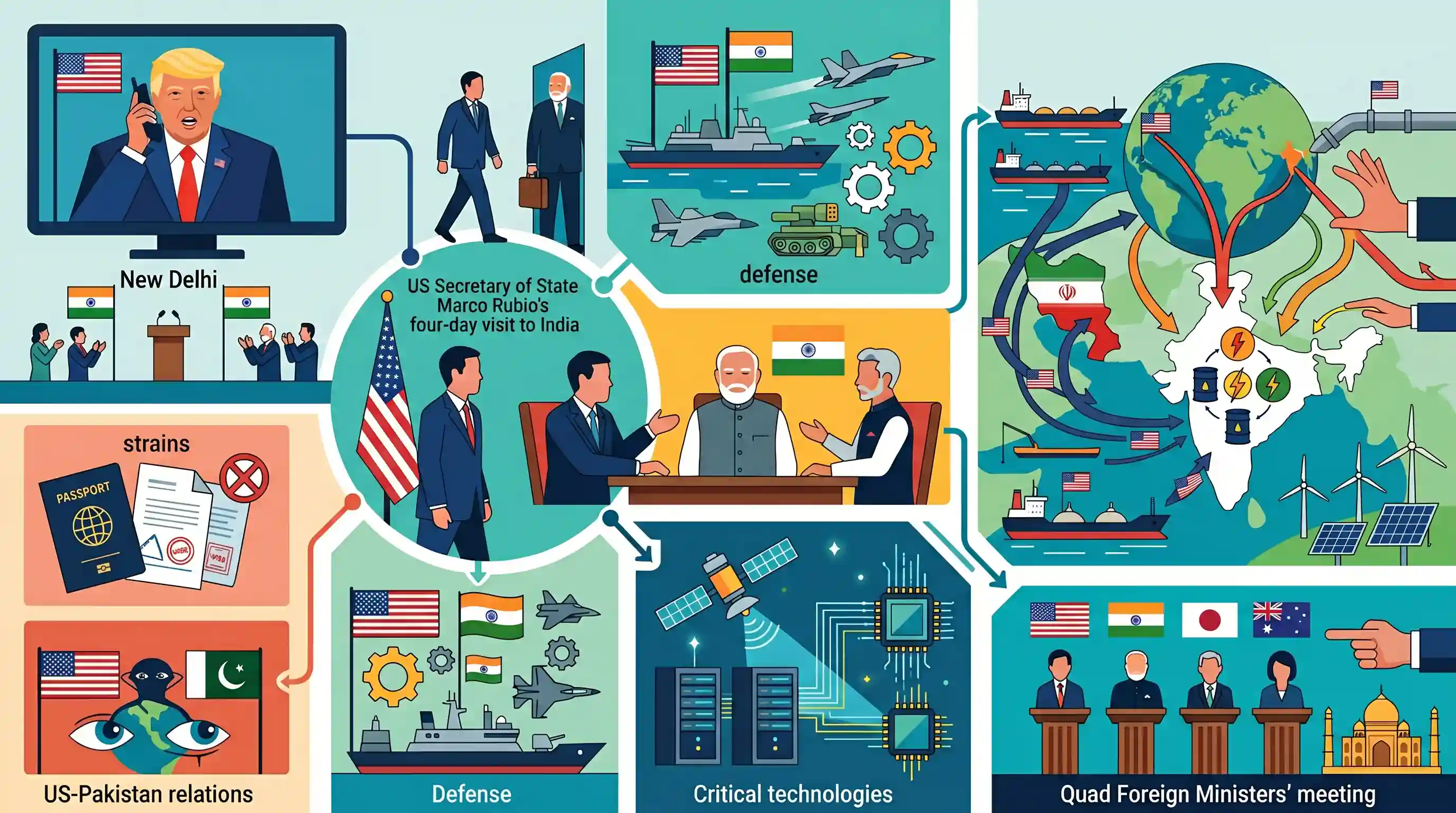
US President Donald Trump dialed into an event in New Delhi celebrating America's 250th Independence Day, expressing strong admiration for India and Prime Minister Narendra Modi. The remarks occurred during US Secretary of State Marco Rubio's four-day visit to India, which focuses on repairing bilateral strains regarding visa issues and US outreach to Pakistan. Rubio's talks with PM Modi and EAM S. Jaishankar covered defence cooperation, critical technologies, and energy security, with the US offering its energy exports to diversify India's supplies and counter Iran's influence. The visit also sets the stage for the upcoming Quad Foreign Ministers' meeting in New Delhi.
Key Points
- US President Donald Trump dialed into an event in New Delhi marking America's 250th Independence Day, emphasizing close bilateral ties and praising PM Modi.
- The event coincided with US Secretary of State Marco Rubio's visit, aimed at repairing strains over visa restrictions, deportations, and US outreach to Pakistan.
- Rubio held talks with PM Modi and EAM S. Jaishankar on defence, trade, strategic technologies, and the upcoming Quad Foreign Ministers' meeting in New Delhi.
- On energy security, Rubio stated the US would not let Iran dictate the global energy market and offered US energy exports to help diversify India's supply.
Important Terms
India-US Comprehensive Global Strategic Partnership

A high-level diplomatic framework formalized in 2020, elevating bilateral ties to include cooperation in defense, trade, technology, and global health, acknowledging India's significant role in global geopolitics.
UPSC context
GS Paper II: International Relations. Essential for analyzing the evolution and depth of India's most critical bilateral relationship.
Quad (Quadrilateral Security Dialogue)
An informal strategic forum comprising India, the United States, Japan, and Australia, dedicated to supporting a free, open, and inclusive Indo-Pacific through maritime security and technological cooperation.
UPSC context
GS Paper II: Bilateral/regional groupings. Tests understanding of regional security architecture and balancing China's influence.
iCET (Initiative on Critical and Emerging Technology)
A 2023 framework to expand strategic technology partnerships in artificial intelligence, semiconductors, space, and defense, aimed at building trusted supply chains and reducing technological dependence on adversarial nations.
UPSC context
GS Paper II/III: Technology and IR. Evaluates the shift from traditional trade to high-tech strategic collaboration.
Energy Security (India-US context)
Bilateral cooperation focusing on stable resource access, resilient supply chains, and nuclear energy (including Small Modular Reactors) to ensure India's economic growth while diversifying away from traditional suppliers.
UPSC context
GS Paper II/III: Infrastructure/Energy. Relevant for discussions on climate goals, nuclear deals, and strategic petroleum reserves.
Strategic Autonomy
India's foreign policy principle of making independent decisions based on national interests, engaging with multiple power centers (multi-alignment) without committing to formal military alliances or external bloc politics.
UPSC context
GS Paper II: International Relations. Key concept for explaining India's nuanced stance on global conflicts (e.g., Russia-Ukraine) vs US ties.
Prelims Trap
India continues to import crude oil from Iran to assert its strategic autonomy despite US sanctions.
India halted commercial crude imports from Iran in 2019 after US waivers expired under CAATSA. Strategic engagement with Iran now focuses on connectivity (Chabahar Port), not oil.
Static Concepts Connected
What are secondary sanctions and how do they impact India?
- Definition: Sanctions penalizing third-party countries or entities for conducting business with a primary sanctioned nation.
- CAATSA Framework: US domestic law authorizing sanctions against countries engaging in significant transactions with Iran, North Korea, or Russian defense sectors.
- Energy Impact: Forced India to halt cheap Iranian oil imports in 2019, shifting reliance toward US and Middle Eastern suppliers.
How has the Quad's mandate evolved beyond maritime security?
- Non-Military Nature: Quad remains a diplomatic network, explicitly avoiding a formal mutual defense treaty structure or collective security alliance like NATO.
- Economic Resilience: Expanded into securing critical mineral supply chains, combating climate change, and maritime domain awareness (IPMDA).
- Tech Standards: Focuses on establishing open, secure architectures for emerging technologies like 5G, artificial intelligence, and semiconductors.
Cross-Topic Patterns
Energy Security & Rupee Internationalisation
Shifting from Iranian/Russian oil to US exports heavily impacts rupee trade settlement mechanisms, increasing reliance on dollar-denominated procurement and affecting forex reserves.
iCET overlaps with Quad Tech
Bilateral US-India critical technology cooperation (iCET) acts as a foundational pillar for Quad working groups aiming to set regional standards for AI and semiconductors.

Expect a 2026 prelims question pairing US energy sanctions (CAATSA/Iran) with India's import diversification strategies and iCET framework.
Linked PYQs · 2
Linked PYQs · 2
- 2020MainsGS2
What is the significance of Indo-US defence deals over Indo-Russian defence deals? Discuss with reference to stability in the Indo-Pacific region.
- 2020MainsGS2
Quadrilateral Security Dialogue (Quad)' is transforming itself into a trade bloc from a military alliance, in present times - Discuss.
