Hyderabad Policy Conclave Focuses on Implementation and Governance
Source:The Hindu ↗
Why It Matters
The article touches upon several core UPSC Mains themes: the disconnect between policy formulation and execution, the 'output vs outcome' evaluation challenge, financial constraints of urban local bodies, and the role of citizen behaviour in sustainable waste management. These issues frequently appear in GS2 (Governance) and GS3 (Environment/Economy).
Summary
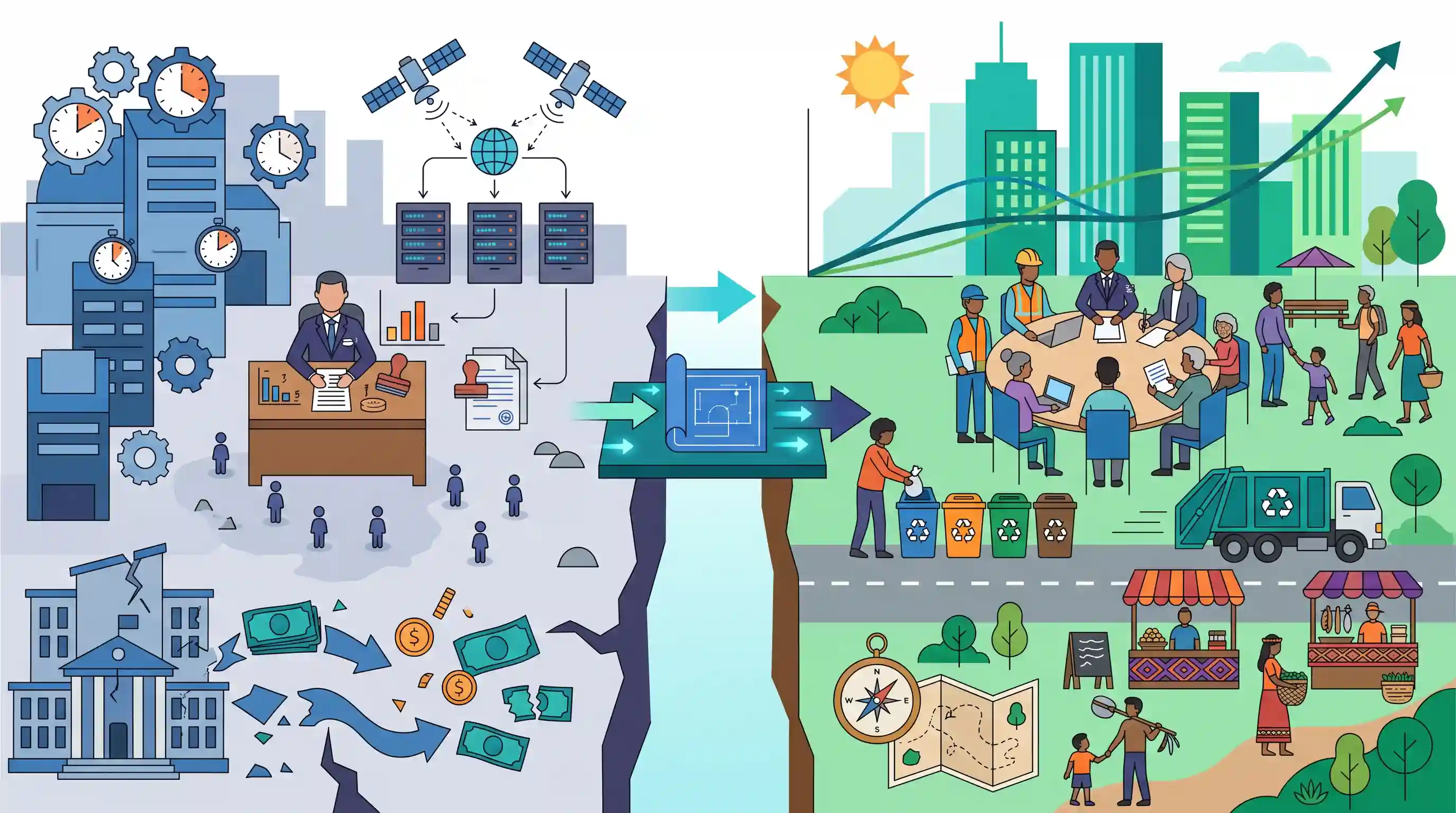
The ‘Hyderabad Policy Conclave – The Indian Era’, organized by the Tata Institute of Social Sciences (TISS), concluded with extensive discussions on bridging the gap between public policy design and its actual implementation. Experts highlighted major systemic hurdles, such as the bureaucratic tendency to measure short-term outputs rather than long-term outcomes, and top-down data systems failing to capture field realities. Key domains discussed included urban fiscal reforms, highlighting the structural weaknesses in municipal finances and local revenues. Additionally, the conclave focused on sustainability challenges, particularly emphasizing the necessity for behavioural change and citizen accountability in solid waste management. Overall, the discussions underscored that resolving implementation gaps requires adopting inclusive governance approaches, supporting informal livelihoods, and incorporating indigenous knowledge systems.
Key Points
- The 'Hyderabad Policy Conclave' by TISS highlighted a persistent disconnect between public policy formulation and on-ground implementation.
- Experts emphasized the need to shift policy evaluation metrics from quantitative 'outputs' to meaningful, long-term 'outcomes'.
- Urban governance discussions focused on systemic challenges in municipal finances, property tax collections, and the need for comprehensive urban fiscal reform.
- Addressing sustainability and the waste crisis requires pushing accountability down to citizens to foster behavioural change, particularly for source segregation.
- Inclusive governance models must effectively integrate women's livelihoods and leverage indigenous knowledge systems to address implementation gaps.
Important Terms
Tata Institute of Social Sciences (TISS)

A premier multi-campus public research university specializing in social sciences. It hosts the School of Public Policy and Governance, which led the conclave on bridging policy-implementation gaps.
UPSC context
GS II (Governance/Social Justice); crucial for research-led policy design and inclusive development models.
MCR HRD Institute
Telangana's apex administrative training institute; it hosts induction programs for All India Services and served as the venue for the Hyderabad Policy Conclave.
UPSC context
GS II (Role of Civil Services); relevant for capacity building and bureaucratic reforms.
WIEGO India
A global research-policy network focused on improving conditions for the working poor, particularly women, in the informal economy through better statistics and legal protections.
UPSC context
GS III (Inclusive Growth/Informal Sector); focuses on livelihoods of waste pickers and street vendors.
Urban Fiscal Reforms
Structural changes to enhance the financial health of municipalities through improved property tax systems, user charges, and access to municipal bonds for sustainable infrastructure.
UPSC context
GS II (74th Amendment) & GS III (Fiscal Federalism); addresses the financial autonomy of Local Bodies.
Solid Waste Management (SWM)
The systematic process of waste collection and treatment; the conclave highlighted the need for behavioral change and citizen accountability alongside technological solutions.
UPSC context
GS III (Environment) & GS II (Governance); central to urban sustainability and Swachh Bharat Mission 2.0.
Inclusive Governance
A governance model that ensures the equitable participation of all stakeholders—especially marginalized groups—in decision-making and access to public services.
UPSC context
GS II (Governance/Social Justice); tests understanding of bottom-up approaches and decentralization.
Prelims Trap
Outputs and Outcomes are interchangeable terms representing the short-term physical targets achieved by a scheme.
Outputs are short-term products/services (e.g., toilets built), whereas outcomes measure the actual socio-economic impact (e.g., reduced open defecation). UPSC often swaps these definitions.
Static Concepts Connected
What are the constitutional revenue sources for Urban Local Bodies (ULBs)?
- Tax Revenue: Includes property tax, professional tax, and tolls as authorized by the State Legislature under Article 243X.
- Non-Tax Revenue: User charges for water/sanitation, building permission fees, and rents from municipal properties.
- Devolution: Grants-in-aid from the Consolidated Fund of the State, recommended by the State Finance Commission (Article 243Y).
- Borrowings: Issuance of municipal bonds and loans from state/central bodies, subject to state government regulations.
What are the primary mandates of the Solid Waste Management Rules, 2016?
- Source Segregation: Mandates households and institutions to segregate waste at the source into wet, dry, and domestic hazardous streams.
- Generator Responsibility: Waste generators must pay prescribed user fees for collection and face spot fines for littering or burning waste.
- Informal Sector Integration: Requires state governments and local bodies to formally integrate ragpickers and waste workers into the sanitation framework.
Cross-Topic Patterns
74th CAA + Municipal Bonds
ULB financial autonomy remains weak due to incomplete 74th CAA devolution, driving recent policy pushes toward municipal bond issuances and urban fiscal reforms under AMRUT.
Circular Economy + Informal Sector
The integration of informal waste pickers is a critical social component of India's circular economy targets, tying directly into Extended Producer Responsibility (EPR) guidelines.

Expect a multi-statement question contrasting 'Outputs' vs 'Outcomes' in budgeting, coupled with ULB fiscal autonomy constraints.
Linked PYQs · 3
Linked PYQs · 3
- 2025MainsGS2
"In contemporary development models, decision-making and problem-solving responsibilities are not located close to the source of information and execution defeating the objectives of development." Critically evaluate.
- 2023MainsGS2
“The states in India seem reluctant to empower urban local bodies both functionally as well as financially.” Comment.
- 2018MainsGS3
What are the impediments in disposing the huge quantities of discarded solid wastes which are continuously being generated? How do we remove safely the toxic wastes that have been accumulating in our habitable environment?
