Hurricane Melissa Devastation Highlights Climate Change Vulnerability
Source:The Hindu ↗
Why It Matters
The increasing intensity of tropical cyclones like Melissa highlights the direct impact of global warming on extreme weather phenomena. For UPSC aspirants, this emphasizes the intersecting challenges of climate change vulnerability, particularly for island nations, and the critical importance of disaster preparedness, response, and international cooperation in mitigating such catastrophic events.
Summary
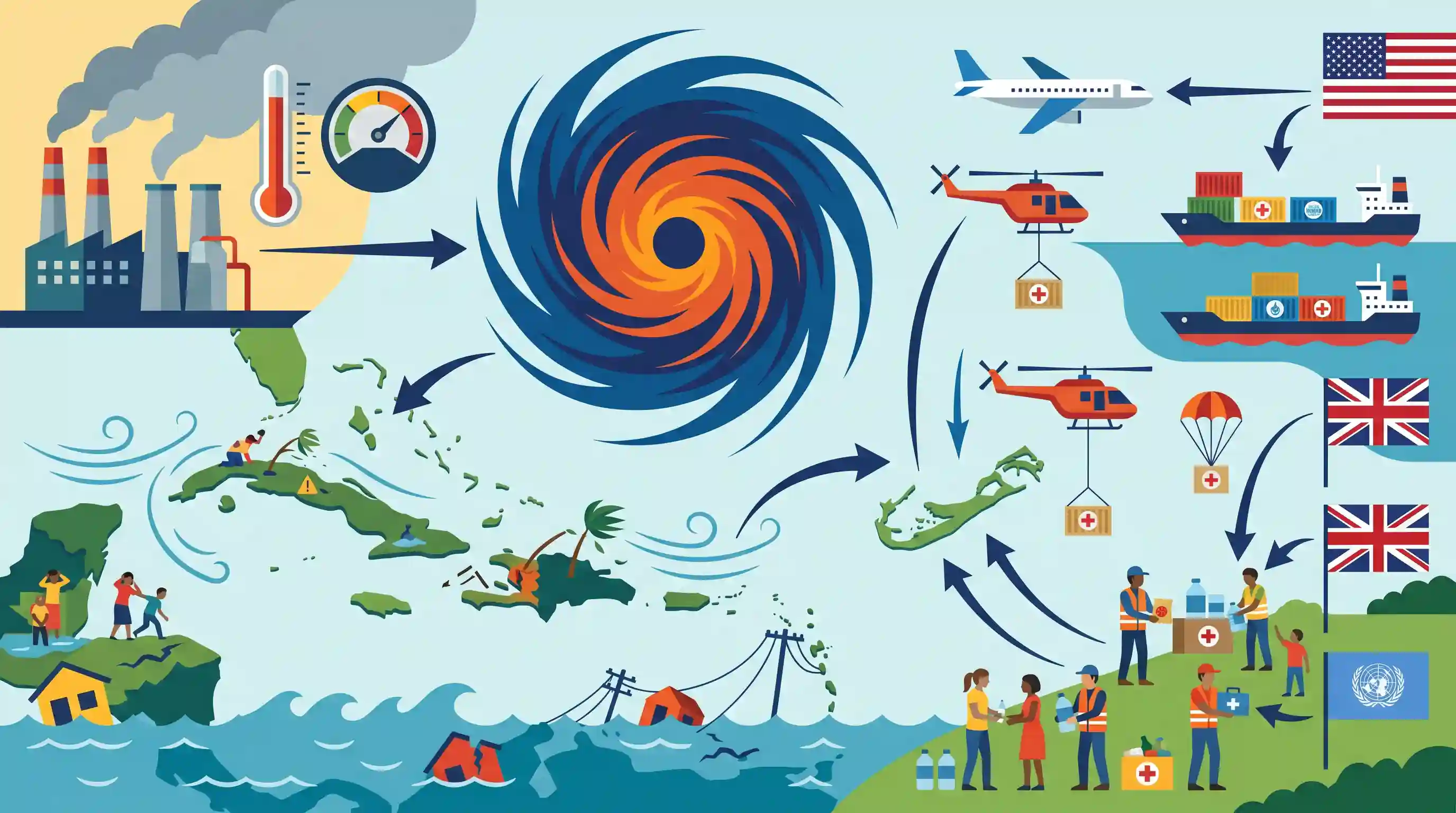
Hurricane Melissa, one of the most powerful storms ever recorded, has brought immense devastation to the Caribbean, severely impacting countries like Haiti, Jamaica, and Cuba before heading toward Bermuda. The massive storm, which tied a historic 1935 intensity record, caused numerous fatalities, flooded streets, and destroyed critical infrastructure. A study linked the hurricane's severity to human-caused climate change, noting it was four times more likely to occur as a result. International organizations and countries, including the US, UK, and UN, are coordinating humanitarian aid to assist the profoundly vulnerable island nations facing a long road to recovery.
Key Points
- Hurricane Melissa caused immense devastation across Caribbean nations like Haiti, Jamaica, and Cuba, leaving at least 24 people dead and causing massive infrastructure damage.
- The storm tied a 1935 record for the most intense storm to ever make landfall, according to NOAA.
- An Imperial College London study found that the storm's intensity and occurrence were made four times more likely due to human-induced climate change.
- Mass evacuations took place in Cuba, while international aid efforts from the US, UK, and UN were rapidly mobilized to assist affected countries.
- The event serves as a stark reminder of the vulnerability of island nations to extreme weather events and the pressing need for accelerated global climate action.
Important Terms
Tropical Cyclone

A rapidly rotating storm system characterized by a low-pressure center, strong winds, and heavy rain, originating over warm tropical oceans.
UPSC context
GS Paper I (Geography) and GS Paper III (Disaster Management); tests knowledge of atmospheric dynamics and disaster mitigation.
National Oceanic and Atmospheric Administration (NOAA)
A U.S. federal agency that monitors oceanic and atmospheric conditions, provides weather forecasts, and conducts research on climate and coastal ecosystems.
UPSC context
GS Paper III (Environment/Disaster Management); relevant for global climate monitoring and international scientific cooperation in forecasting.
National Hurricane Center (NHC)
A division of NOAA responsible for tracking and forecasting tropical cyclones in the Atlantic and Eastern Pacific to save lives and mitigate property loss.
UPSC context
GS Paper III (Disaster Management); crucial for understanding early warning systems and international disaster preparedness standards.
United Nations (UN)
An international organization that coordinates global humanitarian relief and disaster response through specialized agencies like OCHA, WFP, and the Central Emergency Response Fund.
UPSC context
GS Paper II (International Relations); focuses on the role of multilateral organizations in global crisis management and aid.
Climate Change Attribution
A scientific field (frequently led by institutions like Imperial College London) that quantifies the influence of human-caused global warming on specific extreme weather events.
UPSC context
GS Paper III (Environment); vital for understanding the scientific basis of "Loss and Damage" in climate negotiations.
Disaster Management
A systematic process of planning and implementing measures for disaster prevention, mitigation, preparedness, and recovery to minimize human and economic loss.
UPSC context
GS Paper III (Disaster Management); a core syllabus topic testing institutional frameworks (like NDMA) and global relief strategies.
Prelims Trap
"Atlantic hurricanes rotate clockwise, whereas cyclones in the Indian Ocean rotate counter-clockwise."
All tropical cyclones in the Northern Hemisphere—whether they are called hurricanes, typhoons, or cyclones—rotate counter-clockwise due to the Coriolis deflection to the right.
Static Concepts Connected
What are the prerequisite atmospheric conditions for tropical cyclone formation?
- Sea Surface Temperature: A large sea surface with a temperature above 26.5°C to provide continuous moisture and latent heat.
- Coriolis Force: Sufficient Coriolis force to create the cyclonic vortex (which is why cyclones do not form exactly at the equator).
- Low Wind Shear: Small variations in vertical wind speed (low vertical wind shear) to maintain the storm's structure.
- Existing Disturbance: A pre-existing weak low-pressure area or low-level cyclonic circulation.
How does the UNFCCC Loss and Damage (L&D) fund function?
- Genesis: Agreed upon at COP27 and operationalized at COP28 to assist vulnerable developing nations facing unavoidable climate impacts.
- World Bank Role: It is hosted by the World Bank for an interim period of four years as a Financial Intermediary Fund.
- Voluntary Funding: Contributions are based on voluntary pledges from developed countries; it does not entail legally binding liability or compensation.
Cross-Topic Patterns
SIDS + Ocean Warming + L&D Fund
The vulnerability of Small Island Developing States (SIDS) links physical climatology (marine heatwaves) directly to international climate diplomacy, specifically driving demands under the UNFCCC's Loss and Damage mechanism.
Attribution Science + Climate Litigation
'Attribution science' bridges meteorology and international law, providing the meteorological evidence needed by vulnerable nations to pursue climate litigation against major historical emitters.

Expect a GS3 Mains question in 2026 linking 'Attribution Science' of extreme weather to the operationalization of the Loss & Damage fund.
Linked PYQs · 5
Linked PYQs · 5
- 2024MainsGS1
What is sea surface temperature rise? How does it affect the formation of tropical cyclones?
- 2025MainsGS1
How are climate change and the sea level rise affecting the very existence of many island nations? Discuss with examples.
- 2019MainsGS3
Disaster preparedness is the first step in any disaster management process. Explain how hazard zonation mapping will help disaster mitigation in the case of landslides.
- 2019MainsGS3
Vulnerability is an essential element for defining disaster impacts and its threat to people. How and in what ways can vulnerability to disasters be characterized? Discuss different types of vulnerability with reference to disasters.
- 2024MainsGS3
What is disaster resilience? How is it determined? Describe various elements of a resilience framework. Also mention the global targets of Sendai Framework for Disaster Risk Reduction (2015–2030).
